WATCH: Gila River among tribes with most to lose in Colorado River water negotiations

By Adam Klepp, KNXV staff

Click here for updates on this story

    SACATON, AZ (KNXV) — As the Colorado River negotiations continue, Arizona tribes could potentially lose a lot of water they have received for years.

The Gila River Indian Community is one of the tribes that could lose as much as 50% of the water they have been receiving each year.

The tribe has done its part to conserve every drop of water it can, from solar panels over canals to automated irrigation systems.

Please note: This story was provided to CNN Wire by an affiliate and does not contain original CNN reporting. This content carries a strict local market embargo. If you share the same market as the contributor of this article, you may not use it on any platform.

Kennewick Council opposes home for sex offenders as residents ask for action, transparency

By Caleb Stipkovits

Click here for updates on this story

    KENNEWICK, Wash. (KAPP) — Dozens of frustrated Central Kennewick residents filled the city council chamber Tuesday night, advocating for action and transparency as a home for level three registered sex offenders is set to open in their neighborhood.

In a joint action with the Kennewick School District, the Kennewick City Council voted 5-0 to approve a resolution opposing the opening of the Less Restrictive Alternative (LRA) home after community members have been voicing concerns for over a month.

“We’re setting the stage for the whole state to understand that these are things that need to be changed statewide, and the resolution sends that message directly back to Olympia that they need to be recognizing the needs of our communities,” Kennewick Mayor Jason McShane said.

While some residents applauded city leaders for taking action, others questioned whether the resolution would actually prevent the home from opening.

“What does this joint resolution accomplish exactly, and what action does it take on this current proposed LRA?” resident Janette Romero asked during public comment.

According to Mayor McShane, the city is limited in taking further action due to state laws. The mayor added that it’s been hard for the city to get answers from state leadership on how it can legally stop the LRA home from opening.

The city has identified one potential way to fight the proposal.

“There are very few restrictions on these LRA homes for sexually violent predators,” Mayor McShane explained. “They do, however, identify certain facilities in the city as being places of concern. And they call those a risk facility. And one of those is a publicly dedicated pathway.”

The publicly dedicated pathway would be less than 400 feet away from the home’s front door, and Mayor McShane believes it could assist in residents’ fight to stop the LRA from opening.

While the need for action was atop many residents’ minds during the meeting, another issue arose in the council chamber: transparency. Several residents expressing frustration over how late they were informed about the proposed facility.

“For us, you’ve failed us. I want to know what you are going to do,” resident Tina Gregory told the council.

“You guys had a golden opportunity to give legislation a chance to help us out more,” another resident said.

The transparency concerns intensified when Councilmember John Trumbo made a surprising revelation near the end of the meeting, claiming he had learned about the proposal months earlier.

“This city councilman [I] learned about this proposed idea months ago. And I learned about it in a setting that prevented me from going public. I could not talk about it. There’s something called an executive session, I could not talk about it,” Trumbo told residents.

However, one day after the meeting, Mayor McShane disputed Trumbo’s account.

“I was quite surprised about Councilman Trumbo’s comments last night. I spoke with him this morning, Councilman Trumbo was mistaken. He was inaccurate in his depiction of that. This was not at any time discussed in an executive session. He was referring to a meeting he had in December of last year after the closing of the property had been completed,” McShane clarified.

Mayor McShane added that he first heard of the proposed LRA around the time the city and state legislators sent out a joint statement to the community about the plan. He explained that he was briefly off of the city council before taking the position of mayor, and he did not fully understand the situation until after the statement was shared.

During the meeting, one councilmember proposed hosting a community workshop to discuss the timeline of the proposed home and share additional information the city has gathered about the situation. The proposal is set to be discussed at a further date.

Please note: This story was provided to CNN Wire by an affiliate and does not contain original CNN reporting. This content carries a strict local market embargo. If you share the same market as the contributor of this article, you may not use it on any platform.

Officers jumped in to save 30 farm animals that escaped a trailer in the Pueblo I-25 crash

By Jessica Porter

Click here for updates on this story

    PUEBLO, Colo. (KMGH) — Animal Law Enforcement officers with the Humane Society of the Pikes Peak Region jumped in to rescue 30 sheep and a goat caught in the chaos of a deadly crash on I-25 in Pueblo on Tuesday.

“It’s one of those days where you know everything’s going okay until it’s not,” said Nicole Michon the Animal Law Enforcement Training and Response Manager.

High winds whipped up dust, creating “brownout” conditions on the highway. Low visibility ultimately contributed to a massive crash involving 30 vehicles, shutting down both sides of the highway. Colorado State Patrol confirmed Wednesday that five people lost their lives.

Among the vehicles was a trailer carrying 30 sheep and a goat. According to Humane Society of Pikes Peak Region, some of the animals were trapped inside the damaged trailer, others were running loose along the interstate.

“It’s a stressful environment in terms of this gigantic situation unfolding, but their training really comes in handy at that point to just be able to focus on the animal and remove them from that safely,” said Michon.

Two Animal Law Enforcement officers were called to remove the animals from immediate danger. They successfully transported the animals to a new trailer and reunited them with their owner. Four of the sheep were severely injured and did not recover.

There are 45 officers on the Animal Law Enforcement team who are trained in animal handling and transportation. They serve El Paso, Pueblo, and Douglas Counties as well as the City of Centennial.

Please note: This story was provided to CNN Wire by an affiliate and does not contain original CNN reporting. This content carries a strict local market embargo. If you share the same market as the contributor of this article, you may not use it on any platform.

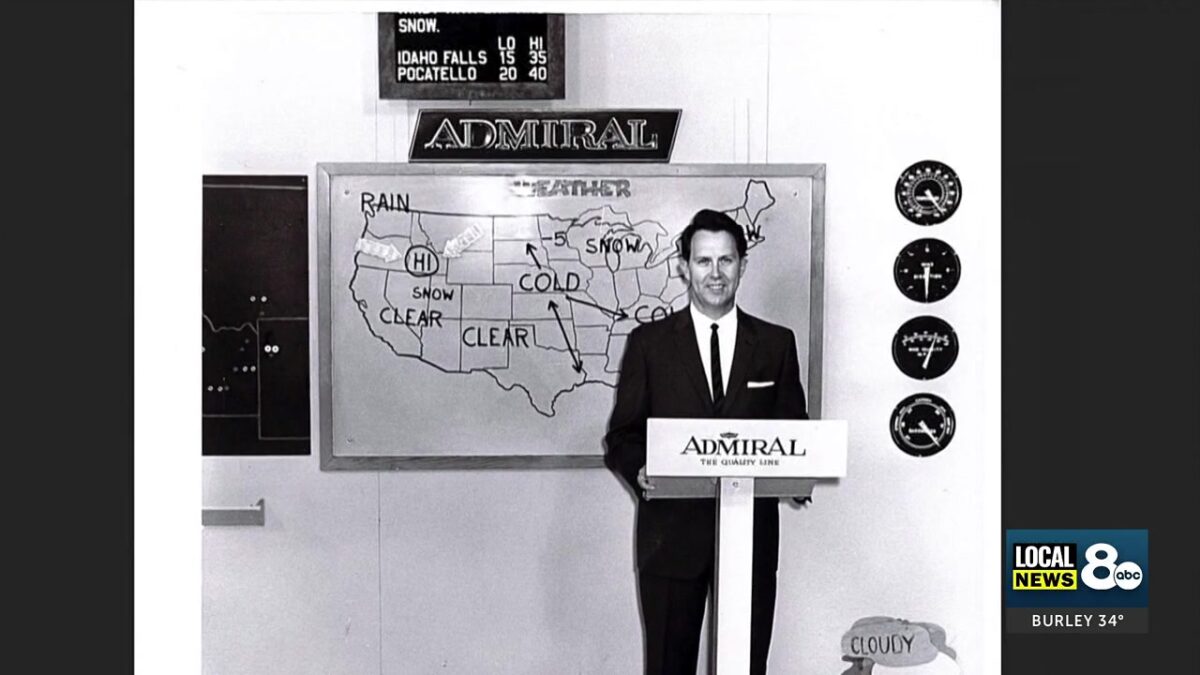
KIFI 65 Years: Weather tech and forecasting in the early days of broadcasting

Michael Coats

IDAHO FALLS, Idaho (KIFI) — Since the very start of KIFI’s 65 years of broadcasting, weather reports and forecasts have been a fixture of our live broadcasts.

From a simple map, podium, and pointer, the first weather reports on KIFI were fairly basic. More of a weather report than a forecast.

Bert Metcalfe (Circa 1966-1967)

Bill James (Circa 1960s)

John Haeberle (Circa 1966)

Former weathercaster and news anchor Steve Cannon says, “I would drive to the airport and get the upper air configuration and the radar chart. Draw it out on the board. When it came time, we had three studio cameras, as we do now, and the charts would be there and I say, the radar shows us… and the camera would go there. Then pan over to the upper air chart. Then back to me at the weather desk.”

Steve Cannon worked in eastern Idaho television for over 40 years, retiring from KIDK and KIFI in 2019

Long before computer graphics, on-air weather presenters needed some perfect penmanship

“I had five colors, black, green, blue, red, and something else…We had a big map, covered with plexiglass.” Cannon said. “I would take these vis-a-vis water soluble markers and draw everything. Then at the end of the weathercast, I had a bottle of Windex and paper towels. Spray it down, wipe it all down, go have my supper, come back and start all over.”

Today, we take computers and weather data for granted. A meteorologist can import layers of live and forecasted data instantly.

Cannon says when remembering the first weather computers, “It will do what? Oh yeah, it will chart this and that, it will do everything. I learned that first one, then the second generation came in, then the third generation, and then everyone added to each other. The animation you could use and the color pallets you could use, that was just amazing.”

Weather technology moves so fast these days, for example, since 2006 and since that time we have updated or completely changed weather computer systems at KIFI 9 times.

Click here to follow the original article.

Repairs finally coming to troubled drainage ditch in Cimarron Hills, east of Colorado Springs

Scott Harrison

EL PASO COUNTY, Colo. (KRDO) — On Wednesday, a crew began removing old concrete panels in a block-long drainage ditch that was crumbling and had accumulated thick brush and piles of debris.

The ditch is between the intersection of Ford Street and Seneca Road, and Valley Street to the south, in the Cimarron Hills community just east of the Colorado Springs city limits.

Neighbors and nearby business owners have complained about the ditch’s condition for years, but a complication in repairing it was that local governments couldn’t agree on who had responsibility for maintaining it.

In 2024, El Paso County accepted responsibility for repairing the 500-foot channel.

“Our plan is to come in here and install a reinforced concrete-lined channel,” said Thomas Donahue, senior public works engineer for the county. “We’ll be increasing the capacity, which will accommodate larger flows than we would anticipate with larger storm events.”

Donahue said that the previous channel layer wasn’t reinforced, and that was a factor in its deterioration.

He added that the project should be finished by the end of March — weather permitting.

Orlando Jiron owns Precision Finish, an auto body repair shop along the channel, and was observing the first day of construction.

“It creates a lot of worries,” he revealed. “But at the same time, now that this is going, I have a lot more confidence and less stress — seeing that the actual progress is moving forward to get this rectified.”

The clogged ditch also caused occasional flooding and erosion of business property on both sides of the channel.

Another issue is stormwater drainage from the upper Seneca neighborhood, which flows so quickly in street gutters downhill that it bypasses a storm drain into the channel and floods the intersection.

Donahue said that the county is considering plans to improve drainage from the neighborhood, and to replace a failing underground metal drainage pipe emptying into the channel.

“We are considering upgrading that with reinforced concrete pipe,” he explained.

The channel drains into a similar ditch in better condition west of Valley Street, which eventually connects to a newer, extensive drainage channel along Paonia Street.

A raccoon, apparently displaced by the construction, was seen slowly crawling through the ditch and into the metal drainage pipe.

Last spring, the county repaired another crumbling drainage channel in Security-Widefield.

The county continues to assess its overall stormwater infrastructure needs.

Click here to follow the original article.
Local historical society documents and preserves Colorado Springs Black history

Bradley Davis

COLORADO SPRINGS, Colo. (KRDO) – As the country continues to celebrate Black History Month, the founder of the African American Historical and Genealogical Society of Colorado Springs (AAHGSCS) says it’s a topic they never stop documenting.

Candice McKnight, a third-generation Colorado Springs native, founded the museum in 2009. McKnight says after her great-great-grandmother heard the freedom bells, she left the McKinney plantation in Texas and moved to southern Colorado.

The AAHGSCS collects and preserves any and all artifacts that tell the story of Colorado Springs’ Black community throughout the centuries. It has books, newspapers, clothing items, replicas, paintings, pamphlets and more.

Anyone can tour the museum, but it is by appointment only. You can call 719-217-2647 to plan your visit.

The museum also hosts events and classes throughout the year. See their upcoming events below. You can also contact the museum if you are interested in genealogy lessons.

April 18: Black Women’s History Month

June 18: Juneteenth Celebration

Oct 17: AAHGSCS 45th Anniversary Open House

Click here to follow the original article.

21-year-old Ukrainian refugee with Utah ties killed alongside boyfriend in N.C. shooting

By Arianne Brown

Click here for updates on this story

    ST. GEORGE (KSL) — A 21-year-old Ukrainian refugee with Utah ties was killed alongside her boyfriend on Valentine’s Day, and the family is seeking to bring her body back to St. George to be laid to rest.

Kateryna “Kate” Tovmash was fatally shot alongside her boyfriend, Matthew Wade, 28, who was a soldier stationed at Fort Liberty (formerly Fort Bragg), west of Fayetteville, North Carolina. The two were at Tovmash’s home in Vass, North Carolina, where she was living with her mom, stepdad and three younger siblings, according to area police. Reports also say that the two were allegedly killed by Tovmash’s ex-boyfriend, Caleb Fosnaugh, 25.

The family, including younger siblings were present during the shooting.

Family spokesperson Amberlyn Brown said Tovmash’s mother, Olena Brown, and stepfather Mycal Brown want to express gratitude to those who have supported them during this time, adding that they don’t want there to be animosity directed at the man suspected of killing their daughter.

“The message they want most portrayed in any of this is just to spread love,” Amberlyn Brown told KSL. “They’re very sad at the decision Caleb (allegedly) chose to make. They did have a relationship where they did know him, and they cared for him.

“Kate was known by everybody as loving, outgoing and ambitious,” she continued. “She loved her siblings more than anything. She loved children. She wanted to travel and she just had dreams as most young girls do. She had just turned 21.”

The family originally moved to the U.S. in 2023 as refugees to escape the war in Ukraine. The family first settled in St. George following Kate’s graduation from high school in Ukraine, Brown said. Following her parents’ divorce, Tovmash moved to North Carolina with her siblings, mother and stepfather two years ago. It was while out there that she met and dated Fosnsaugh, an Ohio resident, and then connected with Matthew Wade, who lived in North Carolina.

“Mycal and Olena would like everyone to know that although it can be hard not to throw hate out there, and as angry as something like this can make somebody, that they’re of the Christian faith,” Amberlyn Brown said. “They know they’ll see Kate again, and as hard as it may seem, the one request that they have, is that people don’t let hate and anger surround this situation. … They believe in forgiveness and that part of them finding peace is forgiving Caleb for what he’s done. They also want to share their love and condolences for Matthew’s family.”

Amberlyn said that at this time, the family is making plans for a funeral in North Carolina and has a goal of bringing her body to St. George to be laid to rest and have a service for her in Utah.

Brown said they have set up a GoFundMe* for the family to help with expenses related to their daughter’s death.

Tovmash’s stepfather told KSL the fundraiser was “set up by the community and has already been passed to Olena, who is the executor of Kate’s estate.”

“They came here originally to escape the war in Ukraine, and they found a lot of people that really cared for them in Utah,” Brown said. “Their overall hope is to bring Kate back to where she first came, which would be St. George. The family is hoping to eventually come to Utah, so our goal is to get the funds raised to be able to transport her body back here. Any other funds will be used for funeral expenses.

“The family believes that Kate is still with them in spirit, and they want to just carry on her legend of happiness and family and love.”

This story was reported on-air by a journalist and has been converted to this platform with the assistance of AI. ­­­KSL verifies all reporting on all platforms for fairness and accuracy.

Please note: This story was provided to CNN Wire by an affiliate and does not contain original CNN reporting. This content carries a strict local market embargo. If you share the same market as the contributor of this article, you may not use it on any platform.

A look into the rampant prostitution along LA’s Figueroa Corridor

By Kevin Ozebek and Jason F. Burks

Click here for updates on this story

    LOS ANGELES (KABC) — Los Angeles is known around the world for being the home of Hollywood and having some of the world’s best beaches, but it also has a much darker side.

There’s a notorious hub for human trafficking just south of Crypto.com Arena and the Los Angeles Convention Center.

Criminal activity often happens in the shadows. Hidden so as not to draw the attention of passers-by, police or nosy neighbors.

On a stretch of the Figueroa Corridor, however, very little is hidden from view.

A four-mile section of Figueroa Street in South Los Angeles, from Gage Avenue to Imperial Highway, is well known for rampant prostitution.

On nearly every corner, women in revealing outfits approach cars, day and night, out in the open, offering sex for a price.

This area has become known as “the Blade.”

Law enforcement officers, nonprofit advocates and survivors say it’s one of the most dangerous hubs for human trafficking in the state.

It’s fueled by a constant stream of customers and a lack of law enforcement resources to stop it.

“It is a huge, huge issue, and everybody should be extremely concerned,” said Liz Armendariz, an LAPD officer and vice investigator for LAPD’s 77th Division. “I just think, man, that is somebody’s kid, and it’s heartbreaking.”

Vice units from the 77th patrol this section of Figueroa Street. We spent two nights with investigators, who showed us how they stop women from selling sex and perform age checks.

If the person they stop is underage, she is brought back to the station, interviewed and turned over to the Los Angeles County Department of Children and Family Services. If the woman is over the age of 18, she is often released.

“There are men out there that have a taste for females and juveniles, and they know that they can find it. The pimp starts noticing, ‘Hey, they want underage-looking people.’ They’re going to start recruiting underage people. The thing is that they’re much easier to manipulate mentally because a lot of times they come from broken homes,” said Navarro.

“Our goal these days is not to arrest them. Our goal is to get them resources and the help they need to get out of their lifestyle,” he added.

Police tell us the pimps expect women working “the Blade” to earn hundreds of dollars a night.

“That’s going to change girl to girl,” Sgt. Navarro said. “It’s going to be $600 to $800 to $1,200 a night.”

We learned from our time out on “the Blade” and by talking to women who survived trafficking that the violence out there is extreme.

That violence comes from the pimps, the sex buyers and the other girls and women working out there.

What happens to the underage girls the LAPD finds out there, and does the LAPD have the resources to get in front of this problem?

Those are just some of the issues we’ll be tackling in our primetime 7 On Your Side Investigates special.

Please note: This story was provided to CNN Wire by an affiliate and does not contain original CNN reporting. This content carries a strict local market embargo. If you share the same market as the contributor of this article, you may not use it on any platform.

Nebraska bar owner sues state over ‘barber shop’ name dispute

By Hannah McIlree

Click here for updates on this story

    OMAHA, Nebraska (KMTV) — A Nebraska bar owner has filed a federal lawsuit after the Nebraska Board of Barber Examiners told him that using “barber shop” in his business name is illegal without a barber license.

Mike DiGiacomo owns and operates Blackstone Socials and the speakeasy below called The Barber Shop Blackstone. The cocktail bar serves drinks, not haircuts, but the state barber board says the name violates Nebraska law.

DiGiacomo and his siblings chose the barber shop theme to pay homage to their father and other Italian barbers.

“Everything was going great. The bar had a great opening,” DiGiacomo said.

In April, he received a letter from the state barber board stating the bar’s name broke the law by using “barber shop” without having a license to cut hair. The letter warned he could face “civil and criminal consequences” and “criminal and civil penalties” for violations of the Nebraska Barber Act if he didn’t change the name.

“We went through the proper procedures to get the name approved by the Secretary of State’s office. They approved the name, and so we were taken aback,” DiGiacomo said.

DiGiacomo initially agreed to comply, planning to rebrand the bar and change the barber poles. But he said the cost would have been significant for a small business.

“There are significant costs to rebrand. It’s not something that we wanted to do or put expenses towards, but at a moment, it was a lot cheaper than trying to fight the state of Nebraska,” DiGiacomo said.

The University of Nebraska Lincoln’s First Amendment Clinic agreed the state was overreaching and took on DiGiacomo’s case for free.

“I don’t think this is the spirit of the law or even the letter of the law,” said Sydney Hayes, assistant director of the clinic.

“I’m confident about how this case is going to proceed. I think we’re confident that the court will find that the threatened sanctions violate the bar’s First Amendment rights,” Hayes said.

In the lawsuit, they argue no reasonable person would confuse his bar with an actual barbershop.

“It just means a lot to us to keep calling this the barbershop. That was the intent of our concept—to pay tribute to our dad and all his buddies,” DiGiacomo said.

The lawsuit names Nebraska’s Attorney General and three members of the state’s Board of Barber Examiners as defendants. The Nebraska Board of Barber Examiners did not respond to a request for comment.

Hayes said the complaint is filed, but the clinic still needs to serve the board.

“This story was reported on-air by a journalist and has been converted to this platform with the assistance of AI. Scripps editorial team verifies all reporting on all platforms for fairness and accuracy.”

Please note: This story was provided to CNN Wire by an affiliate and does not contain original CNN reporting. This content carries a strict local market embargo. If you share the same market as the contributor of this article, you may not use it on any platform.

Inside Peek Into the New Water Tower

Megan Lavin

Image courtesy of the City of Idaho Falls.

IDAHO FALLS, Idaho (KIFI) — The Idaho Falls skyline looks a lot different now that the old water tower is officially gone.

But what does the new water tower actually do for the Idaho Falls community? Anchor Megan Lavin gives us an exclusive inside look.

Locals React

For many, the previous water tower was more than just a structure. There was a strong emotional attachment to the longtime landmark.

When the city announced it was coming down, the news sparked strong reactions across the community.

A quick search of “water tower” in any of the Life in Idaho Falls Facebook pages shows just how much conversation it generated.

Many people don’t care for the look or design of the new water tower compared to the old one. Others say they’re not exactly sure what it does — other than change the view. We interviewed several Idaho Falls residents. Here’s what they had to say:

“I don’t even know.”

“Have no idea.”

“I think it’s pretty sad.”

Thirsty for Knowledge

We climbed all 160 steps of the spiraling interior staircase to get directly underneath where the water sits.

We even looked out the window painters use to access the exterior of the tower.

The octagonal hatch is how workers access the final portion at the top — an area we were not permitted to enter. Standing beneath 8.3 million pounds of water is a staggering feeling.

The new water tower holds 1 million gallons of water — twice the capacity of the old tower, that’s approximately 333 Wes Deist Aquatic Centers.

How It Works

Water Superintendent David Richards says the new structure is a major upgrade for the city.

“This is leaps and bounds ahead as far as technology goes,” Richards said.

Despite the improved technology, the concept is fairly simple.

“So we have two separate pipes — one that brings water into the tower and one that brings water out,” Richards explained.

“Elevation and gravity supply water pressure into our system. And that water pressure helps protect our system.”

That pressure plays an important role.

“It helps keep contaminants out of the water system because if there’s a break or a leak, the water flows out of the pipes rather than allowing anything to flow back in,” Richards said. “It also stores water for emergency needs such as firefighting. And in the event of a catastrophic emergency, we have water stored and aren’t reliant on power to pump it.”

Richards said the project was a long time coming and necessary for several reasons — not just the lead paint on the old tower.

“2008 was when we first found out the old tower was an issue,” Richards said. “The foundation needed to be replaced. The piping inside the tower needed to be replaced. When we started adding up the costs associated with those repairs — and considering that when it was built, earthquake loading wasn’t part of the design — one thing led to another. Its useful life had been met. It needed to be replaced.”

Richards said the interior staircase is also a major improvement. In the past, workers had to climb the outside of the tower in the elements when maintenance was needed — including changing a light bulb about twice a year.

With population growth in mind, Richards said the tower will meet demand.

“This, combined with our other well sites, will provide water to meet all of our needs,” he said.

Why Downtown?

Some have questioned why the new tower was built downtown near the old site instead of farther away in the foothills.

“We opted to build it here near the river because the aquifer isn’t very deep,” Richards explained. “The existing well used for the old tower is still in service. It’s located near Idaho Falls Power’s administration building just across the street. Instead of pumping to the old tower, it now pumps to this new tower. That’s why we wanted to build it as close as possible to the existing well site.”

Is the Water Safe to Drink?

“This water has a multitude of uses,” Richards said. “First and foremost, culinary uses indoors — cooking, showering, and all the typical household needs.”

Other Benefits

“Gravity is always available,” Richards said. “We have generators at our other well sites to supply water if the power goes out, but it takes time for those generators to start up. This tower is integral in keeping water pressure available until those generators are running.”

The new tower is also designed to withstand earthquakes.

“All of our structures are designed for earthquake loading,” Richards said. “If an earthquake were to happen in the area, this structure will support itself and will not come down. The walls are close to about a foot thick.”

City officials say the earthquake-resistant design, expanded water storage, and updated technology should help support the community’s water needs for decades to come.

The project cost approximately $9 million. Richards said the city began gradually raising water rates in 2015 to help cover the cost.

They anticipate the new tower should last approximately 100 years.

Click here to follow the original article.