InvestigateWest
By Whitney Bryen / InvestigateWest and Sam Stecklow / Invisible Institute
BOISE, Idaho (Investigate West) — Idaho’s prison system and the state agency that certifies law enforcement will now conceal information about officers’ employment histories, making it more difficult to scrutinize job candidates and ensure accountability for officers accused of misconduct.
The increased secrecy by the Idaho Department of Correction and the Peace Officer Standards and Training Council comes less than four months after InvestigateWest used the information to expose alleged sexual misconduct by dozens of Idaho prison guards — many of whom were allowed to resign and faced no other consequences.
Responding to journalists’ findings in October, Gov. Brad Little called for a review of the prison system’s handling of public records requests, saying in a statement that “transparency and the public’s confidence in state government are top priorities.”
Yet behind the scenes, Little’s office advised state police to withhold information from InvestigateWest reporters about officer misconduct investigations, internal Department of Correction and Idaho State Police emails show. And state officials say the reporting caused them to reconsider the public’s access to officer employment information. Now, the Department of Correction and Peace Officer Standards and Training say they will no longer release information about whether an officer retired, resigned or was fired to the public.
The governor’s office supports the change, citing a new interpretation of an unchanged state law.
Emily Callihan, the governor’s communications director, defended his position in a message stating that the Department of Correction “was correct in not providing the requested info/records moving forward … to be compliant with the law.”
Attorneys from Idaho and elsewhere, criminal justice researchers and public records experts are condemning the changes, saying they could endanger the public. Law enforcement employment data has been used in Idaho and other states to ensure agencies that certify officers are properly investigating misconduct and to track “wandering cops” — officers who commit misconduct at one police or correction agency, but are able to obtain employment with another that may be unaware of the indiscretion. Department of Corrections spokespeople in two neighboring states said they rely on public information to vet candidates for hire.
The Idaho Association of Criminal Defense Lawyers said in a statement it is “deeply concerned” about the changes, noting prosecutors have an obligation to disclose information calling into question an officer’s credibility if they’re involved in a criminal case. The group says the rollbacks “weaken accountability, not only to the public at large but to people accused of crimes, for whom an officer’s employment history may be directly relevant to credibility, bias, or misconduct. A justice system that shields such information risks undermining fairness and the rule of law itself.”
Under Idaho’s Public Records Act, the classification, salary, status, workplace and employment history of government workers are public information. “The Legislature acknowledges that there is some loss of privacy when one accepts a position supported by public money,” the Idaho attorney general’s 2025 public records manual states. Personal information including an employee’s race, birthdate, home address, telephone number, grievances and performance evaluations are exempt from disclosure under the law.
 Gov. Brad Little’s called for greater transparency in response to findings of rampant sexual abuse by women’s prison workers. Behind the scenes, his office worked to limit what information was shared with reporters about officer misconduct. (Provided)
Statements from the governor’s office, Idaho Department of Correction and the Idaho Division of Human Resources assert that the reason a public worker is no longer employed is exempt from public disclosure, and the release of this information, which informed the work of journalists and researchers for years prior, was a mistake.
The state law, however, does not explicitly declare that information as exempt. Nor does it require its release, making it unclear whether the policy changes comply with the letter of the law.
Idaho civil rights attorney Deborah Ferguson said it’s clear that the changes violate the spirit of the law.
“The whole point of transparency is so that there is some accountability, and this is the government that’s supposed to be acting on our behalf,” Ferguson said. “And if they’re under the cover of darkness and no one can review what these actions are from our public agencies, it really convolutes the purpose of the Public Records Act and the transparency in government.”
Few states have rolled back access to officer employment data
Idaho’s reduction in public access mirrors recent shifts made by officials in states like Alaska, Colorado, Louisiana, Montana and Virginia — states that previously released police employment history data and now refuse to. But it deviates from the majority of states, which have made officer employment information more accessible, including Idaho’s neighbors Oregon, Utah, Washington and Wyoming.
In Idaho, this data is held by Peace Officer Standards and Training, or POST, a division of the state police responsible for certifying law enforcement and correctional officers. It’s overseen by a 14-member board of law enforcement and other government officials appointed by the governor.
Now, with Idaho agencies refusing to disclose whether an Idaho officer was terminated, potential employers are left relying on the honor system.
Prisons in neighboring Oregon and Washington gather data on job candidates through criminal background checks that aren’t publicly accessible. But they also rely on public information to verify whether certified officers are in good standing and why they left their previous job, according to department of corrections spokespeople in both states.
Chris Wright, communications director at Washington State Department of Corrections, said in an email that “there is no way for us to know exactly why a candidate left a previous position besides checking with references or getting that info from the candidate.”
Access to this kind of data elsewhere has allowed researchers in Texas to advocate for stronger state oversight of wandering cops; law professors studying Florida’s data to demonstrate just how much more likely it is for a cop who’s been fired to be disciplined again; and reporters in states from Georgia to California to expose the systems that allow these officers to continually find new employment in law enforcement.
In Idaho, the issue was highlighted by the 2015 fatal shooting of rancher Jack Yantis by Adams County sheriff’s deputies Brian Wood and Cody Roland. Coverage of the incident by the Idaho Statesman noted gaps in the state’s police hiring system, which did not require thorough background checks — leading to Wood and Roland being hired despite both having disciplinary histories, including one being fired. Other Idaho officers had been allowed to resign while under investigation to avoid being fired and maintain clean employment records, the newspaper noted. There is still no provision that requires police chiefs or sheriffs to notify POST of behavior that could warrant decertification. POST is the only agency that tracks officers statewide.
Eight years later, Invisible Institute, a nonprofit public accountability journalism organization in Chicago, sought data from Idaho POST for its National Police Index: a searchable database of certified police and correctional officers by state and where they’ve worked. Idaho’s data was first published on the National Police Index in January 2025.
Invisible Institute shared its database with InvestigateWest reporters, who in 2025 requested an updated list of correctional officers’ employment histories, then combined it with Idaho Department of Correction data showing officers who left the department, and their terms of departure, since 2015.
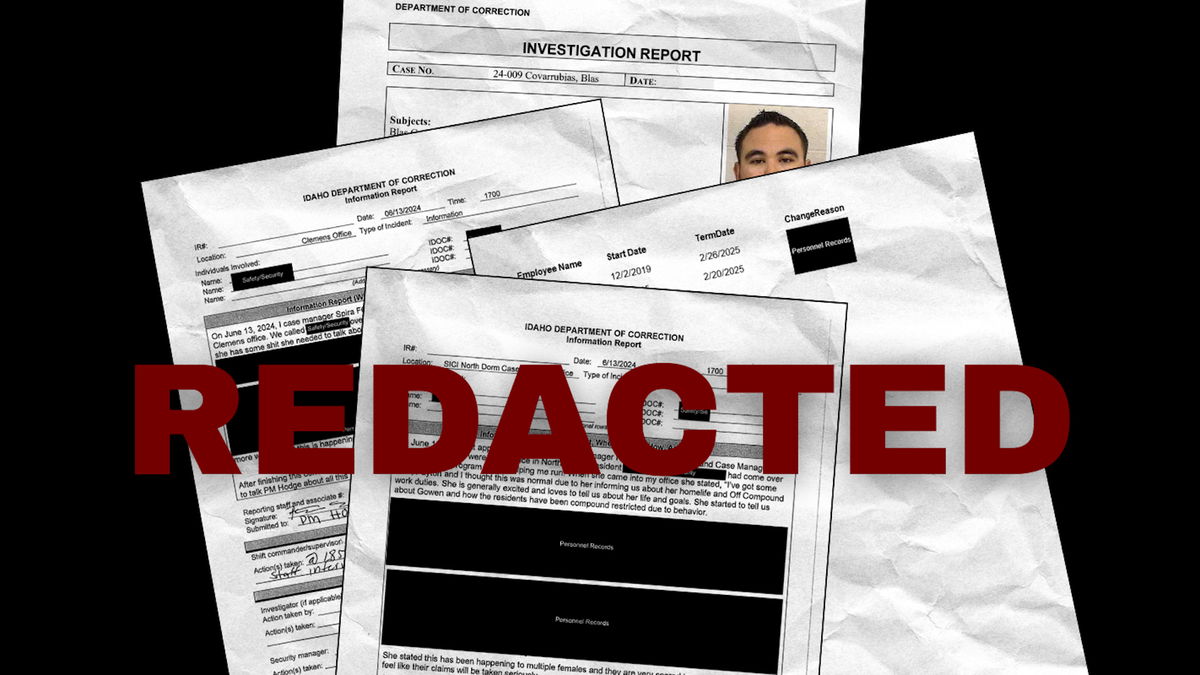
Journalists used that data, along with witness and victim interviews, investigative files and other public documents, to identify 37 prison workers who were accused of sexually abusing incarcerated women. At least 18 of those workers resigned after the alleged misconduct or after it was reported, leaving victims without justice. In October, InvestigateWest published a series of reports outlining those findings.
The reporting, however, caused Gov. Little’s office to take a closer look at what information about officer misconduct is being released to reporters. Weeks before those reports were published, the governor’s office convened a meeting on Sept. 26 with Idaho State Police Director Bill Gardiner and Department of Correction Director Bree Derrick to “discuss InvestigateWest inquiries.” Afterward, both the agencies ran their planned responses to journalists’ through the governor’s communications director, Callihan. All state agencies are required to get approval from the governor’s office before responding to questions from legislators or the media — a policy that Callihan said pre-dates Little’s administration, according to a recent Idaho Capital Sun report.
Idaho State Police planned to clarify details of its investigations of prison guards, emails show. But on Oct. 2, InvestigateWest’s deadline, Callihan told both agencies their prepared responses were “not to be provided to (InvestigateWest).”
In recent months, POST has withheld data related to officer employment history that it previously had released. Invisible Institute and InvestigateWest both requested updated data from POST but were told the record they wanted doesn’t exist.
When Invisible Institute filed its request in October 2025, the agency’s responses included less information than previous reports. POST provided three different files, one after the next, but when reporters searched the records using the names of officers found in news reports, they discovered data was still missing. Wood and Roland, both of whom still maintain their officer certifications and appear on POST’s online lookup tool, were not in the records. Reporters notified the agency again, expecting to receive another batch of data.
That’s when POST says it turned off the platform that allowed them to retrieve the data.
“We have discovered that the platform previously used to capture the … information you requested was flawed,” Kelsey Woodward, an administrative assistant for POST, told Invisible Institute. “For this reason, the platform has now been dismantled and will no longer be used moving forward.”
POST now says that all the information it will make public about officers is contained within its certification lookup tool, which does not include any information about employing agencies of officers, or the reason why officers left their agencies — two crucial pieces of information previously released by the agency.
“POST data is incredibly valuable to study police misconduct and the law enforcement labor market, two critical policy areas with major national data gaps,” Ben Grunwald, a Duke University law and criminology professor who has conducted multiple in-depth studies using POST employment data from state agencies across the country, wrote in an email. “I’ve engaged closely with roughly twenty-five POSTs to obtain data. Most have worked dutifully to comply with my requests and some have even expended significant resources to correct errors I’ve identified. But there are also a substantial minority of POSTS — most often those that have devoted few resources to data collection and management — who aren’t interested in public transparency and data sharing, or are openly hostile to it.”
 Recent reports by InvestigateWest exposed years of sexual abuse by women’s prison guards across Idaho and the prison system’s failure to stop it. (Whitney Bryen/InvestigateWest)
The Department of Correction also now won’t share information that was previously shared with journalists. When InvestigateWest requested information in January 2026 about whether two Idaho prison guards accused of sexually abusing multiple women were fired, resigned or retired, the Department of Correction refused to disclose the answer.
“It’s concerning that in response to investigative reporting that exposed abuse and problematic practices at (the Idaho Department of Correction), the department locked down records that had previously been public — the very records that helped expose the problems in the first place,” said Melissa Davlin, president of the Idaho Press Club. “We encourage all involved agencies to reconsider this approach and commit to transparency, for the sake of Idahoans who demand accountability from their government.”
A new interpretation of the Public Records Act
Department of Correction Public Information Officer Ryan Mortensen wrote in an email that its new interpretation of the Public Records Act resulted from “the Governor’s request for recommendations to improve our public records request processes.” The reason an employee no longer works for the agency is a personnel record that is exempt from disclosure under the state law, Mortensen said. The previous release of information was a result of “internal issues,” he said, and that the department is “addressing those issues through additional training and updated procedures to ensure compliance” with state law.
Ferguson, who represented the Idaho Press Club in a 2019 case that forced Ada County to release previously withheld public documents, disagrees.
“Whether they were terminated or resigned is very much a part of the employment history,” Ferguson said. “What else would employment history be?”
The law says that agencies do not have to produce a document that doesn’t exist. Woodward, the administrative assistant for POST, said that since POST no longer has a document capturing the data, it “has no further responsive documents to provide.”
David Cuillier, co-director of the University of Florida’s Brechner Center for the Advancement of the First Amendment, called that argument “bogus.” Just because the agency says it has dismantled the tool that lets it search the database doesn’t mean it doesn’t have the data, he said.
POST is “not following the law because you asked for a copy of a record that they have in their possession … and they’re not giving you a copy of it.”
Josh Parker, deputy policy director for New York University’s Policing Project, called POST’s decision “borderline outrageous. I can’t think of any reason for not making that information publicly available other than a desire to hide that information from lawmakers and the public.”
He added that it also “really hampers lawmakers and community members from ensuring that Idaho POST is satisfying its responsibility to conduct investigations of officers who engage in misconduct and decertify officers who engage in serious misconduct.”
Jorge Camacho, a former prosecutor in Manhattan who now studies regulation of police at Yale Law School’s Justice Collaboratory, called for law enforcement officials in Idaho to consider individuals most impacted by officer misconduct.
“Sunshine really is the best medicine when it comes to these types of issues,” he said. “Especially within policing, where you have so many vulnerable people who are bearing the brunt of the harms that result from the lack of transparency.”
InvestigateWest (investigatewest.org) is an independent news nonprofit dedicated to investigative journalism in the Pacific Northwest. Reporter Whitney Bryen covers injustice and vulnerable populations, including mental health care, homelessness and incarceration. Reach her at 208-918-2458, whitney@investigatewest.org and on X @WhitneyBryen.
Invisible Institute (invisible.institute) is a nonprofit public accountability journalism organization based in Chicago. Sam Stecklow is an investigative journalist and FOIA fellow with Invisible Institute, and a co-lead of the National Police Index project. Reach him at sam@invisibleinstitute.com and on Bluesky at @samstecklow@bsky.social.
Click here to follow the original article.


 Courtesy: City of Calexico
 Courtesy: City of Calexico