Lightning-speed computations: Supercomputer powers ISU, U of Idaho and BSU world-class research opportunities

David Pace
IDAHO FALLS, Idaho (KIFI) – Idaho’s public universities are tapping into a powerful Lemhi supercomputer in a unique partnership with Idaho National Laboratory.
“It gives us a really big advantage to have access to these really big supercomputers,” said Idaho State University’s Michael Ennis, a high performance computing research solutions architect. “Just compared to what we had at ISU before we had this partnership with INL in the Falcon system, I’d say it’s probably increased our computing power by at least ten times.”
INL’s Collaborative Computing Center in Idaho Falls currently hosts five supercomputer systems – including a brand-new Teton supercomputer that has been in operation for nine days.
“The Lemhi supercomputer is exciting because it’s operated by the Idaho universities for the benefit of Idaho education,” said Battelle Energy Alliance’s Senior Advisor for Scientific Computing Eric Whiting.
Students and professors can access the supercomputer remotely from across Idaho. Around 400 accounts are currently active, researchers said.
“The Lemhi Computer was initially deployed in 2018,” Whiting said. “The laboratory used it for several years. We got a lot of really good use out of it, and then as we purchased more machines – newer machines – we made this machine available to universities.”
Representatives from Idaho State University, Boise State University, and University of Idaho also staff the machine on location.
“We have university staff that work with us in the building. We learn from them. They learn from us,” Whiting explained.
Idaho State University projects include GIS systems, wildfire analysis with NASA and pharmacy research.
“We have researchers that are working on the supercomputer to do things from analyzing medical imaging using AI to look for tumors,” said University of Idaho’s High Performance Computing Systems Administrator Joe Leister. “We have researchers doing bioinformatics, gene sequencing, researchers that are doing work with astrophysics and looking at black holes hitting each other, as well as researchers down here in Idaho Falls that are working with INL on nuclear systems and different fuels.”
The Lemhi system is an upgrade from the previous Falcon supercomputer that was ranked the 97th fastest computer in the world in 2014, but is now being replaced.
Boise State University PhD candidate Bourgeois Gadjagboui shared how the supercomputers have accelerated his computational chemistry research – training an AI model on a large database of organic molecules.
“I have been allocated 100 terabytes to store my data and also to run thousands of molecules,” Gadjagboui said. “Without Lemhi, I’m not sure I would be able to complete my research in a short time period.”
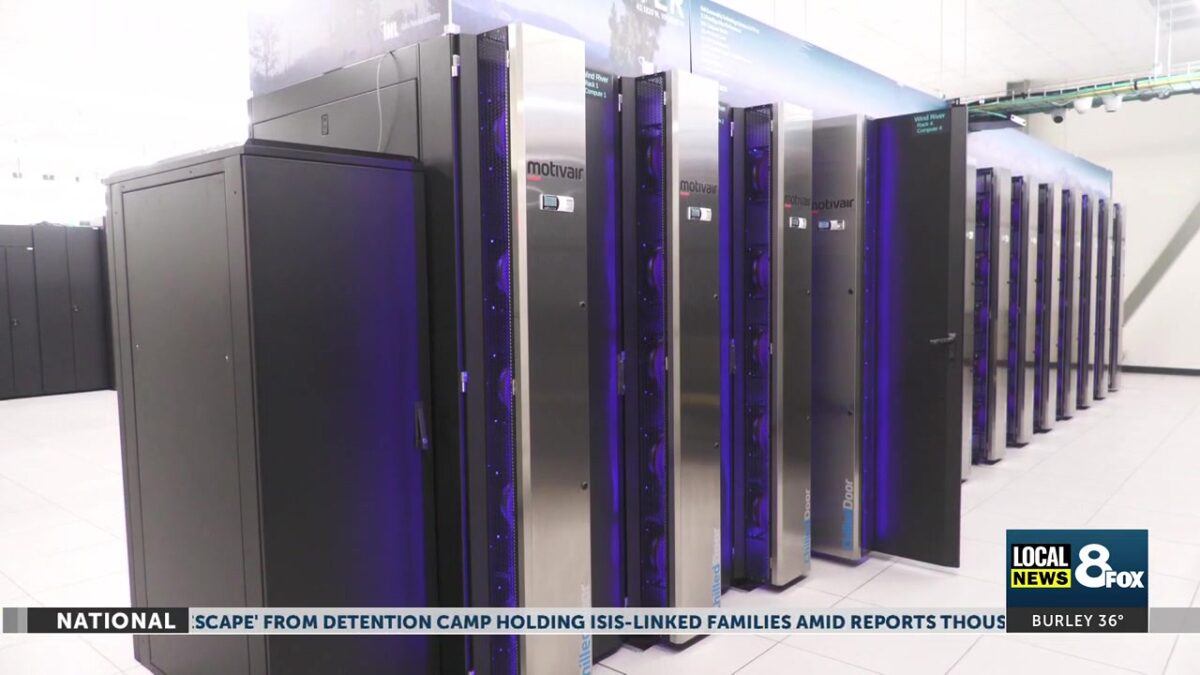
The Lemhi supercomputer contains eight racks that boast 94.5 terrabytes of memory, 20,160 cores and 504 nodes. It originally cost $5 million.
“Universities do two things. We train students, and we do research,” Boise State University’s Manager of Research Computing Jim Beck said. “Supercomputers sit really at the center of both of those things.”
The collaboration with INL places Idaho’s three public universities in an elite cadre of colleges that offer world-class supercomputer access to their students.
 The Lemhi Supercomputer offers 94.5 terabytes of memory to Idaho’s universities in partnership with Idaho National Laboratory.