Moore’s Ford Bridge: Remembering America’s last mass lynching

By Brian Unger
Click here for updates on this story
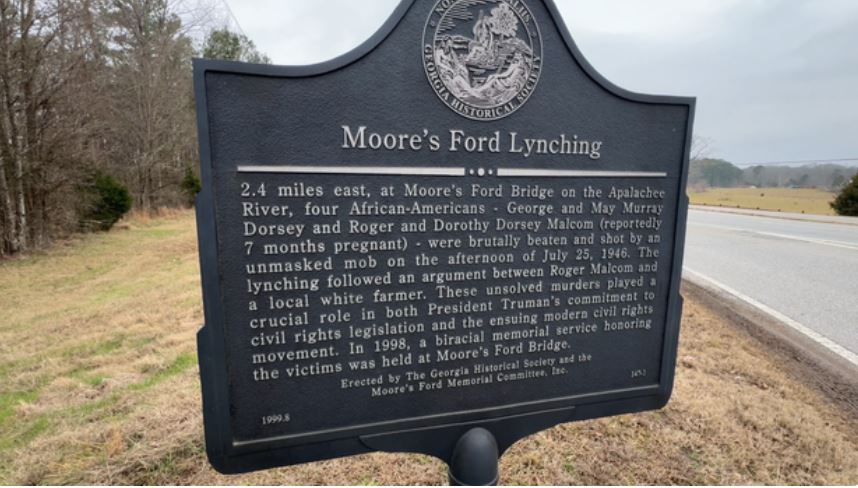
WALTON COUNTY, Georgia (WUPA) — About 50 miles east of Atlanta, along Highway 78 near the Oconee County line, a modest roadside marker tells the story of one of the most horrific racial crimes in American history.
It marks the site of the Moore’s Ford Bridge lynching — widely recognized as the last documented mass lynching in the United States.
Between 1880 and 1968, Tuskegee University researchers say Georgia recorded 637 lynchings — one of the highest totals in the nation. Most went unprosecuted.
Among them: the killings on July 25, 1946.
On that summer day, George Dorsey — a World War II veteran — and his wife Mae, along with Roger and Dorothy Malcolm, were traveling near the Apalachee River in Walton County.
The Malcolms and Dorseys were sharecroppers who had encouraged Black community members to vote in Georgia’s all-white primary earlier that year.
After a confrontation with a wealthy white landowner, Roger Malcolm was arrested and jailed in Walton County. He was later bailed out by Loy Harrison, a local farmer who was also identified as a Klansman.
As Harrison drove the two couples toward his farm, their car was stopped at Moore’s Ford Bridge by a mob of roughly 30 white men.
George Dorsey and Roger Malcolm were dragged from the car, tied to a tree in a nearby field, and shot. Dorothy Malcolm, who was seven months pregnant, and Mae Dorsey were also killed. According to statements later given to authorities, the four were shot dozens of times.
No one was ever convicted.
For Cassandra Greene and Nicole King-Crawford, the site is not just history — it is sacred ground.
“I immediately feel sad… hurt,” Greene said during a recent visit to the bridge. “This is exactly where they were killed.”
For two decades, Greene and King-Crawford have helped organize an annual July 25 reenactment of the lynching. They say the performance is not about spectacle, but remembrance.
“It reconnects you to your humanness — your compassion, your empathy,” Greene said. “That’s what it should do.”
Despite four sweeping investigations by the FBI and the Georgia Bureau of Investigation over 81 years, no suspects were publicly named and no arrests were made.
Many in the community believe prominent local residents were involved.
“This town… there were prominent people here that were involved,” Greene said. “Would you want your family’s name to be out? They don’t want it.”
One potential key to the case remains locked away: sealed federal grand jury testimony from 1946. More than 100 witnesses reportedly testified.
Hank Klibanoff, a Pulitzer Prize-winning author and director of the Georgia Civil Rights Cold Cases Project at Emory University, has long pushed for access to those records.
“I do believe the secrecy behind grand juries — including Moore’s Ford — is to protect the bad guys, not the good guys,” Klibanoff said.
He remains hopeful that answers may still exist in archives — or within families.
“You don’t know if someone gave a deathbed confession 40 years ago,” he said.
Authorities acknowledge it is unlikely that anyone who directly witnessed the lynching is still alive. But descendants in Walton County may hold pieces of the truth.
Greene says she prays one day a family member will come forward — not just for accountability, but for reconciliation.
“We want reconciliation,” she said. “That’s what’s important.”
The impact of Moore’s Ford reached beyond Walton County.
In December 1946, the killings helped prompt President Harry Truman to establish the President’s Committee on Civil Rights — a 15-member panel tasked with investigating racial violence and recommending federal action to protect civil rights.
Nearly 80 years later, Moore’s Ford Bridge stands as a reminder of terror, silence, and unfinished justice — and of a chapter of Black history that remains as difficult to confront as it is necessary to remember.
Please note: This story was provided to CNN Wire by an affiliate and does not contain original CNN reporting. This content carries a strict local market embargo. If you share the same market as the contributor of this article, you may not use it on any platform.