She’s had unclaimed funds for decades. She had no idea until the Browns stadium came along.

By Michelle Jarboe
Click here for updates on this story
BROOKLYN, Ohio (WEWS) — Until last summer, Linda Pietrasz had no clue that Ohio was holding money with her name on it – a life-insurance check that’s been sitting for 35 years, since her husband died.
She found out about the cash after state lawmakers decided to tap unclaimed funds to help pay for pro-sports facilities, starting with a new suburban stadium for the Cleveland Browns. And she’s feeling more urgency as other sports franchises turn to the same well.
Ohio’s budget office solicited grant applications from teams in January, despite an ongoing legal fight over the state’s move to grab unclaimed funds – money the state’s been holding on behalf of individuals, businesses, nonprofits and even public entities.
This week, the Cleveland Cavaliers and Cleveland Guardians confirmed that they both applied for state grants, with hopes of landing money for repairs at Rocket Arena and Progressive Field. The Cavs are seeking $40 million toward $161 million worth of work. The Guardians want $65 million toward $259 million in projects.
Pietrasz has strong feelings about all of that.
“I think it’s terrible,” she said Friday afternoon. “It’s not their money.”
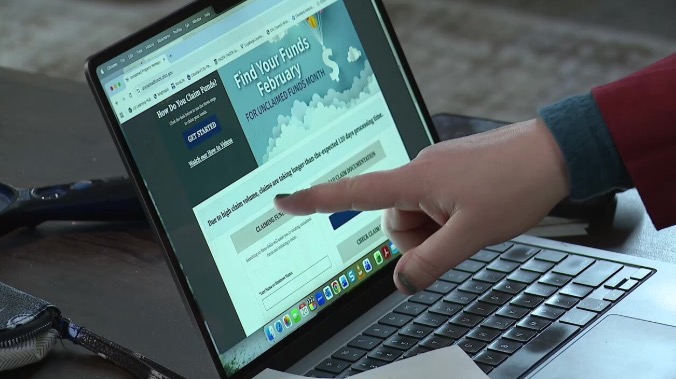
Linda Pietrasz only found out last summer that she has unclaimed funds – money from a life-insurance policy from her husband, who died in 1991. Gary Abrahamsen/News 5 Linda Pietrasz only found out last summer that she has unclaimed funds – money from a life-insurance policy from her husband, who died in 1991. At 72, she doesn’t have a computer, Internet access or a car. She called News 5 for help submitting documents online to support her claim for that old insurance payout.
“The process, to me, is too complicated,” she said, running through a checklist of documents that the Ohio Division of Unclaimed Funds requires.
“I found out the stuff that I had to get, and it was basically everything,” she said.
Pietrasz didn’t know that her husband, who was only 40 when he died in 1991, had a life insurance policy. She found out in July, when her son searched the state’s unclaimed-funds database and discovered the misplaced money.
She managed to file an initial claim but couldn’t scan and upload any supporting documents. Pietrasz doesn’t have a way to make copies. And she didn’t want to send the original documents to the state by mail, and risk losing them.
“I’ve got my marriage certificate, his autopsy report, date of death,” she said.
Here’s the backstory Records show Ohio has been holding the money since 2011, when John Hancock Life Insurance Company turned it over to the state. It’s part of a roughly $1.7 billion to $1.9 billion bucket of unclaimed funds the state’s been sitting on for a decade or longer.
The General Assembly directed state officials to pull that long-held money out of the unclaimed funds trust and convert it to state property, starting Jan. 1. Lawmakers earmarked $1 billion for grants for sports and cultural facilities, with the first $600 million going to the new $2.4 billion Browns stadium in Brook Park.
And for the first time, lawmakers set a clock on how long people are allowed to file claims. Going forward, the money will become Ohio’s property 10 years after the state accepts the unclaimed funds from the original holders, including banks, insurers and utility companies.
The General Assembly created a grace period to give people whose funds get taken another chance to file claims. That reimbursement window runs through Jan. 1, 2036.
Ohioans with unclaimed funds sued last year. They argue the state’s new approach is an unconstitutional taking of private property. Lawyers for the state, meanwhile, say Ohio is on firm legal ground – and that owners have had ample time to claim their money.
In December, a Franklin County Common Pleas Court judge temporarily blocked the state from taking that first tranche of misplaced money. That temporary restraining order is still in place. The court is considering whether to impose a longer-term hold while the legal battle plays out. A decision on a preliminary injunction is expected soon.
Please note: This story was provided to CNN Wire by an affiliate and does not contain original CNN reporting. This content carries a strict local market embargo. If you share the same market as the contributor of this article, you may not use it on any platform.