After cancer diagnoses, Massachusetts family seeks answers about landfill contaminated with PFAS

By Karen Anderson & Alexi Cohan
Click here for updates on this story
TEWKSBURY, Massachusetts (WCVB) — A Tewksbury family is on a mission to find out if PFAS contamination from a former local landfill is what caused cancer and other illnesses in their community.
Ryan Connor was diagnosed with kidney cancer when he was just 22 years old, and his sister, Briana Garcia, was diagnosed with thyroid cancer and the autoimmune disease scleroderma in her thirties. Their mother died of cancer when they were just kids.
“My whole life growing up, people in our neighborhood got sick and passed away from rare blood cancers, rare diseases,” Connor said.
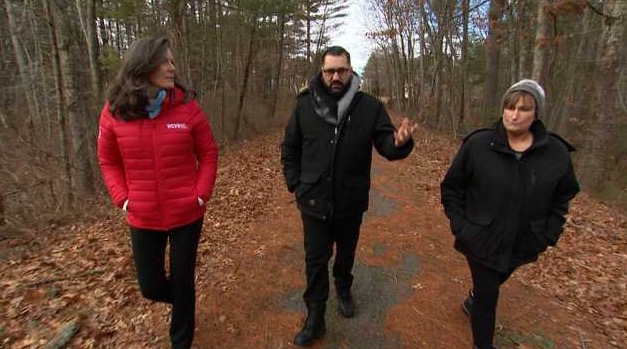
The siblings, who now live in New Hampshire, grew up on South Street in Tewksbury, just a short walk from Sutton Brook Disposal Area, a dump previously known as Rocco’s Landfill.
They played in the wetlands surrounding the dump, often fishing and catching frogs. Connor even camped out there.
“There were no fences. It was just an easy, accessible area,” Garcia said.
The dump was supposed to serve as a town landfill, but instead received unregulated commercial and industrial chemicals for decades, even after it was ordered to close, according to town records and reports from the U.S. Environmental Protection Agency.
Many residents voiced concern about the dump for years, old newspaper clippings show, but were often told there was nothing to worry about.
The site is located just a few hundred yards from municipal drinking wells that in 1989 tested positive for a number of harmful chemicals, such as chloroform, according to records from the Tewksbury Water Department.
Connor and Garcia, along with many of their neighbors, got their drinking water from those wells until they were taken offline in the early 1990s.
“The number one question is, were those wells affected?” Connor asked.
Right now, that answer is unclear. But Connor and Garcia are on a quest to find out, with hopes of getting medical monitoring for themselves and their neighbors.
“I just feel motivated to get information and the truth out for myself and for our community because they deserve to know exactly what the truth is,” Connor said.
The landfill was designated an EPA Superfund site in 2001, meaning the federal government flagged it as a risk to human health. As part of the Superfund process, the site is cleaned, reviewed every five years and monitored.
About a decade after the Superfund designation, a $30 million settlement was reached to clean up the site. Hundreds of chemical drums were excavated, polluted groundwater was treated and 14,000 tons of contaminated soil were removed.
Nearly 50 parties were found potentially responsible for the contamination, including the Rocco family, who owned the dump; the town of Tewksbury; and several large companies.
The Rocco family declined to comment when reached by 5 Investigates. They no longer own the land.
The most recent five-year review from the EPA, published in 2024, revealed high levels of PFAS, which stands for per- and polyfluoroalkyl substances, at the dump.
PFAS, also known as “forever chemicals,” are a family of synthetic substances made in the 1950s that do not break down easily in the environment or in the human body. PFAS chemicals are nonstick and resistant to water and heat.
PFAS are found in many everyday items, including nonstick pans, dental floss, fast food packaging, Gore-Tex outerwear and more.
They’ve been found to be harmful to human health, causing subtle changes like high blood pressure and cholesterol as well as leading to diseases like thyroid and kidney cancer, according to Dr. Laurel Schaider, a senior scientist at the Silent Spring Institute.
Schaider said 99% of people have PFAS in their blood.
She reviewed some details about the Sutton Brook site.
“Based on the information that I’ve seen so far, it does seem like there are many illnesses in this small area and it does raise concerns that there might be an environmental factor at play,” Schaider said.
But proving someone was sickened by PFAS isn’t easy.
“It’s challenging to try to make those linkages because we know that there are often long periods of time between when an exposure happens and when effects from those exposures become apparent,” Schaider said.
The municipal drinking wells in Tewksbury were never tested for PFAS because they were taken offline before PFAS testing began.
The EPA, in a statement to 5 Investigates, said, there is “no evidence that the Sutton Brook Superfund site has impacted drinking water historically or presently.”
The agency said that’s because their studies over decades have shown the contaminants from the site don’t flow in the direction of the wells.
But Connor and Garcia aren’t convinced. In the last year, they’ve filed public records requests, dug up old news stories and made a Facebook page to share their findings.
They surveyed their old neighbors, and nearly 100 people reported kidney cancer, thyroid cancer, leukemia, autoimmune disease, diabetes and more.
Garcia has helped with this effort while still battling her own health issues.
Scleroderma is a rare disease marked by the overproduction of collagen in the body. It restricts blood flow, causing Garcia to have limited use of her hands and difficulty eating and digesting food.
“I just want somebody to blame. You took my life away from me. You took my life away from me,” said Garcia.
Garcia and Connor have joined a multidistrict litigation connecting cancer to PFAS. That lawsuit is ongoing.
The pair have been in touch with the EPA and the Massachusetts Department of Public Health to share their findings and ask for more investigation.
DPH said it is currently reviewing site documents from the EPA, which will help determine whether further public health follow-up is appropriate.
DPH confirmed they spoke with Connor about his concerns. EPA monitoring wells remain at the site, which is now capped and fenced off.
Please note: This story was provided to CNN Wire by an affiliate and does not contain original CNN reporting. This content carries a strict local market embargo. If you share the same market as the contributor of this article, you may not use it on any platform.