I-25 northbound reopens overnight after deadly crash; troopers share brown-out safety guidance

Stella Girkins
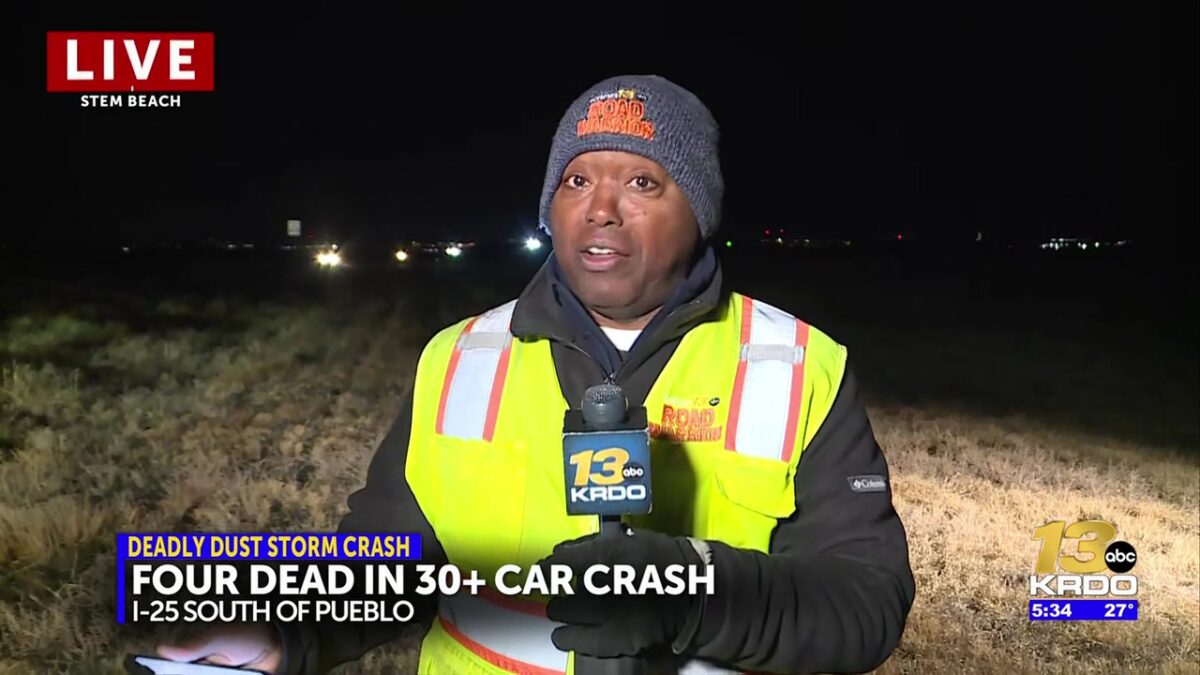
PUEBLO COUNTY, Colo. (KRDO) – I-25 has reopened in both directions after Tuesday’s deadly crash shut down the highway south of Pueblo for more than 12 hours.
The Pueblo County Coroner has identified the four people killed as David Kirscht and his adult son, Scott Kirscht, both of Walsenburg, Mary Sue Thayer of Rye, and Karen Ann Marsh of Pueblo.
The crash happened in the Stem Beach area around ten in the morning. The interstate was closed in both directions, while law enforcement, fire and rescue, and emergency crews responded.
Southbound lanes reopened Monday evening, while northbound traffic remained detoured until early Tuesday morning.

According to the Colorado State Patrol (CSP), the pile-up involved 29 passenger vehicles, seven semi-trucks, and a livestock trailer.
CSP says the chain-reaction crash unfolded during sudden “brown-out” conditions – strong winds kicking up dust and dirt, drastically reducing visibility.
“The visibility was not bad until it wasn’t,” said Kimber Begano, who narrowly missed the crash. “There was no bracing yourself for it. You were just in the thick of it.”
What CSP says to do in a brown-out
Following the crash, viewers asked what drivers should do if they suddenly lose visibility on the highway.
Before heading out, CSP encourages drivers to check CoTrip.org and local weather.

“If drivers encounter a brownout while traveling, they should immediately slow down, turn on their light-beam headlights, and increase following distance,” says Trooper Sherri Mendez. “Reducing speed and increasing following distance gives drivers more time to react.”
Drivers should also avoid sudden braking or abrupt lane changes.
If visibility drops to near zero, CSP reminds drivers not to stop in the travel lane. Instead, carefully move completely off the roadway by taking the next exit or pulling off – well beyond the shoulder.
“Once safely off the road, drivers should turn off their lights, set the parking brake, and remain in their vehicle with their seatbelts fastened until visibility improves,” says Mendez. “Leaving lights on while stopped can unintentionally cause other motorists to follow those lights and collide with the parked vehicle.”
Authorities continue to investigate the crash as the southern Colorado community recovers from one of the most significant pile-ups in recent memory.
The Colorado Department of Transportation (CDOT) also shared this guidance.
Similar to a blizzard, brownouts reduce visibility significantly. Motorists should avoid driving through a dust storm if possible. When that’s not possible, motorists should not stop in a travel lane but should exit the roadway, park, turn off headlights and use the emergency brake.
CDOT works with State Patrol to determine whether and when wind-related restrictions or closures need to be put into place; typically, 60 mph gusts or sustained winds are a threshold we use to help make this determination.
If CDOT, in coordination with the Colorado State Patrol, determines that high winds – typically 60 mph+ – could compromise traveler safety, a High Wind Restriction will be issued for a particular segment of highway. High profile vehicles such as semi-trucks, loaded or with an empty load, will be required to park and shelter in place or turn around until it is determined winds have subsided and it is safe for such vehicles to resume travel. The restriction helps prevent a truck, trailer or light-weighing vehicles from suddenly entering into another lane or causing a rollover.
– The Colorado Department of Transportation.