Witnesses push for transparency during school report card bill Senate hearing

Marie Moyer
Editor’s Note: AI was used in background research for this article.
JEFFERSON CITY, Mo. (KMIZ)
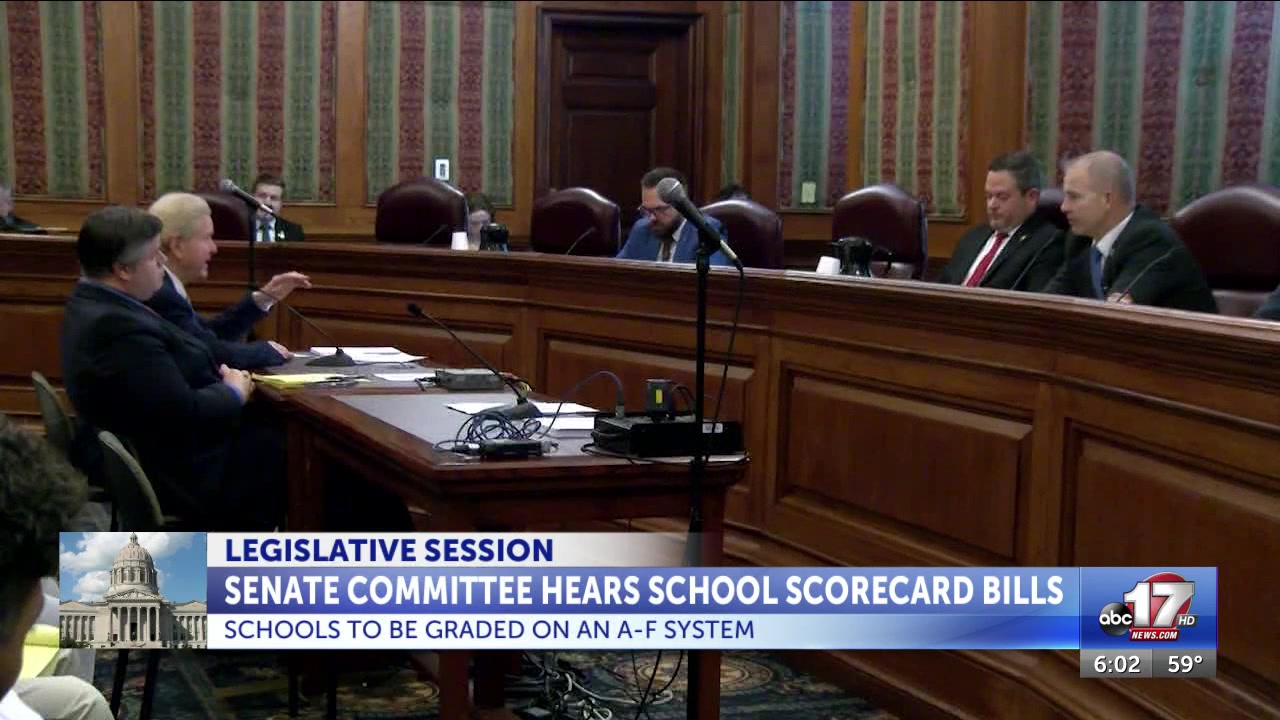
Teachers and parents faced Missouri legislators on Tuesday as two Missouri senators work to write a new grading system for schools into law.
Gov. Mike Kehoe signed an executive order creating school report cards in January, before his State of the State address. The order directed the Missouri Department of Education to implement a new letter-grade system for schools by June.
Senate Bills 1194, sponsored by Sen. Ben Brown (R-Washington), and 1653, sponsored by Sen. Curtis Trent (R-Battlefield) seek similar provisions to Kehoe’s order to codify the bill. Both texts would also create the “Show Me Success Program.”
During Kehoe’s address, he highlighted Brown’s bill and encouraged the General Assembly to pass similar legislation.
“[Parents] know what a good report card looks like,” Trent said. “When it comes to schools, they’re handed pages of acronyms, charts that don’t really tell them anything in plain English as to how their child’s school is actually doing.”
The Show Me Success Program will link high school performance to funding. Schools ranking in the top 5% of student performance statewide will receive $100 per student. Those in the top 10%, but below the top 5%, will be eligible for $50 per student.
According to the fiscal notes for the bill, more than $7 million would be eligible for the program. Committee member Sen. Maggie Nurrenbern (D-Gladstone) pushed back against the program during Tuesday’s hearing.
“If a school is doing well, then they’re going to receive more money, but a school that is doing poorly will not receive additional money. So my question is, how are they expected to improve then?” Nurrenbern said.
Trent defended the bill, arguing that school performance is a policy issue instead of a financial issue, adding that he is willing to drop the program in favor of moving forward with the report card.
“If schools were failing to perform because they didn’t have sufficient funding, that’s thing that we could just address with more money,” Trent said. “People deserve to be rewarded financially if they are performing above expectations.”
According to the Secretary of State’s Office, public schools and public charter schools will be graded on a lettered A through F scale based on a 0 to 100-point scale:
A – Producing excellent student outcomes
B – Producing more than satisfactory student outcomes
C – Producing satisfactory student outcomes
D – Producing less than satisfactory student outcomes
F – Failing to produce adequate student outcomes
Scores will be based on the annual Missouri Assessment Program, or MAP, results. High schools will also be evaluated on their graduation rates. The new grade cards are designed to be standardized and easily understood by parents, taxpayers, school personnel and legislators.
“Many people have mentioned that a through F is easier to understand than stars or different indicators that aren’t necessarily self-explanatory,” Jordan Zakery the Regional Advocacy Director for ExcelinEd in Action said.
Testimonies for the bill also included members from the school groups in Louisiana and Mississippi, two of 11 states in the nation with a letter grade system for schools. Both witnesses reported seeing academic growth following the new system.
Schools that fail to test at least 95% of students will drop a letter grade. The point scale will also become stricter as school scores, Trent calling the rule a “treadmill for success.” For example, when 65% of schools earn an A or B, the minimum score required for each letter grade will go up by five points for the next year.
Zakery added the system is not meant to punish low-performing schools.
“On both sides of the coin, whether a school is low performing, high performing or so on A or an F, it highlights the positive things about these schools,” Zakery said. “This policy also helps identify where schools can improve.”
Opponents of the bill support the need for transparency, but warned that the test is too one-size-fits-all. Steven Carroll with St. Louis Public Schools and the Cooperative School Districts of Greater Kansas City reported that many students face socioeconomic issues and unstable home lives that can affect school performance.
“A public school has to take in whatever child walks through their front door, all the social problems, the challenges that a student may have,” Carroll said. “Yet you expect them to go in and maybe do well on a test and then the school is the only one getting graded.”
Mike Lodewegen, the Director of Legislative Advocacy with the Missouri Association of School Administrators, testified at the hearing for information. He took no particular stance and instead reported on what administrators are discussing regarding the bill.
Some concerns included resources being moved away from teachers.
“We will be able to increase scores if we focus on the test, whatever you focus on, that will happen, resources will be dedicated specifically to that, right?” Lodewegen said. “What does that do? How does that impact the profession?”
The Missouri Department of Education is required to finalize the implementation plan for the grading system by June. Schools will begin receiving their first annual scores under this system by Sept. 15. Schools will also need to publish their scores for the public by Sept. 30.
If approved by the committee, the bills will be moved to the Senate floor for debate.