Supreme Court upholds private education tax credit

Ryan Suppe
Originally posted on IdahoEdNews.org on February 5, 2026
by Ryan Suppe, IdahoEdNews.org
BOISE, Idaho — The Idaho Supreme Court upheld the state’s private education tax credit Thursday.
The five-member court unanimously agreed that challengers failed to show the Parental Choice Tax Credit violates the state constitution’s mandate that the Legislature fund public schools. The credit is Idaho’s first private school choice program, enacted last year through House Bill 93.
The court also granted attorney fees to the Idaho State Tax Commission, which defended the credit and was represented by Attorney General Raúl Labrador’s office.
Chief Justice G. Richard Bevan wrote Thursday’s opinion. Justices Robyn Brody, Colleen Zahn and Cynthia Meyer concurred. While Justice Gregory Moeller also concurred, he wrote a separate opinion.
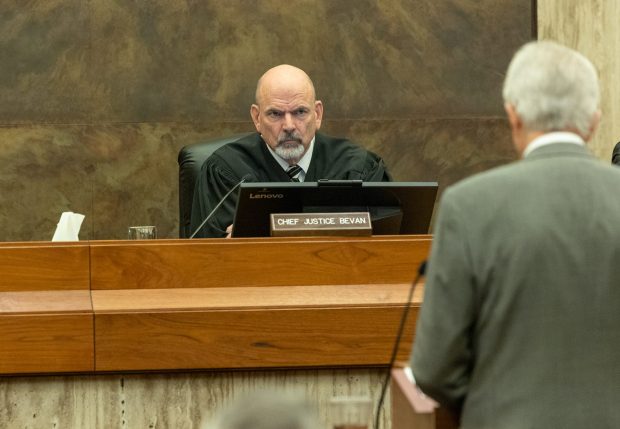 Chief Justice G. Richard Bevan listens to oral arguments at the Idaho Supreme Court on Friday, Jan. 23, 2026, in Boise. (Sean Dolan/EdNews)
The court ruled that a coalition of challengers — including the Idaho Education Association (IEA) and Moscow School District — failed to show that the tax credit violated Article IX Section 1 of the Idaho Constitution. The provision says that the Legislature has a “duty” to “establish and maintain a general, uniform and thorough system of public, free common schools.”
The coalition argued that taxpayer funding for private education creates a separate system that’s tuition-based and not open to all students.
The court concluded that this reading of the constitution is “inapt.” The interpretation is “unduly restrictive” and disregards the Legislature’s “plenary power” to enact laws that aren’t prohibited by the state or federal constitutions, Bevan wrote in the opinion.
“Rather, it establishes a floor, and not a ceiling,” Bevan wrote. “When a constitutional provision mandates the legislature do something that it has authority to do, it is not reasonable to read that mandate as restricting the legislature’s broader power to do something more.”
The opinion comes less than two weeks since the court heard oral arguments in the case.
In a joint statement Thursday, the coalition said that while the court found the tax credits “are not unconstitutional,” this “does not mean that they are good policy.”
“Despite this setback, our organizations will continue to advocate for Idaho’s students and public education and believe the Legislature and the voters of Idaho should look critically at this program,” the coalition said.
Justices also rejected the coalition’s argument that the tax credit violates the “public purpose doctrine” implicit in the Idaho Constitution. This legal principle requires that the state spend taxpayer dollars in the public interest, not in private interests.
The tax credit may “incidentally benefit private enterprise,” Bevan wrote, but this doesn’t transform its purpose into a private one. The chief justice noted that the credit covers more than private-school tuition — it also can be claimed for books, curriculum and other expenses in private- and home-school settings.
“The fact that some educational services are provided by private actors who may limit the scope of admission to their schools does not make the educational services less beneficial to the public as a whole,” Bevan wrote.
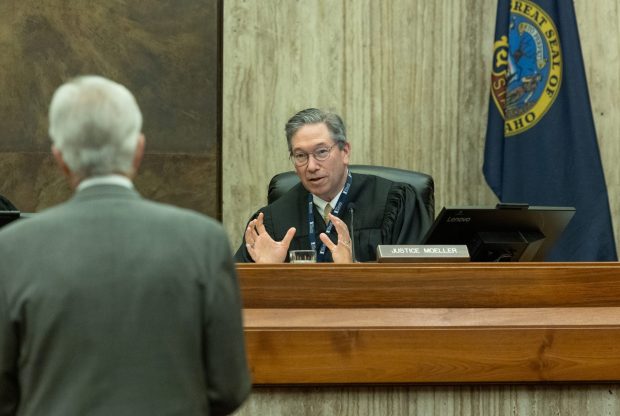 Justice Gregory Moeller speaks during oral arguments at the Idaho Supreme Court on Friday, Jan. 23, 2026, in Boise. (Sean Dolan/EdNews)
Moeller agreed with the other four justices. But he also penned an addendum directed at court-watchers who might call the decision a “landmark” or “watershed” that would make a “fundamental change in the constitutional landscape.”
“I wish to stress that I do not believe that is what has occurred today,” Moeller wrote.
He went on to write that the “constitutional foundation for public education…remains firmly intact.” The coalition brought its challenge before the tax credits have been distributed, and the harms they claimed were “hypothetical and speculative.”
“(Y)et they may be reexamined in the future when the impact of this legislation can be properly ascertained,” Moeller wrote.
This is a breaking story and will be updated.