Rancho Mirage Writers Festival examines immigration policy under Trump admin

Daniella Lake

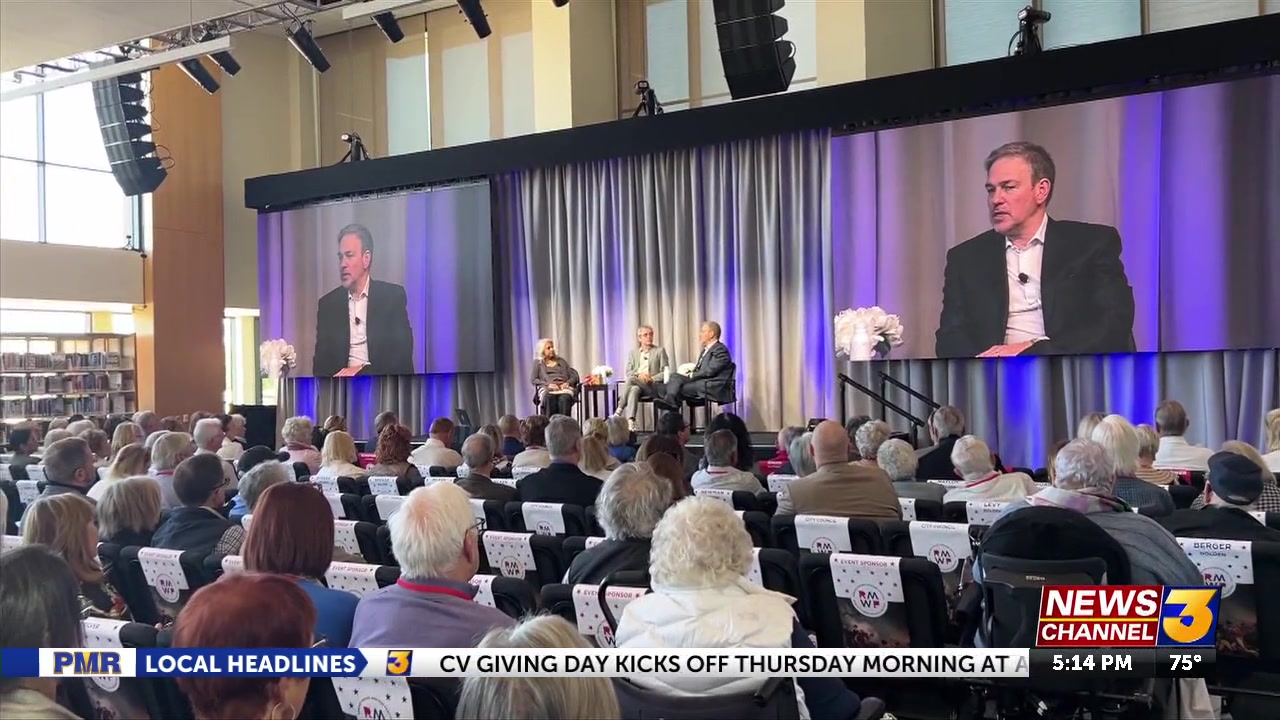
RANCHO MIRAGE, Calif. (KESQ) – The Rancho Mirage Writers Festival hosted a panel focused on current immigration policy, called Crossroads: America’s New Immigration Reality this morning. The panel featured journalist Meena Ahamed, historian Russell Shorto and columnist Bret Stephens. They examined immigration policy under the Trump administration and how immigrants have shaped American society.

“We absolutely need a policy that secures the border. The complaints about immigration are not entirely illegitimate, and we have to be the ones who enforce these laws,” said Stephens, a columnist for The New York Times often writing about politics.

“One couldn’t have imagined that the streets of America would see federal agents in masks and uniforms coming in and threatening its own citizens,” said Meena Ahamed, who recently authored a book about the contributions of Indian immigrations to the U.S.

Attendees say they joined the event in hopes of making sense of current immigration policy.

“My heart breaks for what’s going on now. But this conference, because it talks about history and how we’ve survived in the past, gives me hope,” says Jo Kaplan.

Click here to follow the original article.

North Idaho non-profit director sentenced for $154K Medicaid fraud

Seth Ratliff

KOOTENAI COUNTY, Idaho (KIFI) — A North Idaho woman has been sentenced to three years of probation after orchestrating a scheme to defraud the state’s Medicaid program of more than $150,000.

On January 21, 2026, First District Judge Barry McHugh ordered Tracy Hofius, 49, of Coeur d’Alene, to serve three years of supervised probation and 45 days of community service through the Kootenai County Sheriff’s Community Labor Program. As a condition of her sentence, Hofius must also pay $154,119 in restitution back to the Idaho Medicaid program.

The Fraudulent Scheme

Hofius served as the Executive Director of the North Star Child Development Center, a non-profit organization designed to provide developmental disability services to Idaho Medicaid participants.

On January 1st, 2022, Hofis was charged with fraudulently adjusting and submitting false information to the Idaho Department of Health and Welfare for reimbursement from the Medicaid program. Court documents indicate that North Star billed for several services that were never actually provided by Hofius or her staff.

According to Idaho Attorney General Raúl Labrador, Public Assistance Provider Fraud is a felony currently punishable by up to 15 years in prison, though at the time of Hofius’ fraudulent conduct in 2022 and 2023, the penalty was 5 years in prison. 

Hofius entered a guilty plea on November 18, 2025. Beyond her probation and labor service, the guilty plea also allows the Federal Department of Health and Human Services to suspend her credentials as a Medicaid provider.

AG Labrador touted the sentence as a victory for his office and the Idaho Medicaid program.

“When the Legislature gives my office authority to investigate fraud, we get results,” said Attorney General Labrador. “This defendant stole $154,000 by billing for services never provided to children with disabilities. We recovered every dollar and will continue pursuing anyone who defrauds Idaho’s Medicaid program.” 

Click here to follow the original article.

Two Idaho prison guards sexually assaulted her, witnesses said. Neither was charged

InvestigateWest

Editor’s note: “Guarded by Predators” is an investigative series exposing rape and abuse by Idaho’s prison guards and the system that shields them. Find the entire series at investigatewest.org/guarded-by-predators.

Originally Published: January 28, 2026

By
Whitney Bryen

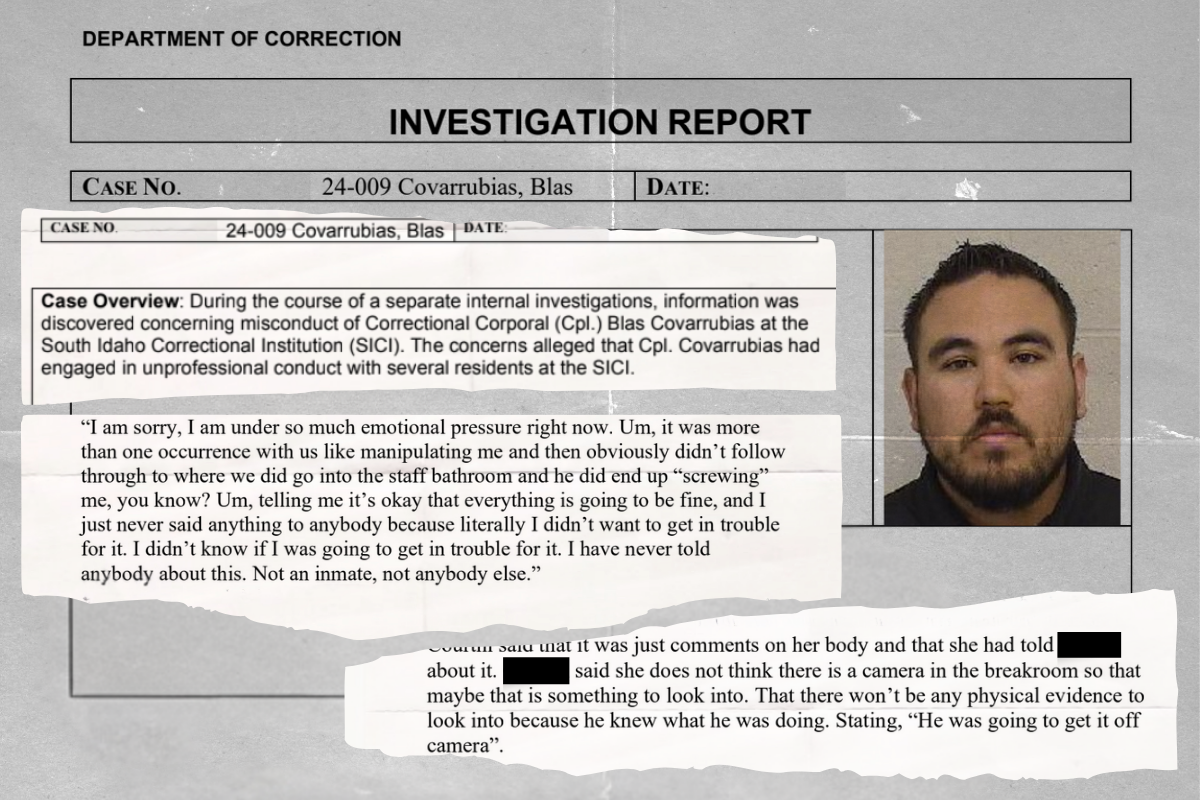
Boise, IDAHO — It was November 2023, in a staff break room at South Idaho Correctional Institution, when prison guard Blas Covarrubias unbuttoned Michele’s pants and sexually assaulted her, she told an investigator. She was one of six inmates that the corporal — known as “Covi” to the women he was entrusted with protecting — was accused of abusing in 2023 and 2024.  

Eight months later, Michele was sexually assaulted again. This time by someone else: a correctional officer named Justin Tillema, a witness reported.  

The Idaho Department of Correction conducted investigations into both men. State police detectives investigated one of them. 

Both men avoided criminal prosecution.

Investigative files and witness interviews reveal how state agencies and county prosecutors resisted punishment for the two guards despite allegations from several incarcerated women. And the records show how those decisions took a toll on Michele, who says she was sexually abused twice while in state custody and left to face the consequences alone.     

Under federal and state laws, prisoners cannot consent to sexual acts with corrections staff. Tillema’s officer certification was revoked for “criminal conduct whether charged or not” and “inappropriate sexual conduct while on duty,” as well as failing to cooperate with or lying to investigators, according to the state agency that certifies prison guards. InvestigateWest sent messages to Tillema on social media and at his last known address. Tillema did not respond to requests for an interview.  

The federal Prison Rape Elimination Act and Idaho Department of Correction policy require prisons to report all “potentially criminal” acts to law enforcement. Yet police had no record of the allegations against Tillema being reported to them. The Department of Correction declined to answer specific questions about its handling of the allegations, stating via email that it only reports sexual abuse allegations to police “when criminal evidence is uncovered” — a statement that conflicts with its own policy and federal standards.

State police detectives sent the evidence against Covarrubias, including detailed descriptions of assaults from two alleged victims, to Ada County felony prosecutor Whitney Faulkner, who declined to charge him. The prosecutor’s office said it could not explain the decision, citing “ethical obligations” in a written statement to InvestigateWest. “The office is not permitted to comment on cases that have been declined for prosecution,” according to the statement. Covarrubias no longer works for the Department of Correction and the agency refused to say whether he was fired or resigned. InvestigateWest sent requests for an interview to Covarrubias at his last known address, but he did not respond.  

The failure to hold the guards criminally accountable follows a decade-long pattern of rampant sexual abuse by Idaho women’s prison staff that often results in shoddy investigations and punishment for victims who speak up. That dynamic was exposed in a series of October reports from InvestigateWest, which counted Covarrubias and Tillema among 37 prison workers accused of sexually abusing incarcerated women. Of those workers, at least 18 resigned after the alleged misconduct or after it was reported, leaving victims without justice, and future employers and the public in the dark about the accusations.

Eight of those employees, including Tillema, were fired. Three were criminally charged with sexual contact with an inmate. And only one was given a prison sentence, which he avoided after completing a nine-month rehabilitation program that serves as an alternative to incarceration. 

Covarrubias and Tillema were on leave when InvestigateWest began looking into their cases in January 2025. Investigations by the prison system had stalled until Michele, who is being identified by her middle name, shared her story with a reporter from behind bars. This story is the first to detail Michele’s allegations against the two guards.  

“I haven’t talked freely about what has happened to me out of fear of retaliation,” she wrote to InvestigateWest then.

“I need help,” Michele said. “I do not feel safe here.”

Prison workers accused of sexual misconduct

‘He acted like he cared’

Cpl. Covarrubias first took notice of Michele in the summer of 2023, she recalled in an interview with Department of Correction investigators the following year. Michele had been in prison for six years for killing a man while driving drunk. 

That summer, Michele helped Covarrubias organize a staff vs. inmates volleyball tournament. After the tournament ended, Michele and Covarrubias were talking in his office, where there were no surveillance cameras, when he said “you have a really nice ass,” Michele later told investigators. Covarrubias continued commenting on her body, and by the fall he started coming onto her and telling her his marriage was in trouble because he was unfaithful to his wife. Michele told investigators she ignored him. She was focused on preparing for an upcoming parole hearing.

But after she was denied parole, Michele’s mental health plummeted. When Michele developed an eating disorder and lost more than 20 pounds, Covarrubias said he was concerned and asked how she was doing, she told an investigator. Michele confided in Covarrubias, describing the guilt she felt for her crime and her anxiety over her prolonged prison sentence. One day around Thanksgiving, Covarrubias pulled Michele into a break room, which had a copy machine and refrigerator that inmates sometimes used, but no cameras. He said he could help relieve her stress. Covarrubias groped Michele and then unbuttoned Michele’s pants, put his hand down them and sexually assaulted her. Afterward, he told Michele, “next time, it’s going to be my cock.”

“He acted like he cared,” Michele said. “After this happened, he didn’t even care or look at me. Like he got what he wanted, then that’s it.”
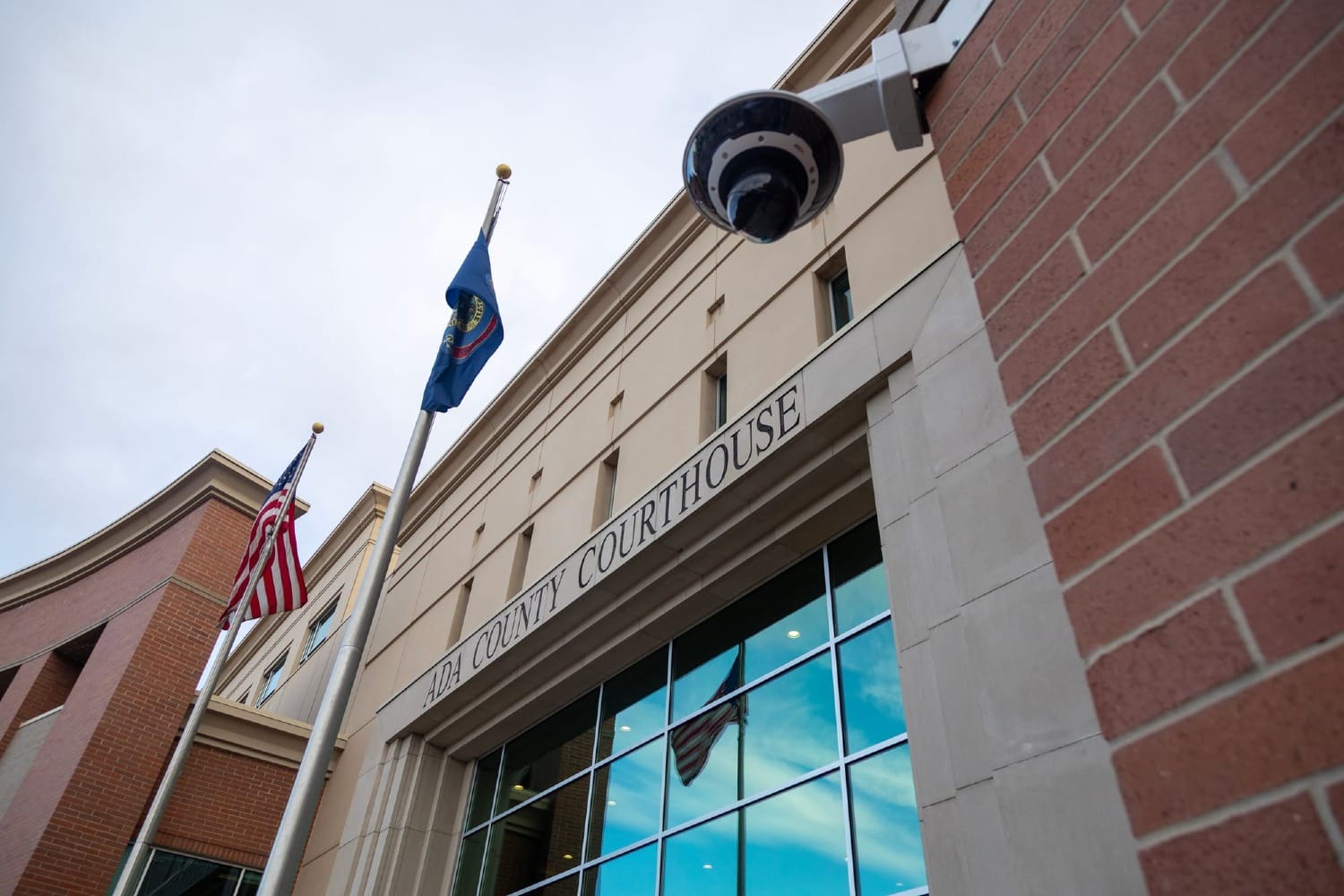
The Ada County prosecutor’s office declined to charge Blas Covarrubias for allegedly sexually assaulting two inmates at South Idaho Correctional Institution. (Kyle Green/InvestigateWest)

Michele told InvestigateWest that she initially did not report Covarrubias for fear of retaliation. But the following year in 2024, allegations against Covarrubias arose during another investigation conducted by the Department of Correction’s Special Investigations Unit, prompting them to question Michele, according to investigative records. When investigators questioned Michele about whether she ever had physical contact with prison staff, she asked if she could speak to investigators at a later date. They agreed. 

On June 13, 2024, more than six months after Covarrubias allegedly assaulted Michele, another woman who was locked up with Michele reported to case managers that Covarrubias had assaulted an inmate in the break room but did not name Michele, according to reports filed by those case managers. The woman also told them that Covarrubias had sex with a second inmate who worked for Covarrubias sorting and distributing incoming mail and commissary items. The woman said Covarrubias was assaulting other inmates, too, but they were afraid to speak up. Two weeks later, Michele told the case managers what happened to her, and they filed another report warning prison leadership of the accusations. 

The Department of Correction launched an investigation into Covarrubias on June 20, but he wasn’t put on leave until 10 days later. By that point, complaints had been filed accusing Covarrubias of sexually assaulting four women. 

And there was another officer who was also accused of committing sexual misconduct, the case managers learned. He supervised inmate workers who performed landscaping jobs, the other inmate told them. His name was Tillema.  

‘I was raped by their staff’

Also in June 2024, Tillema began grooming Michele, she told an investigator months later. 

Tillema was Michele’s boss at a worksite where she and other inmates trimmed trees, mowed and performed other landscaping duties. Michele’s mental health was improving, and this job gave her purpose, she said. Tillema took an interest in Michele, assigning her “special projects” like clearing tree limbs with a chainsaw. He told her she had the body of a model. He listened and empathized when she told him about the guilt she carried for the man she killed while driving drunk. Tillema gifted her candy, energy drinks and sunglasses, and other inmates began complaining about her special treatment, Michele told the investigator.  

But Michele didn’t tell the investigator everything. Still fearing retaliation from prison staff and other inmates, Michele did not share what she later alleged in an interview with InvestigateWest: that Tillema started making excuses to touch her, like saying he was protecting her “from getting hurt by the chain saw.” That one day, he put his hands down her pants and that soon after, she was performing oral sex on him. She said that the abuse spanned from July to September 2024. 

Even without her own account, Michele felt investigators had enough evidence to hold Tillema accountable.

“They knew we were alone in the office and that sexual abuse likely occurred,” Michele wrote to an InvestigateWest reporter. “They didn’t send me to medical to get checked out. They didn’t have a clinician come and talk to me. NOTHING.”

More than a week later, when a prison investigator asked if Tillema had ever touched her, Michele denied it. 

“I was raped by their staff,” Michele wrote to InvestigateWest. “Why would I feel safe talking to the same people that abused me???”

There were no cameras in the secluded area of Gowen Field Air Force Base where it all happened. But there was other evidence that Tillema sexually abused Michele, including one witness who reported it months earlier and another who filed a complaint after seeing Tillema receive oral sex from Michele at the base. 

Sexual abuse reports provided by the Department of Correction show that after Tillema was reported for sexual misconduct in June 2024, he was accused of another incident on July 11. The Department of Correction withheld the details of those complaints. Tillema remained on duty. A third report of sexual abuse was lodged against Tillema on Sept. 4, 2024, accusing him of a “personal relationship” with an inmate. He was removed from his position, and an investigation was launched. 
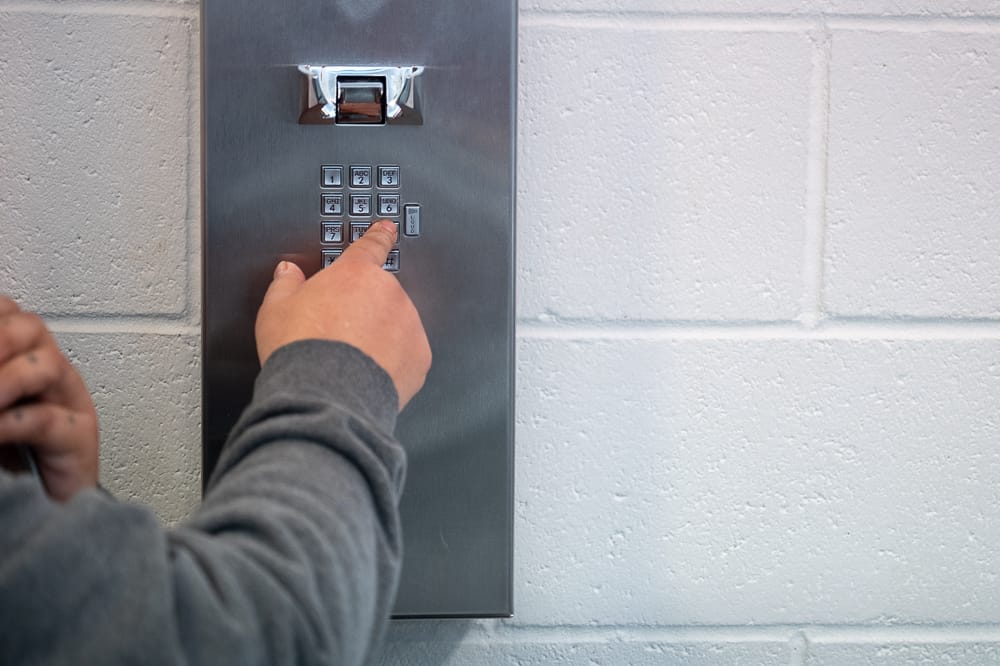
Michele told an ex-boyfriend that South Idaho Correctional Institution correctional officer Justin Tillema sexually assaulted her over the phone, like the one pictured here. Prison phone calls are monitored by staff. (Whitney Bryen/InvestigateWest)

When the Department of Correction closed the investigation on Dec. 5 of that year, they marked the allegations against Tillema “unsubstantiated.” The investigation had not produced enough evidence to determine whether or not the abuse occurred. 

On Christmas night in a series of tearful phone calls, Michele told an ex-boyfriend who was out on parole about the abuse and said she was scared. The following day, her ex-boyfriend filed a complaint accusing Covarrubias and Tillema of sexual abuse with the Department of Correction’s Prison Rape Elimination Act coordinator, who is responsible for ensuring Idaho prisons comply with federal standards designed to protect inmates from sexual harassment and abuse. Department of Correction investigators had access to those phone calls but the files provided to InvestigateWest do not say whether they were reviewed. 

In January 2025, the South Idaho Correctional Institution’s warden at the time, Noel Barlow-Hust, and two deputy wardens conducted an internal review of one of the incidents. No changes were needed to better prevent, detect or respond to sexual abuse, they determined, according to a report submitted to the Prison Rape Elimination Act coordinator. 

Michele’s Feb. 1 e-mail disclosing her abuse to an InvestigateWest journalist was initially blocked by the prison. All inmate messages and calls are monitored and controlled by staff. After Michele asked staff why it wasn’t sent, the message was released Feb. 6. That same day, the Department of Correction notified Michele that the allegations against Tillema were unsubstantiated, but Tillema was fired anyway, records show. 

‘Consistent behavior’

Department of Correction investigator McKenna Sato, who joined the Special Investigations Unit in 2024, interviewed four of Covarrubias’s alleged victims, including Michele. Sato stressed to them that sexual contact between staff and incarcerated women is inherently coercive, and that the women were not to blame for abuse that may have occurred.

“The reason that there isn’t consent is because the person that the (inmate) is consenting with has the ability to affect the (inmate’s) day-to-day life,” Sato explained to Michele. “So while in the moment you feel like you’ve consented … there is that underlying fear, whether you’re conscious of it or not. ‘If I say no, what are the consequences? Will I get fed tomorrow? Will I lose my job? Will I get moved? Will I have a target on my back?’”
Recent reports by InvestigateWest exposed years of sexual abuse by women’s prison guards across Idaho and the prison system’s failure to stop it. (Whitney Bryen/InvestigateWest)

Of the four women Sato interviewed, two denied having sexual contact with Covarrubias. Another inmate described a pattern of abuse that unfolded over several months. She told Sato that Covarrubias had already been investigated before, but he had been cleared by prison investigators because she denied that it happened, following Covarrubias’s direction to “deny, deny, deny.” 

The abuse escalated after the previous investigation was closed, the woman told Sato. Covarrubias instructed her to meet him in a small closet with an ice machine to make out. They later met in a tool shed where Covarrubias put his hand down her pants and touched her genitals. In a staff bathroom, Covarrubias raped her twice, she told Sato. 

Michele, who is friends with the other inmate who accused Covarrubias and was aware of the abuse, told Sato, “I feel like he got away with it and was like, ‘Oh here we go.’” 

Sato asked, “And that’s when it became consistent behavior?”

Michele confirmed. 

When she interviewed Michele, Sato asked about the allegations against Covarrubias and Tillema. Michele repeated the details of Covarrubias’ assault in the break room but denied any sexual contact with Tillema, adding that she didn’t agree with the prison’s policy that inmates cannot consent to sexual activity with prison staff. 

Sato identified a fifth alleged victim during one of those interviews, though it is unclear if she was interviewed by the Department of Correction because there is no documentation included in the records provided to InvestigateWest. 

The Department of Correction shared its interviews with Covarrubias’s four alleged victims with state police detectives. When police questioned Covarrubias, he denied the allegations of sexual harassment and assault. 

State police recommended Covarrubias for prosecution, but Ada County declined without explanation, according to an e-mail obtained by InvestigateWest. After Covarrubias left the Department of Correction, an inmate accused him of having sex with a sixth victim who was released on parole before the report was made. 

Records show the allegations against Tillema were not reported to police. State police staff confirmed they did not investigate him for sexual abuse of an inmate. 

Michele, who remains incarcerated, lost her job at Gowen Field after Tillema was accused of abusing her. It had been the only thing keeping her from losing herself completely. Michele’s mother says she saw glimpses of her bubbly, go-getter daughter when Michele called to brag that she had learned to use power tools or gotten a promotion. It gave Michele purpose in an otherwise bleak existence. 

“That girl, she’s gone,” Michele’s mother said. “She’s lost her light.” 

InvestigateWest (investigatewest.org) is an independent news nonprofit dedicated to investigative journalism in the Pacific Northwest. Visit investigatewest.org/newsletters to sign up for weekly updates.

Click here to follow the original article.

Shelley man arrested for battery and mayhem after Police standoff at local trailer park

Seth Ratliff

SHELLEY, Idaho (KIFI) — A Shelley man is behind bars today following a violent fight that turned into a police standoff at a local trailer park late Wednesday night.

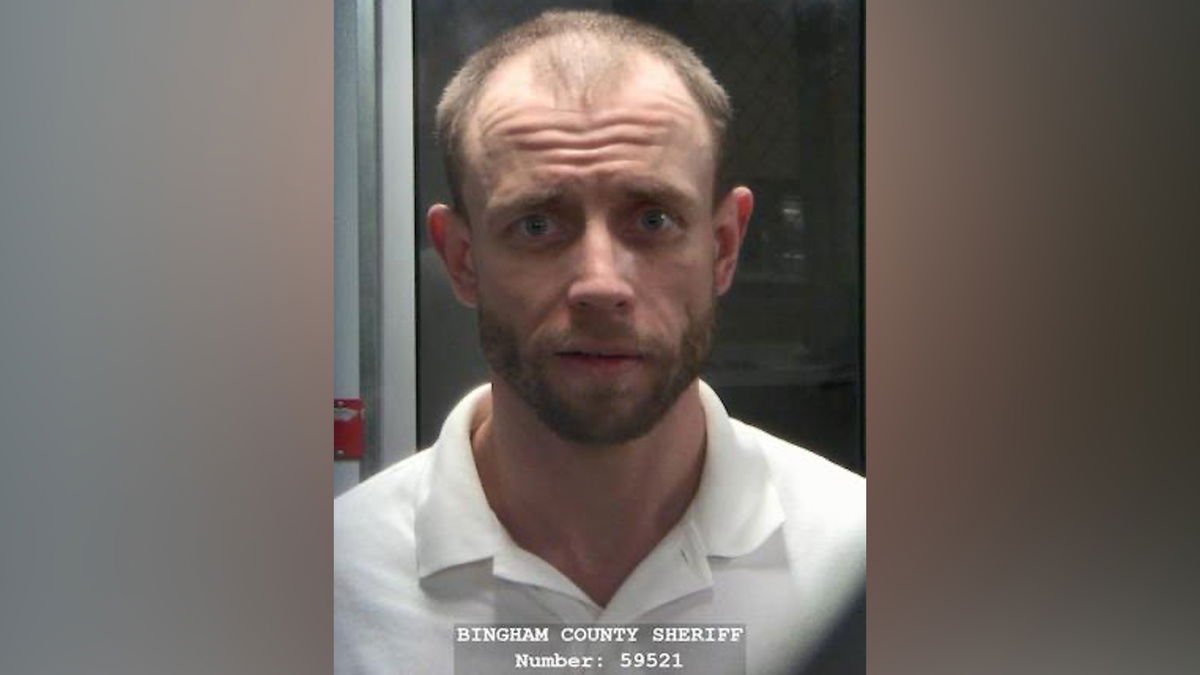
Jeffery S. Fredrickson, 34, has been booked into the Bingham County Jail on charges of Felony Battery and Mayhem.

The Shelley Police Department reported on Facebook that the trouble began around 9:30 PM on January 28, as their officers responded to a battery at the trailer court on W. Oak Street. After they arrived on the scene, the victim told police Fredrickson had been hit and bitten them before they managed to escape the trailer and call for help.

When the victim had left the trailer, Fredrickson reportedly barricaded himself inside and refused to come out. The victim was taken to the hospital by a private vehicle for their injuries.

Because of the violent nature of the fight and the possibility that he had weapons, the Shelley police called in the STAR tactical team and detectives with the Bingham County Joint Investigations Division.

While police cordoned off the area and worked on getting a warrant to enter the home, Fredrickson’s family stepped in. They managed to get him on the phone and eventually convinced him to leave the trailer and surrender to the police.

In its post, the Shelley Police Department thanked the neighbors for their patience during the incident and the Bingham County Joint Investigations Division and STAR team for helping resolve the night peacefully. The case remains under investigation.

All parties are presumed innocent until proven guilty in a court of law.

Click here to follow the original article.
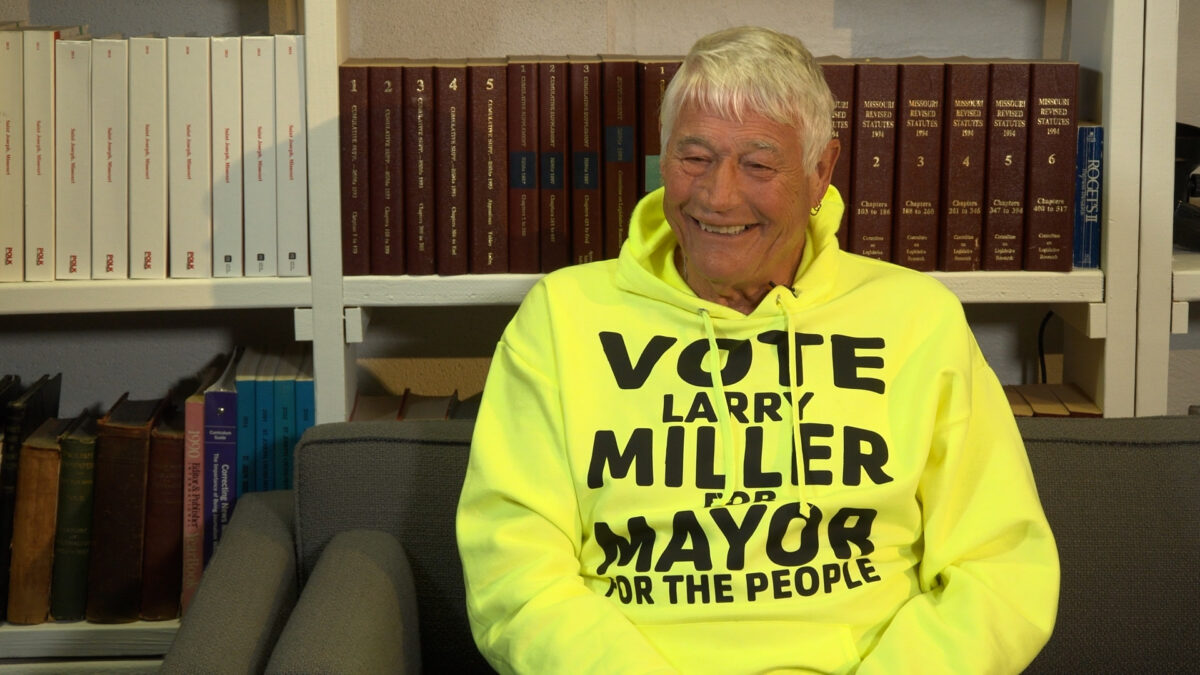
From neighborhood walks to City Hall Larry Miller puts name on ballot for mayor

TaMya Bracy

ST. JOSEPH, Mo. (KQTV) — Larry Miller, a familiar face known for waving and smiling on his daily walks, is running for mayor.

Miller was born and raised in St. Joseph and graduated from Central High School. He worked at Johnson Controls before retiring.

Known as the “Walking Waver,” Miller said oftentimes while out on said walks, he would be asked by residents if he would run for the mayoral office.

“I told them I would. I decided about the last three years, I been wanting to run. People been asking me to, so I did,” he said.

Miller said his campaign is based on the notion that he wants more ideas to get to the mayor’s office.

“That you need to go and talk to the people to see what they want and what’s not getting done. That you can do for them,” Miller said.

Being a big “people” advocate, Miller said he would exercise an open-door policy as mayor. He also has plans to check in on the community.

“Any people that want to come and see me, they can, they gotta a problem, and we’ll see if we can fix it,” he said. “I’m planning on every three to four months, I’m going go to everybody’s district, and I’m going have a meeting with the people and see if everything is going okay or if they need something.”

If elected, Miller made mention of working in every sector, to bring more jobs and safer communities.

“I want to work with the Chamber of Commerce. I would like to get more jobs for people. I want to work on the streets, get the streets ready for them,” he said. “I want to get maybe two or more policemen on the street. I would like to start neighborhood watch again, so we can stop the crime.”

When asked about his mayoral priorities, fixing St. Joseph’s streets was at the top of the list for Miller.

“I think what they’re doing right now is putting a Band-Aid on the streets. It only lasted for a year. The people are working hard for their money and paying their taxes,” Miller said. “I think we need to start fixing streets right. Even if we only fix two or three streets a year, at least the people would say they’re trying. I want to get their trust back.”

Miller added he wanted St. Joseph to be safe again, calling on the help of residents to help him in the feat.

He also suggested an audit of the City of St. Joseph’s finances.

“To see where every dime is going. We should start from there and build from there on up,” Miller said.

As an avid walker, Miller’s eyes are keen to issues with city sidewalks. He plans to work with different departments to make sidewalks accessible to anyone wanted to enjoy them.

“The sidewalks, people can’t walk. They are all overgrown, and we need to clean the city up. We need it so you and I can go Downtown and walk anywhere we want to and have to not worry about anything,” he said. “If I’m elected mayor, once I’m in office for three weeks, I’m going to work with the city street people for a day or two. See how they’re doing and see if there’s anything I can do to help them with their jobs.”

Miller hammered on transparency, especially when it comes to letting people know when decisions are being made with the city.

“We need to tell the people when we do that. Tell them why we have to do that and get their opinion on it,” he said. “I don’t like closed doors. Closed doors to me are like we’re hiding something. Everybody should know what’s going on at City Hall.”

The primary election will take place on Tuesday, Feb. 3. Miller is running against St. Joseph’s mayoral incumbent, John Josendale, and candidates Jonathan McClain and Kenneth Reeder.

Click here to follow the original article.

Boone County daycare owner takes the stand in Day 3 of Boone County baby death trial

Olivia Hayes

COLUMBIA, Mo. (KMIZ)

The unlicensed Boone County daycare owner took the stand in her own defense Thursday in the manslaughter trial against her.

Brown is charged with first-degree involuntary manslaughter for her alleged role after Ayla Gibson died in her care on May 25, 2023.

Brown detailed her experience in childcare noting she had been running her daycare from her home for nearly 30 years. She said she was routinely caring for children under the age of one and had never been been investigated prior to Gibson’s death.

Brown said she had briefly looked into becoming a licensed day care but she faced some hurdles, like the state’s requirement for seven foot ceilings in licensed facilities.

Brown walked the jury through what she would go through before taking a new child into her care. She said that she would make all parents aware that her daycare was not licensed and explained to them what the differences were.

Brown testified that she knew by taking Gibson into her care that she would be over her allowed child limit of six. However she said she knew some of the children in her care would be leaving soon and was under the impression that Gibson’s daycare situation was urgent.

She also said that Gibson’s mother, Leah Salisbury, downplayed her sickness. Gibson was found to have a viral lung infection.

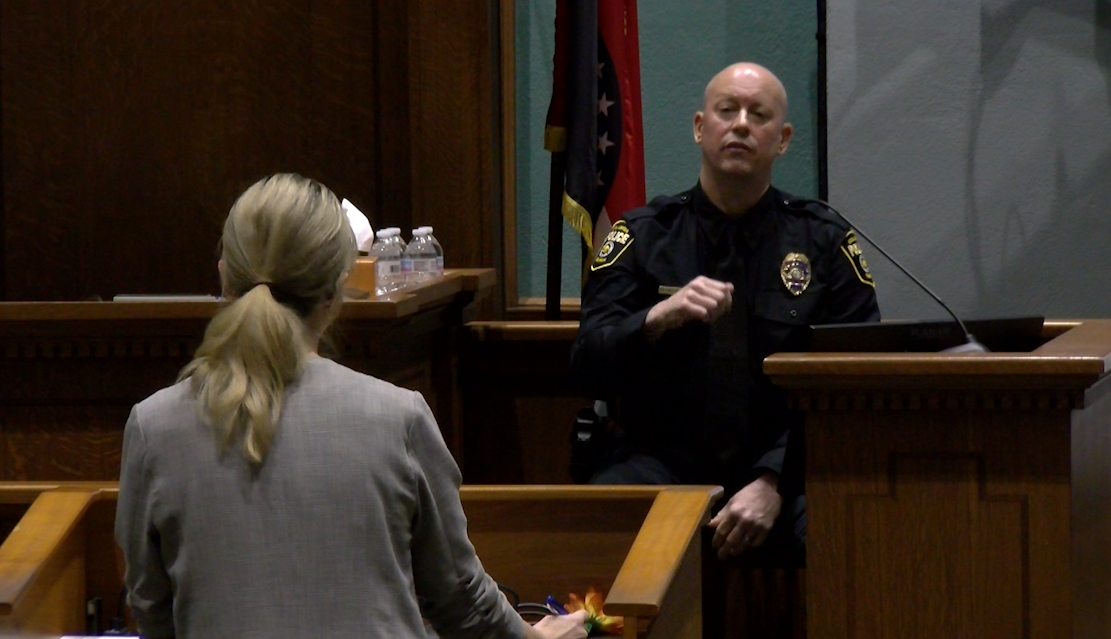
Columbia Police Detective Brian Graff took the stand and noted three inconsistent statements given by Sarah Brown following the death and discovery of Gibson.

“She found Ayla about 15 minutes later after laying her down. Still swaddled, still on her back or on that 45 degree angle,” Graff said. “Statement number two aws she found her about 15 to 20 minutes later, but she was on her face.”

Brown is alleged to have put Gibson–who was 3-months-old at the time– in a crib at her daycare in north Columbia with a loose, unfitted blanket and pillow in a position that resulted in death by suffocation, court documents say. Documents also claim the baby had a viral lung infection and that Brown ignored parent instructions to have her sleep on her back.

Brown’s first two statements were to other officers, Graff took her third statement.

“She found Ayla approximately one hour later, but she was also on her face,” Graff said regarding statement No. 3.

The court was shown body camera footage of the encounter where Brown told Graff that Gibson was dropped off in her car at 6:30 a.m. May 25, 2023. Brown said she put Gibson down for a nap at 7:30 a.m. By 8:30 a.m. Brown said she noticed Gibson had not woken up, but since she knew Gibson was sick she decided to make a bottle and let her sleep a bit longer.

Brown told Graff she initially gave inconsistent statements to officers as to how she found Ayla because she was scared.

Brown alleged it was just after 8:30 a.m. that she found Gibson when she went to wake her up and feed her the bottle. She told Graff that within seconds, she realized something was wrong and attempted mouth-to-mouth resuscitation attempts before calling 911. However Graff noted the 911 call was not made until 9:58 a.m. leading him to later take a fourth statement from her.

In Brown’s fourth statement about what happened, she spoke with Graff again the day after Gibson’s death.

Body camera footage of the interview shown in court shows Brown telling Graff that she found Gibson around 9:30 a.m. When he asked her about the time discrepancy she explained she looked at her call logs and saw she called 911 closer to 10 a.m. so she must have found Gibson around 9:30 a.m.

Prosecutors also noted differing statements from Brown about the number of children in her care. Graff explained that she told officers on scene she was caring for seven children, then in Brown’s interview with Graff for her fourth statement she said she was caring for nine. Graff testified that officers accounted for 12 children in Brown’s care.

Missouri law requires that anyone caring for more than six children be licensed. Brown did not have a license for her daycare.

The defense argued that Brown told officers she normally cared for six children but extra youth were in her care the day of Gibson’s death due to school year coming to an end. Brown’s lawyer also argued that licensed daycare facilities have state laws that they have to follow, but unlicensed daycares are not held to the same standards.

The defense also questioned Graff around his conversations with Gibson’s parents. Graff recounted Leah Salisbury, Gibson’s mother, telling him Gibson had respiratory issues that started on May 4. She said the baby was diagnosed with a viral infection on May 10 and that when she placed Gibson in Brown’s care she was having trouble breath both day and night, with the symptoms being worse at night.

In body camera footage of her interview with Graff, Brown expressed multiple times that she was concerned about Gibson’s breathing while in her care. She specifically noted the issue worsening when she had Gibson doing “tummy time.”

Brown said in the interview with Graff she did “tummy time” with Gibson Monday, Tuesday and Wednesday while she was in her care. Brown explained that if Gibson fell asleep during “tummy time,” she would not move her so she could sleep, but would monitor her condition. Thursday, the day of Gibson’s death, was the first time Brown told Graff she had put Gibson down for a formal nap which she said included swaddling Gibson, laying her down on her back and propping her up at a 45-degree angle to prevent any potential choking risk.

Photos were presented in court of Gibson sleeping during the ‘tummy time’ that were shared to Salisbury by Brown through text messages. Graff testified that he was provided the photos by Salisbury the day after Gibson’s death, but not the full text conversation where the defense noted Salisbury responding to Brown with texts like “that’s great” or “good.”

An investigator for the medical examiner’s office also testified on the stand Thursday. Stacey Huck said she encountered Gibson’s body at the hospital before she was taken to the morgue. Huck described blood pooling and facial blanching on Gibson’s face that was consistent with Gibson being face down when she died.

The defense questioned if the medical response immediately following Gibson’s death could have played a role in how and why the blood pooled.

The former Boone County medical examiner continued further into Gibsons post-mortem assessment and autopsy. She revealed that Gibson’s cause of death was ruled positional asphyxiation with viral pneumonia as a significant contribution. The witness also testified that Gibson’s manner of death was ruled an accident.

The former medical examiner explained that she was told pre-autopsy that Gibson had been suffering from congestion, but was not aware of her viral lung infection diagnosis. She said she found fluid that had pooled towards the front of Gibson’s lungs that would have been consistent with Gibson being face down when she died.

The defense noted the medical examiner’s description of Gibson’s lungs as “heavy and frothy” in the autopsy was not a sign of a healthy baby.

CPD Crime Scene Investigator also took the stand and testified regarding the evidence she collected at the scene. Multiple blankets, a pillow and the pack-and-play Gibson was found in were presented to the jury.

Missouri Children’s Division investigator and social worker Shannon McPherson visited Brown’s home daycare one week after Gibson died. McPherson testified that while she was examining the daycare for signs of child neglect or abuse she found a 11-month-old child face down in a pack and play crib with a blanket blocking their face and a heavy blanket over top of the crib.

Brown explained in her defense that she placed that child down properly and that the child was known to roll over in their sleep. The investigation found no evidence to support the claims of child abuse and neglect at the daycare.

Four women also testified positively to their experiences with Brown providing care to their children. Their separate testimonies were consistent with the notion that they never felt that their children were in danger while in her care.

Brown faces three-to-10 years in prison, if found guilty.

Check back for updates.

Click here to follow the original article.

Former Pettis County deputy indicted by grand jury for child porn charges

Ryan Shiner

COLUMBIA, Mo. (KMIZ)

A former Pettis County deputy who shot and killed a 25-year-old Sedalia woman in June 2020 was indicted by a grand jury on Thursday for charges related to child pornography.

Jordan Schutte, 40, of Sedalia, was indicted by a Pettis County grand jury for child porn possession and first-degree promoting child porn. He is being held at the Miller County Jail on a $75,000 bond. His next court date has not been scheduled.

The probable cause statement says law enforcement received a CyberTip on Aug. 12, 2025, about child porn being uploaded to a SnapChat account. The account’s phone number matched Schutte’s and the phone number was verified for the account by SnapChat in 2022, the statement says.

The statement says Schutte allegedly posted child porn to his “private” SnapChat story.

Click here to follow the original article.
KIFI 65 years: Lloyd Lindsay Young

Michael Coats

Idaho Falls, IDAHO (KIFI) – It’s not just the big news stories we remember when looking back on the 65 years of broadcasting history at KIFI.  We also remember the numerous personalities that came through our front door. Michael Coats talks to one memorable weathercaster from KIFI’s past.  

“Helllooooo Pocatello!”  

That un-mistakable voice might bring back some memories for viewers of KIFI in the 70’s. Lloyd Lindsay Young got his television start as a weathercaster here 

“I was working in Salt Lake City, and I went up to do a live audition. It made me pretty nervous but somehow I pulled if off.” Young said in an interview this month. “I wasn’t under contract in Salt Lake, so I gave them two weeks’ notice and BOOM! 1971 Hello Jackson Hole!” 

Elements that became a trademark for Young, started at KIFI and followed Young’s career through San Franscisco and New York City. 

The infamous long helllloooo, was a Lloyd Lindsay Young staple, invented on the spot at KIFI. “I don’t know what got into me that day, I said helllloooo Jackson Hole. I figured I might be on to something.” 

“I might have been on the air for about a month when I go, HELLLOOOO Jackson Hole Wyoming and somebody sent me, like a cane to point at the weather map. I had a lot of fun with weather pointers. People would send me all sorts of contraptions. Basically, when the weather wasn’t serious, I did a lot of schtick, and it got a lot of attention.” 

“Funniest story, one day I got this long stick, I didn’t know what the heck it was. The Rachers, believe it or not, had sent me a shellacked bull’s penis.”  

“I always felt, and I don’t know if you feel this way? A lot of the news is so serious that I felt my job was to add a little bit of levity. You know a lot of the news can be depressing, shootings etc…I wanted to add a little levity into it, fun you know and try to do that.”    

After working for several years at KIFI, Lloyd eventually jumped to KGO-TV in San Francisco. Then Young went on to WOR-TV (WWOR after 1987) in New York City.  He retired years ago after a decades long career in radio and television. Young now enjoys retirement just outside of Sacramento with his wife.   

Click here to follow the original article.
Man seriously injured after getting hit by truck in Pettis County

Ryan Shiner

COLUMBIA, Mo. (KMIZ)

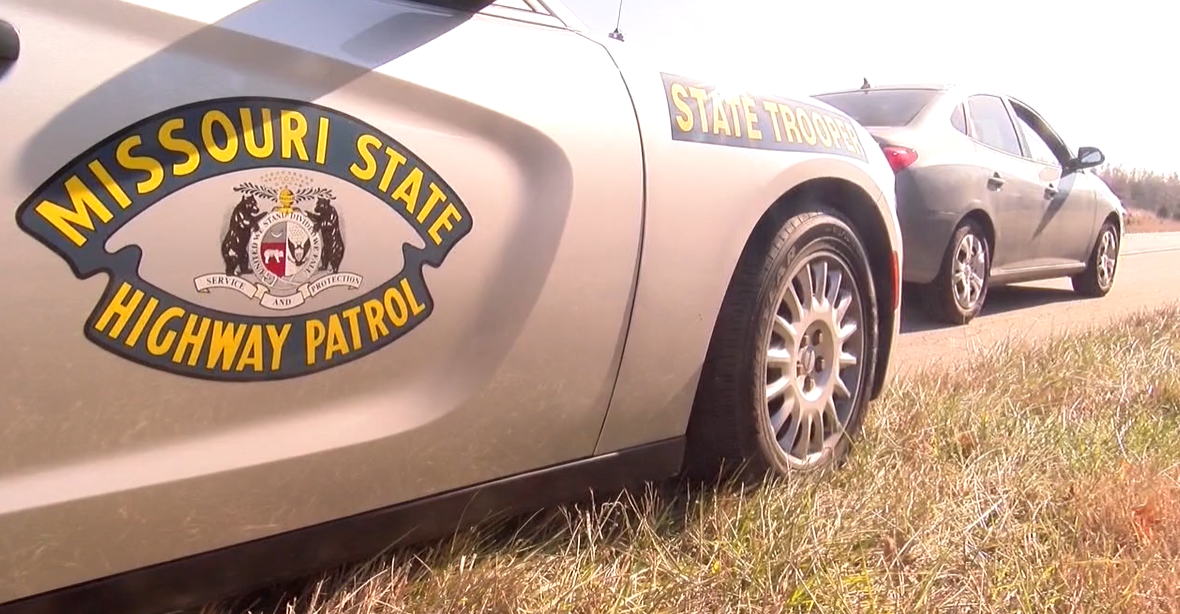
A 32-year-old Sedalia man was seriously injured Thursday morning after he was hit by a 2013 Ram 1500 on Whitfield Road in Pettis County, according to a Missouri State Highway Patrol crash report.

The report says the pedestrian was walking in the roadway just after midnight when he was hit by the truck. He was brought to Western Missouri Medical Center in Warrensburg.

The driver of the truck was a 45-year-old man from Humansville, Missouri. The truck had minor damage and was able to be driven from the scene. The driver had no reported injuries.

MSHP reports do not name those involved in crashes.

Click here to follow the original article.

CV Giving Day kicks off Thursday morning at Acrisure Arena

Jesus Reyes

THOUSAND PALMS, Calif. (KESQ) – “Coachella Valley Giving Day” kicked off Thursday morning at Acrisure Arena. Watch the kickoff event below:

The actual day is in March. Wednesday is the day to build up excitement for the event and News Channel 3’s Patrick Evans will be hosting the fun-filled morning to get the ball rolling.  

There’s over $100,000 in prize money up for grabs — donated by our generous partners and sponsors and presented by Desert Community Foundation in partnership with California Bank and Trust.   

Coachella Valley Giving Day is a 24-hour celebration of generosity and this year it’ll be held on March 3.

For more information, visit www.cvgivingday.org or follow on Facebook

Click here to follow the original article.