Advocacy program provides chance for regional priorities to be heard in Jefferson City

Danielle Bailey

JEFFERSON CITY, Mo. (News-Press NOW) — A group of citizens, business leaders, educators and government officials from Northwest Missouri will convene in Jefferson City next month for a key event focused on educating legislators about the region’s critical issues, part of an effort to promote the “Great Northwest.”

Great Northwest Day at the Capitol, held Feb. 3 to 4, gives Northwest Missourians a chance to have their voices heard by highlighting priorities in a meaningful manner to the state’s legislators.

“Great Northwest Day at the Capitol is a wonderful opportunity for leaders across our region to come together to speak as one voice on the important issues we see in our communities,” said Joe Hegeman, Chairman of Great Northwest Day, in a press release. “We’ve learned over the many years of Great Northwest Day that this approach has proven to be very powerful.”

The GNW Priorities Committee has identified the following as top issues:

Expanding rural healthcare access

Increasing childcare opportunities

Investing in higher education

Supporting K-12 education

Expanding workforce housing

Ensuring sustainable tax reform

Registration for the event is $80 if completed before Jan. 27. For more information on the priorities or to register, visit greatnorthwestday.com.

Click here to follow the original article.

City bids farewell to Paula Heyde after 40 years of service  

Prajukta Ghosh

ST. JOSEPH, Mo. (KQTV)– The City of St. Joseph will soon be saying goodbye to long-time City Clerk, Paula Heyde, as she wraps up her career of over four decades.

“It’s been interesting, I guess. I started when I had just been in college for a year. I was in between semesters and decided to try to get a job,” Heyde said.  

Heyde started working at City Hall when she was just 19 years old, where she said this was her very first “official job.” 

She explained how she was originally hired temporarily through an employment agency, but that short-term position turned into a lifelong career.  

Paula was promoted to Deputy City Clerk in 1984 and was later appointed to City Clerk in 1988 after the previous clerk retired.  

Heyde said she’s excited for what “retirement life” has to offer.

“I am excited for the next phase in my life, and I am looking forward to travelling and visiting family and friends,” Paula said.  

One of her fondest memories over the years has been the friendships she made and the opportunity to work with many different City Council members.  

“Some of the things that have gone on while I have been in this office. A lot of good things have happened to the city over the past forty years, so it’s been an enjoyable trip,” Heyde said.  

Heyde also shared her love for flowering plants, something she’s excited to spend more time on in retirement. 

Although working as a City Clerk wasn’t originally part of her career plan, she said she worked in the office until the opportunity presented itself, saying she’s enjoyed the ride.

“Yes, I have enjoyed it. Very much, actually and I will miss working with the people here, of course, and the building itself,” Heyde said.  

One of the biggest things she noted about her experience is that City Hall has given her a deep appreciation for architecture throughout her career.  

Heyde emphasized how pleased she is that the City has invested in maintaining the building so it can be preserved for generations to come.  

“I am excited about the 100th anniversary of this building next year and what it brings to the people,” Heyde said.  

Heyde’s official last day at City Hall is scheduled for Friday, Jan. 30. The community is invited to attend a reception to share memories and wish her well after over four decades of service.  

Deputy Clerk Kaycee Garton will assume Heyde’s role beginning Monday, Feb. 2.

Click here to follow the original article.

California GOP files emergency petition with SCOTUS to block Prop 50

City News Service

LOS ANGELES (KESQ) – The California Republican Party and others today filed an emergency application at the U.S. Supreme Court seeking to block California from using the congressional district lines enacted through Proposition 50 for the 2026 midterm elections.

The emergency application in Tangipa v. Newsom asks Justice Elena Kagan, the justice assigned to the U.S. 9th Circuit Court of Appeals, to issue an injunction pending appeal that would temporarily reinstate the 2021 California Redistricting Commission map while the case is litigated.

The filing asks the court to act by Feb. 9, citing the start of California’s candidate filing period and arguing that candidates and voters will face immediate effects if the Proposition 50 district lines remain in place.  

“California cannot create districts by race, and the state should not be allowed to lock in districts that break federal law,” Corrin Rankin, California Republican Party chairwoman, said in a statement. “Our emergency application asks the Supreme Court to put the brakes on Prop. 50 now, before the Democrats try to run out the clock and force candidates and voters to live with unconstitutional congressional districts. Californians deserve fair districts and clean elections, not a backroom redraw that picks winners and losers based on race.”

A three-judge panel in Los Angeles federal court last week ruled against California Republicans in their bid to nullify the new congressional map, which California voters approved in November.

In their lawsuit, filed one day after California voters approved Prop. 50, Assemblyman David Tangipa, R-Fresno, the California Republican Party and a group of Republican voters — joined by the U.S. Department of Justice — urged judges to block the new district lines at least temporarily so California’s original map would stay in effect for the 2026 midterms.   

Prop. 50 was passed after Republicans in Texas redrew their congressional map, a move California leaders said was designed to favor Republicans in the upcoming midterms.   

The suit, which names Gov. Gavin Newsom, state Attorney General Rob Bonta and California Secretary of State Shirley Weber as defendants, argues the new Prop. 50 maps are unconstitutional because they improperly use voters’ race as a factor in drawing districts and asked the court to block them from taking effect. 

The proposition’s passage increases Democrats’ chances of winning five additional U.S. House seats in the state in November and seizing control of the chamber. Democrats already hold a 43-9 advantage in the state’s House delegation.

Republicans had asked the court for a preliminary injunction blocking the maps from being used in 2026. In its 2-1 decision, the court upheld the new congressional districts, rejecting plaintiffs’ claims that the maps had been drawn to favor Latino voters over other voting groups.

Judge Josephine Staton, an appointee of former President Barack Obama, wrote the ruling, with Judge Kenneth Lee, a President Donald Trump appointee, dissenting. Judge Wesley Hsu, appointed by former President Joe Biden, joined Staton in her ruling.

“We find that Challengers have failed to show that racial gerrymandering occurred, and we conclude that there is no basis for issuing a preliminary injunction,” Staton wrote. “Our conclusion probably seems obvious to anyone who followed the news in the summer and fall of 2025.”  

Voters overwhelmingly approved Prop. 50 in November, which supporters dubbed “The Election Rigging Response Act.”

It establishes new congressional district maps for the 2026 midterm elections that will also be used for the 2028 and 2030 elections. An analysis by the election news website Ballotpedia said it would shift five Republican- held congressional districts to Democrats.   

Weber, a co-defendant in the lawsuit, said last week she was pleased the court acknowledged “that the will of California’s voters should prevail. Our democracy is in jeopardy and the fight to maintain our constitutional right to vote must continue. … Our democracy is worth protecting and today’s rulingwas the right result.”

Click here to follow the original article.

Boone County dog breeder accused of abuse to have trial in April

Ryan Shiner

COLUMBIA, Mo. (KMIZ)

A woman who is charged with 29 counts of felony animal abuse is expected to go to trial in April.

Melissa Sanders, 26, of Columbia, is scheduled to go to trial on Tuesday, April 28 at the Boone County Courthouse, according to Prosecutor Roger Johnson. She has been held at the Phelps County Jail. She is being held without bond.

Sanders ran Magnum Opus German Shepherds and a number of dead dogs, including a dozen dog skulls, were found at the property of the business when law enforcement served a search warrant in November, according to court documents in previous reporting. Several malnourished dogs were also found at the property.

Court documents say at least two living dogs that were found were on the brink of death. A number of dogs have been returned to owners or are being fostered.

Sanders is also facing a case from several dog owners from around the country and abroad.

Click here to follow the original article.

How much tech is too much? Idaho hunters debate proposed legislation

KTVB

By: Abby Wilt

Published: 10:24 PM MST January 18, 2026

For updates in this story, click HERE.

BOISE, Idaho (KTVB) — Idaho Fish and Game is proposing new regulations to the Idaho legislature this session that would restrict hunters’ use of advanced technology during big game season, after concerns about advancements in hunting equipment.

The regulations stem from recommendations provided by a group of 23 hunters, bear baiters, trappers, long-range shooters and wolf hunters, who advised Fish and Game on fair hunting practices in Idaho. After a public comment period, the agency is now presenting the proposal to state lawmakers.

The proposed rules would restrict four main technologies from Aug. 30 through Dec. 31: drones, night vision equipment, thermal imaging optics and transmitting trail cameras. Hunters would not be able to retrieve animals after their death using these technologies.

Under the proposal, hunters would be completely prohibited from using drones for scouting or hunting big game animals. Night vision and thermal imaging technology could not be used for scouting, hunting or retrieval of big game animals. Transmitting trail cameras would be banned on federal, state or local land for big game hunting and scouting, though Idahoans could still use them to monitor private property and photograph wildlife.

The proposals have drawn mixed reactions from Idaho hunters.

Michael La Course, who has hunted in Idaho since 2012, said he understands the rationale behind some restrictions but worries excessive regulations could diminish both the enjoyment and practicality of hunting.

“I can see, in a sense, where they’re coming from,” La Course said. 

La Course said he agrees with the elimination of drones, but would like to still use thermal imaging and trail cameras. 

“Thermal imaging makes it a lot easier to find your animal just because you can literally walk past it 20 yards,” La Course said. “If you lost the blood trail, you would never find it, and you have to circle and circle. If you have thermal vision, [you] will be able to recover them.”

La Course said some regulations are necessary to protect wildlife but expressed concern about overregulation.

“If we are starting to restrict more and more, it’s going to hurt us in the long run,” La Course said. “It is very important to preserve that way of life.”

Idaho Fish and Game told KTVB they will not comment on pending legislation, and it has not yet been introduced to the legislature. 

Click here to follow the original article.

St. Joseph Mayor John Josendale seeks reelection for second term

TaMya Bracy

ST. JOSEPH, Mo. (KQTV) — Current St. Joseph Mayor John Josendale is seeking re-election for a second term.

Josendale was elected mayor in April 2022. A St. Joseph native through and through, he attended the University of Missouri – Columbia with a Bachelor of Science in Business Administration.  

Josedale also earned a Master’s in Business Administration from Pepperdine University. Josendale said his initial drive to become mayor was because he wanted to help grow and promote St. Joseph.

“Bring it back or make it feel like what it was when I was younger, but also put the new positive, current feeling to it where we can grow, and get people live here and make it a better place,” he said.

Josendale said his decision to rerun comes because he thinks the City is moving in a positive direction, motivating him to continue to do more for St. Joseph.

“We’ve made a lot of changes. We’ve got a lot more coming. I feel like I bring some experience to the job now because, you know, you got four years of understanding it, you’ve got four years working with people. We’ve had a lot of change in the city,” Josendale said. “We’ve had a lot of change in City Hall. To help bring it and continue to bring it along.”

Josendale said he brings business experience and four years of experience of city and municipal government.

When it comes to what sets him apart from other candidates, Josendale said his business experience and previous four years of experience in city and municipal government help.

“Part of what the job of the mayor is, is to be able to communicate, not only with the other council members, because the council is made up of nine people, and that’s really important. I also understand how you have to go out and talk, whether it be to Washington or to Jefferson City or businesses that are trying to bring here,” he said. “How do you work with those companies or politicians to brag on St. Joe to make people want to invest here or be here?”

During his term, the City budget has seen different changes. Josendale said being able to manage those changes and the budget overall is critical.

“Over the last four years, there have been the ARPA funds. Those ARPA funds are gone now, and how do we manage our budget?” Josendale said. “One of the things we’ve done in the last four years, again, is to streamline the financing of how you read the budget, how you understand the budget and we make it more departmental so that you can actually see where the money is being spent to make sure that it’s being most effective for the City.”

Josendale said he wants to work with the different departments on what they need.

“One of the things that is being implemented as we speak, our new drones will be able to help the fire department. It can get out before the fire department does. The thermal image, so they can see where the hotspots are, or they can check for people inside the building,” he said. “The police department, working with that be able to give them a quicker response time. It will be able to also verify whether or not the situation they can be on scene faster, the can report back.”

Josendale said he’s grateful to have served as Mayor for the last four years, and that he would appreciate the continued support for another term.

“To the people of St. Joe, thank you for letting me be there. I believe in people, I believe in St. Joe,” he said. “It means so much to me to, you know, be able to go out and brag on our city because we got so many really good things that I want people to know about, that I want others to be able to see and attract people to come here. St. Joe means a lot to me.”

The primary election will take place on Tuesday, Feb. 3. Josendale’s name will appear next to three other candidates: Ken Reeder, Jonathan McClain and Larry Miller.

Click here to follow the original article.

Raises Approved For Santa Barbara County In-Home Caregivers

Jarrod Zinn

SANTA MARIA, Calif. (KEYT) – A boost in pay is in the works for In-Home Supportive Service (I.H.S.S.) care providers.

The Santa Barbara County Board of Supervisors approved a three year contract that will provide raises. 

This approval was a long time coming.

In-home caregivers represented by United Domestic Workers campaigned for these raises in California for the past 15 years.

The union succeeded in protecting or raising caregiver wages in several counties including San Diego, Riverside, and San Luis Obispo.

“With the IHSS program, people can go get their training, go do what they need to do to be paid,” says Courtney Cazenave, who lives In Guadalupe and cares for her disabled son Edward. “I mean, and it’s a great help.”

I.H.S.S. caregivers provide invaluable support to seniors and people with disabilities.

“It’s so much,” says Cazenave. “Which is why the community and everybody needs to invest in these trainings because the population is just aging.”

Studies project that in the next five years, nearly 25% of Californians including many in Santa Barbara county will surpass age 60, causing a surge in demand for senior support.

Those numbers are expected to grow past 30% by 2060.

“Nobody’s getting–it’s not going to stop,” says Cazenave.

Local caregivers publicly expressed their gratitude for the county supervisors’ approval at last week’s meeting.

“This agreement is a step forward for providers, for care recipients and our community as a whole, and I look forward to continuing this partnership as we move ahead together,” said Olga Bravo, another Santa Barbara county resident who takes care of a disabled son, at the Board of Supervisors’ meeting.

The recently approved contract will raise wages for professional providers, and widen opportunities for family caregivers.

“It’s a good start,” says Cazenave. “I.H.S.S. workers need salary, they need benefits, and they need constant training.”

An estimated 30% of Californians serve as unpaid family caregivers for aging or disabled relatives.

Experts say that added stress can also take a toll on the caregiver’s health.

Caregivers in California currently make $19 an hour.

In March, that bumps up to $20 an hour — then, starting in July, wages will be $3.50 over the minimum wage or, $20.07 per hour, whichever figure is higher.

The Latest Breaking News, Weather Alerts, Sports and More Anytime On Our Mobile Apps. Keep Up With The Latest Articles by Signing Up for the News Channel 3-12 Newsletter.

Click here to follow the original article.

Student Sports Gear Drive to Serve the Goleta – Santa Barbara Area

John Palminteri

GOLETA, Calif. (KEYT) –  A student-led drive to collect sports gear from young athletes is underway with the goal to help those who can’t afford the equipment.

It is led by a junior at Dos Pueblos High School, Johnny Duffy.

He has created a community-wide sports equipment donation event with both the high school students and also Goleta Valley Junior High School.

Duffy says the project is called Ready Set Play Sports — a community initiative built around a simple idea: Gear Up. Give Back. Get Playing.

He wants to make sports more accessible with this gear.

Duff says, students can participate and get involved by stopping by one of the drive dates:

Tuesday – Wednesday: collecting gently used sports gear (cleats, balls, pads, uniforms, etc.) in donation bins on campus. They will also be at Goleta Valley Junior High.

Saturday – Sunday: community donation events where families can receive free sports equipment.

Any gear that isn’t redistributed will be sold to a local sports store, and all proceeds will go toward a $500 athletic scholarship for college-bound student athletes who need help purchasing gear or supplies.

This project focuses on three goals:

Making sports more accessible

Creating service opportunities for students

Supporting local student-athletes beyond high school

“Sports have played a huge role in my life, and this is my way of turning that passion into something that benefits others,” said Duffy.

Aside from school, club sports can be very expensive. “Just to be part of a club sometimes it can be up to $4000 yearly for some people it is not very sustainable,” he said.

As gear was coming in, his friends showed their support.

He doesn’t want anyone on the sidelines if they want to play.

Keenan Bowey said, ” I brought my cleats. I grew out of them they are still in alright condition. They just need to be dusted up. I thought  a price tag shouldn’t get in the way of someone playing soccer or sports so I thought might as well help out a little bit.”

Looking them over he said, “the bottoms are still good.  Ceiling is still good, the leather is intact, nice kangaroo leather, insoles are fine. Good to go!”

Holding a soccer ball, Luca Bottorff said, “I grew up playing soccer and especially in America, it is a very expensive sport.  People call it pay to play and so I think this program is bringing us in the right direction.”

A member of the Dos Pueblos basketball team, Evan Pinsker said, “when I was a little kid they got me involved in basketball and I haven’t looked back since.  I have been playing all my life .” He said it was important “to give back to someone else.”

Checking out some of the donations, with a little air their will be ready for action.

Pinsker said, “indoor basketballs they cost a lot nowadays but I have a bunch that are worn out. I have donated them too  and you can still use them outside which is nice.”

The gear can go beyond bats and balls. Swimming goggles, ankle weights and even boxing gloves are encouraged if they are unused and could find a new home through this donation. As long as they are in “wearable condition so they can enjoy it for as long as they can, ” said Duffy.

He said, sports can build can also help with mental stability and better results in his studies. “For me it has taught me some valuable life skills  but also it has really alleviated my stress and allowed me to do better inside the classroom.”

The distribution will take place this weekend at both the high school and junior high.

Click here to follow the original article.

AAA: Oregon gas prices stay ‘calm,’ though Bend’s edged upward last week

Barney Lerten

PORTLAND, Ore., (KTVZ) -– It’s been another calm week for gas prices across the country, with 45 states seeing pump prices change by a nickel or less, AAA Oregon/Idaho reported Tuesday.

Higher crude oil prices have kept the national average for regular gas from falling, while prices in Oregon and other West Coast states continue to inch down. The national and Oregon averages remain at their lowest prices in nearly five years.

The national average is at its cheapest price since March 2021 and the Oregon average is at its lowest price since May 2021. For the week, the national average for regular gas remains at $2.82 a gallon. The Oregon average slips two cents to $3.33 a gallon, while Bend’s edged upward about a penny, to $3.24 a gallon. Some spots in the Willamette Valley also saw gas prices rise a small amount.

“We’re seeing small increases in a number of markets this week, but not enough to send the Oregon average higher, at least not yet,” Marie Dodds, public affairs director for AAA Oregon/Idaho, told KTVZ News.

Here’s the breakdown and the rest of AAA’s news release:
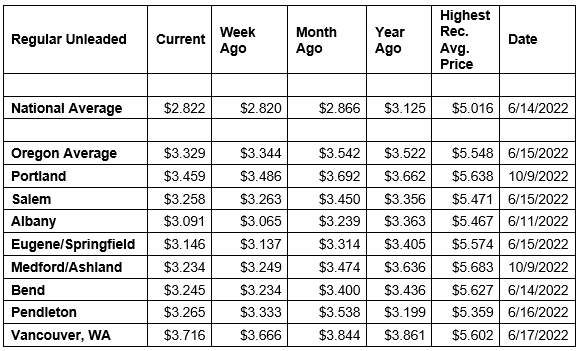
National State Local Gas Prices 1-20-26

“Crude oil prices are around $60 per barrel after spending several weeks in the mid-$50s and that’s putting upward pressure on gas prices ahead of the usual seasonal increases. For now, gas prices in Oregon and most other West Coast states continue to tick lower. However, we only have a few weeks before California begins the process to switch to summer-blend fuel, which kicks off the seasonal increases in pump prices,” says Dodds.

The Oregon average for regular gas began 2026 at $3.42 a gallon, which is the highest price of the year so far. The lowest price of the year so far is today’s price of $3.33.   

The national average began 2026 at $2.83 a gallon, which is the highest price of the year so far. The lowest price of the year so far is $2.795 on January 11.

The average price for the national average for regular gas in 2025 was $3.11 per gallon. The average price of the Oregon average for the year was $3.87.

Demand for gasoline in the U.S. gasoline increased from 8.17 million b/d to 8.30 million b/d for the week ending January 9. This compares to 8.33 million b/d a year ago. Total domestic supply of gasoline increased from 242 million barrels to 251 million. Gasoline production increased last week, averaging 9.03 million barrels per day compared to 9.0 million barrels the previous week.

Gas prices typically rise starting in mid-to-late winter and early spring as refineries undergo maintenance ahead of the switch to summer-blend fuel, which is more expensive to produce and less likely to evaporate in warmer temperatures. The switch occurs first in California, which is why pump prices on the West Coast often rise before other parts of the country. The East Coast is the last major market to switch to summer-blend fuel. Most areas have a May 1 compliance date for refiners and terminals, while most gas stations have a June 1 deadline to switch to selling summer-blend. Switch-over dates are earlier in California with some areas in the state requiring summer-blend fuel by April 1. Some refineries will begin maintenance and the switchover in February.

Gas prices usually drop in the fall, due to the switch from summer-blend to winter-blend fuel, which costs less to produce. The switch starts in September. Many areas, including Oregon, can sell winter-blend fuel starting September 15. However, Northern and Southern California require summer-blend fuel through October 31. Prices usually decline to their lowest levels of the year in late fall and early winter before increasing again in the late winter and early spring.

The U.S. price of crude oil (West Texas Intermediate) has mostly been in the upper $50s to mid-$70s since September 2024.

WTI is trading at $60 today, compared to $61 a week ago and $76 a year ago. In 2025, West Texas Intermediate ranged between $80.04 (January 15) and $57.46 (October 16) per barrel.  In 2024, WTI ranged between $66 and $87 per barrel. In 2023, WTI ranged between $63 and $95 per barrel. WTI reached recent highs of $123.70 on March 8, 2022, shortly after the Russian invasion of Ukraine, and $122.11 per barrel on June 8, 2022. The all-time high for WTI crude oil is $147.27 in July 2008.

Crude prices are impacted by economic news as well as geopolitical events around the world including the current economic uncertainty, the current situation in Venezuela, tensions over Greenland, protests in Iran, unrest in the Middle East, the conflict between Israel and Hamas, and the war between Russia and Ukraine. Russia is a top global oil producer, behind the U.S. and Saudi Arabia. Crude prices were volatile after the attack on Israel by Hamas in October 2023. While Israel and the Palestinian territory are not oil producers, there were concerns that the conflict could spread in the Middle East, which could potentially impact crude production in other oil-producing nations in the region. Crude oil prices declined after October’s fragile peace agreement between Israel and Hamas. In addition, production cuts by OPEC+ in previous years tightened global crude oil supplies, which continued to impact prices. But in 2025, the cartel boosted production which put downward pressure on crude oil prices. For 2026, OPEC+ says it’s not planning any production hikes in the first quarter of the year due to lower demand.

Crude oil is the main ingredient in gasoline and diesel, so pump prices are impacted by crude prices on the global markets. On average, about 47% of what we pay for in a gallon of gasoline is for the price of crude oil, 16% is refining, 20% distribution and marketing, and 17% are taxes, according to the U.S. Energy Information Administration.

Meanwhile, crude oil production in the U.S. remains at or near record highs. The U.S. Energy Information Administration (EIA) reports that crude production in his country is at 13.76 million barrels per day for the week ending January 9. Production has been at 13.5 million barrels per day many times since October 2024. The U.S. has been the top producer of crude oil in the world since 2018 and has been increasing its oil production since about 2009.

Quick stats

Oregon is one of 27 states and the District of Columbia with lower prices now than a week ago. Ohio (-8 cents) has the largest week-over-week decrease in the nation. Colorado (+10 cents) has the biggest week-over-week increase in the country.

Hawaii ($4.41) has the most expensive gas in the nation for the sixth week in a row. California ($4.20) is second. These are the only states with averages at or above $4 a gallon. This week five states and the District of Columbia have averages in the $3-range. There are 43 states with an average in the $2 range this week.

The cheapest gas in the nation is in Oklahoma ($2.31) and Arkansas ($2.43) and. No state has had an average below $2 a gallon since January 7, 2021, when Mississippi and Texas were below that threshold. At the time, the COVID-19 pandemic drove significant declines in crude oil and gasoline demand in the U.S. and around the world.

The difference between the most expensive and least expensive states is $2.10 this week, compared to $2.19 a week ago.

Oregon is one of 40 states and the District of Columbia with lower prices now than a month ago. The national average is four cents less and the Oregon average is 21 cents less than a month ago. Oregon has the largest month-over-month decline in the nation. Michigan (+19 cents) has the largest month-over-month increase.

Oregon is one of 49 states and the District of Columbia with lower prices now than a year ago. The national average is 30 cents less, while the Oregon average is 19 cents less. Wisconsin (-46 cents) has the largest year-over-year drop in the nation. Alaska (+15 cents) is the only state with a year-over-year increase.

West Coast

The West Coast region continues to have the most expensive pump prices in the nation with six of the seven states in the top 10. It’s typical for the West Coast to have six or seven states in the top 10 as this region tends to consistently have fairly tight supplies, consuming about as much gasoline as is produced. In addition, this region is located relatively far from parts of the country where oil drilling, production and refining occurs, so transportation costs are higher. And environmental programs in this region add to the cost of production, storage and distribution.

Rank
Region
Price on 1/20/2026

1
Hawaii
$4.41

2
California
$4.20

3
Washington
$3.81

4
Alaska
$3.45

5
Nevada
$3.36

6
Oregon
$3.33

7
District of Columbia
$3.10

8
Pennsylvania
$3.03

9
Vermont
$2.99

10
New York
$2.98

As mentioned above, Hawaii has the most expensive gas in the country for the sixth consecutive week. California, Washington, Alaska, Nevada, and Oregon round out the top six. Arizona is 11th. Oregon is sixth for the second week in a row.

Five of the seven states in the West Coast region have week-over-week decreases: Alaska (-4 cents), Oregon (-2 cents), Hawaii (-1 cent), California (-1 cent), and Arizona (-1 cent). Washington (+2 cents) and Nevada (+1 cent) have small week-over-week increases.

The refinery utilization rate on the West Coast climbed from 80.0% to 84.4% for the week ending January 9. This rate has ranged between about 70% to 93% in the last year. The latest national refinery utilization rate rose from 94.7% to 95.3%.

The refinery utilization rate measures how much crude oil refineries are processing as a percentage of their maximum capacity. A low or declining rate can put upward pressure on pump prices, while a high or rising rate can put downward pressure on pump prices.

According to EIA’s latest weekly report, total gas stocks in the region increased from 31.35 million bbl. to 31.60 million bbl. for the week ending January 9. An increase in gasoline stocks can put downward pressure on pump prices, while a decrease in gasoline stocks can put upward pressure on pump prices.

Oil market dynamics

Crude oil prices are again above $60 this week as investors weigh the Greenland situation and President Trump’s threats of tariffs on European nations, unrest in Iran, he impacts from the U.S. action in Venezuela and how it might impact that country’s large oil reserves, and the ongoing war between Russia and Ukraine.

Meanwhile, the EIA reports that crude oil inventories decreased by 3.8 million barrels from the previous week. At 419.1 million barrels, U.S. crude oil inventories are about 3% below the five-year average for this time of year. 

At the close of Friday’s formal trading session, WTI gained 25 cents to close at $59.44. U.S. markets were closed Monday in observance of Martin Luther King, Jr. Day. Today crude is trading around $60, compared to $61 a week ago. Crude prices are about $16 less than a year ago. ($75.89 on January 21, 2025)

Drivers can find current gas prices along their route with the free AAA Mobile app for iPhone, iPad and Android. The app can also be used to map a route, find discounts, book a hotel and access AAA roadside assistance. Learn more at AAA.com/mobile.

Click here to follow the original article.

Record-Breaking Amount of Passengers Traveled Through SLO County Airport in 2025

Dave Alley

SAN LUIS OBISPO, Calif. (KEYT) – A record-breaking amount of passengers traveled through the San Luis Obispo County Airport (SBP) in 2025.

Over the course of the year, the airport saw 811,905 passengers use the county-operated facility, marking a 8.7% increase from the previous year.

“The record-breaking passenger total is an exciting reflection of our region and a strong local economy,” said Dawn Ortiz-Legg, San Luis Obispo County Third District Supervisor and Board Chair. “Reliable air service is essential not only for welcoming visitors, but also for supporting our business community by providing critical access to and from San Luis Obispo County. This level of growth highlights the airport’s role as an economic engine for the region and a key connector for residents, businesses and visitors alike.”

The number of passengers for 2025 is more than 65,000 than the total in 2024, and more than 151,000 who used the airport in 2023, representing a nearly 23% increase in just two years.

The airport currently offers several direct daily flights to seven year-round destinations including to Los Angeles, San Diego, Phoenix, Seattle, Portland, Denver and Dallas, with Las Vegas as an eighth destination on a seasonal basis.

Commercial airlines who provide air service at SBP include United Airlines, American Airlines and Alaska Airlines.

“Reaching this historic passenger total is only possible because of the extraordinary teamwork that takes place at the SLO County Airport every day,” said San Luis Obispo County Airports Director Courtney Johnson. “I am deeply grateful to our County staff, airline partners, rental car agencies, concessionaires, CAL FIRE, our air traffic control tower operators, and all those who work behind the scenes to ensure safe, reliable, and welcoming operations for our community and visitors.”

For more information about the San Luis Obispo County Airport, click here to visit the SBP website.

The Latest Breaking News, Weather Alerts, Sports and More Anytime On Our Mobile Apps. Keep Up With the Latest Articles by Signing Up for the News Channel 3-12 Newsletter.

Click here to follow the original article.