Why some felt Indio Hills earthquake before their phones alerted them

Garrett Hottle
INDIO, Calif. (KESQ) A magnitude 4.9 earthquake shook Indio Monday night, rattling residents across the Coachella Valley but causing no major damage or serious injuries — while also raising fresh questions about how California’s Earthquake Early Warning system works and why alerts reached some people before the shaking, but not others.

The quake struck near Indio Hills at 5:56 p.m., sending a brief but noticeable jolt through homes, businesses, and senior centers in the area.
“It was strong. And my husband, he has dementia. He was upstairs, so I got all scared,” Rosalva Gomez.
Others described a sudden, unsettling movement rather than prolonged shaking.
“My bed started shaking… and the dogs started barking,” Mary Ramirez said. “It was the first time I felt an earthquake here in the desert… it was scary,” Gloria Hernandez said.
The U.S. Geological Survey placed the epicenter along the San Andreas Fault — the major fault line that runs through the Coachella Valley. Local geologists say that stretch of the fault typically produces “strike-slip” earthquakes, meaning the ground moves sideways rather than up and down.

That motion is what residents felt Monday night.
Monday’s quake contrasted sharply with the 1994 Northridge earthquake, a magnitude 6.7 event that killed about 60 people and caused widespread structural damage and freeway collapses in Los Angeles. Unlike Monday’s strike-slip event, Northridge was a “blind thrust” earthquake — an upward-shoving rupture on a buried fault beneath the San Fernando Valley.

For many viewers, the bigger question Tuesday was not how the earth moved, but how their phones did.
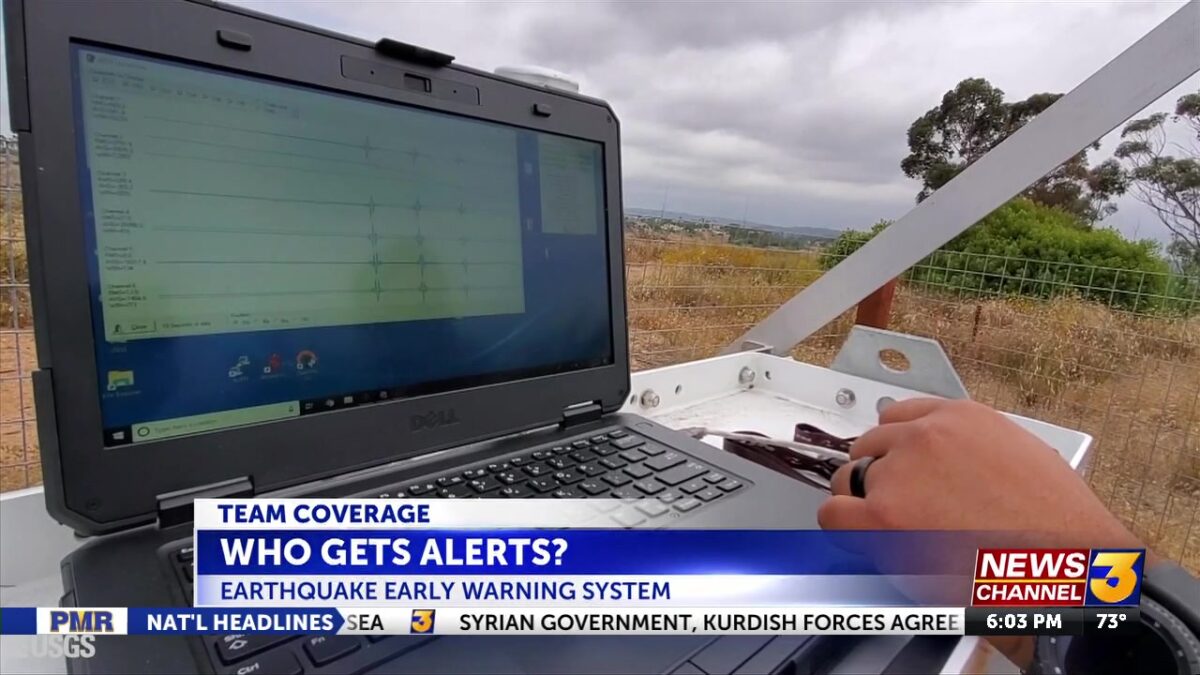
Unlike in 1994, California now operates an Earthquake Early Warning system powered by ShakeAlert, designed to detect the first, lighter tremors of an earthquake and send alerts before stronger shaking arrives.
But those alerts do not reach everyone at the same time.
Derek Lambeth, program manager for Earthquake Early Warning at the California Governor’s Office of Emergency Services (Cal OES), said the timing depends largely on distance from the epicenter.
“If you’re right at the epicenter, we can’t give you that heads-up… but if you’re farther out, we can give you up to tens of seconds to drop, cover, and hold on,” Lambeth said. lambeth
He stressed that even a few seconds can make a difference.
“You may not always get ten seconds, but you’d be amazed at how quickly you can react,” Lambeth said. “Seconds matter.” lambeth
Cal OES officials warned that aftershocks are common in the days following a quake of this size and urged residents to prepare in advance.
“Earthquakes are unpredictable,” Lambeth said. “The best thing people can do is sign up for alerts like the MyShake app, put together a go-kit, and have a plan for your family or workplace.”
You can find out more information including how to download the MyShake App, here.
To sign up for local alerts and find more information on preparedness and resources, visit https://earthquake.ca.gov/