I-Team Investigation: AI on Patrol

Angela Chen
COACHELLA VALLEY, Calif. (KESQ) – If 2025 was the year of dipping our toes into AI, then 2026 is the year we jump in. AI has crept into almost every industry, forcing a reckoning with how some professionals do their job.
But for law enforcement, agencies across the nation have yet to incorporate regular AI use in operations.
As you can imagine, the stakes are high.
“We got to verify that there’s no mistakes,” said Capt. Gus Araiza of the Palm Springs Police Department.
A new survey though by Mark43, an AI-powered public safety platform, shows there’s definite interest.
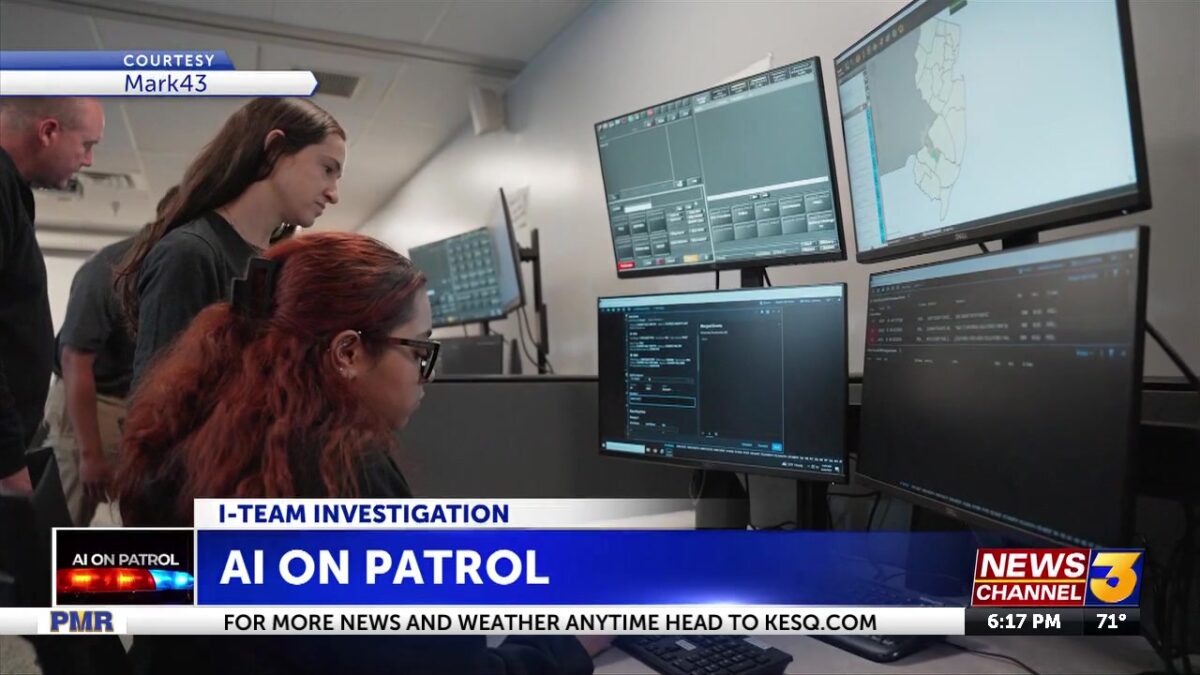
“I view AI as a great enabler and as a community member. If you think about it, when you call for an emergency response or assistance, you want public safety and law enforcement to have all of the information that is available,” said Wendy Gilbert, the Senior Vice President of Product at Mark43.
The survey was based on responses from about 500 public safety professionals across America and showed:
93 percent want to adopt AI to improve analytics and decision-making.
92% believe AI is transforming public safety for the better
93 percent trust agency leadership to use AI responsibly
“89% of them indicated that they actually think that AI can aid in crime reduction. And you know, another interesting statistic was that over 60% said they’re actually using AI currently in some capacity within their operation,” Gilbert said.
Two police agencies already using AI in the valley? Palm Springs and Indio.
“Right now, our AI technology is kind of limited to our drones. More recently, we had an incident at our high school where there was basically a threat was issued, and AI technology, what it does is identify humans that are basically a person that might be in that area,” Araiza said. “So in that situation, it was something that the pilot didn’t see, but the technology alerted them, and then they were able to confirm that.”
The Indio Police Department is also using AI to assist in operations, with the goal of making workflows more efficient.
“We are using AI. Currently, our dispatch center is using a system for non-emergency calls. They intake the calls, and while people are reporting their their crime, if it’s a non emergency, the AI is able to ask that information and gather it for a dispatcher to leave them available for emergency calls,” said Doug Haynes, a lieutenant with the Indio Police Dept.
“Is this a live person taking it and then AI is assisting? Or is it AI answering calls?”
When morning anchor Angela Chen asked if it was a live person taking the calls with AI assisting or AI itself answering the calls, Haynes said, “It’s AI answering the calls. Dispatch is able to monitor it, and they can take over if they need to, or the person that’s calling, they can say they need to talk to a dispatcher, and then it’ll go straight to a dispatcher.”
Currently, one of the biggest uses of AI for police across the nation is writing reports after an incident, something officers say is often the most time-consuming part of their day.
At this time — no valley agencies use AI to help write reports.
“Our shifts…are 12 hours, and I would estimate they probably spend at least three hours writing reports frequently. They’re holding over on their shifts to get those reports completed. So that’s overtime, and also officer burnout,” Haynes said.
“Many police officers, while they’re on patrol, write reports, and that process can take hours,” Gilbert said. “We’re able to then prompt the officer for specific information to complete that report for their department compliance, to make sure that everything that is needed before they ever submit that report for supervisor, review and approval is complete.”
Mark43 and police departments are careful to say these reports are still reviewed and edited by humans to check for accuracy and comprehensiveness.
“Most agencies are facing a staffing shortage, I mean, that’s how you multiply. It’s like a false multiplier, right? It’s not intended to replace the officers on the street, but it’s intended to speed up the work that is done,” Araiza said.
But with AI comes a host of concerns. It has to be used responsibly — with public accountability and transparency at the forefront. AI is often built from historical information, so how do police make sure past biases don’t affect AI and police outcomes?
“Starting with the acceptable use policy, so that everyone understands the technology is a good step one,” said Gilbert. “Number two is objective training of the models to ensure that there is no bias in the data, because… based on specific potentially geographies or within a specific area, you may start to see a bias.”
“There are safeguards built into many of these systems to ensure that the officers are reading through reports that they’re verifying the information that’s provided by AI. We definitely can’t do any full system that’s that’s totally AI, because you can’t remove the human from it,” Haynes said.
We asked all Coachella Valley law enforcement agencies about their AI use — whether each department is exploring whether to use it or if they’re already using it. Here are the responses from each agency:
Palm Springs Police is already using with caution — in drone and license plate tech. they are evaluating more AI use this year.
Cathedral City Police said it is not currently using AI but that it’s exploring the possibility — and that if it considers integrating AI, it will “do so carefully, evaluating their usefulness while adhering to department policy and complying with all legal requirements.”
Desert Hot Springs Police are not using AI but also evaluating future use.
The CHP had no comment on the issue.
Indio Police said it is already using AI in dispatch and license plate operations — and carefully considering other AI tech this year.
Riverside County Sheriff’s Office, the largest law enforcement agency here, is using it for facial recognition, analyzing DNA, identifying crime patterns, optimizing patrol based on historical data, non-emergency calls, drones and more. The Sheriff’s Office was clear that AI is not used for autonomous law enforcement decision-making.
All law enforcement agencies were adamant that if they implement new AI tech, that they would do so carefully and responsibly with acceptable use policies, while making sure it operates within ethical and legal frameworks.
With the integration of AI into modern tech, often making operations more efficient with the possibility of higher successful outcomes, it seems agencies have to adapt or fall behind. But Indio Police are quick to remind the public that machines will never replace people.
“You have to have that human involvement, that human that makes sure that everything is accurate,” Haynes said.