Hawaii’s new macadamia nut label law highlights local pride

By Kimber Collins
Click here for updates on this story
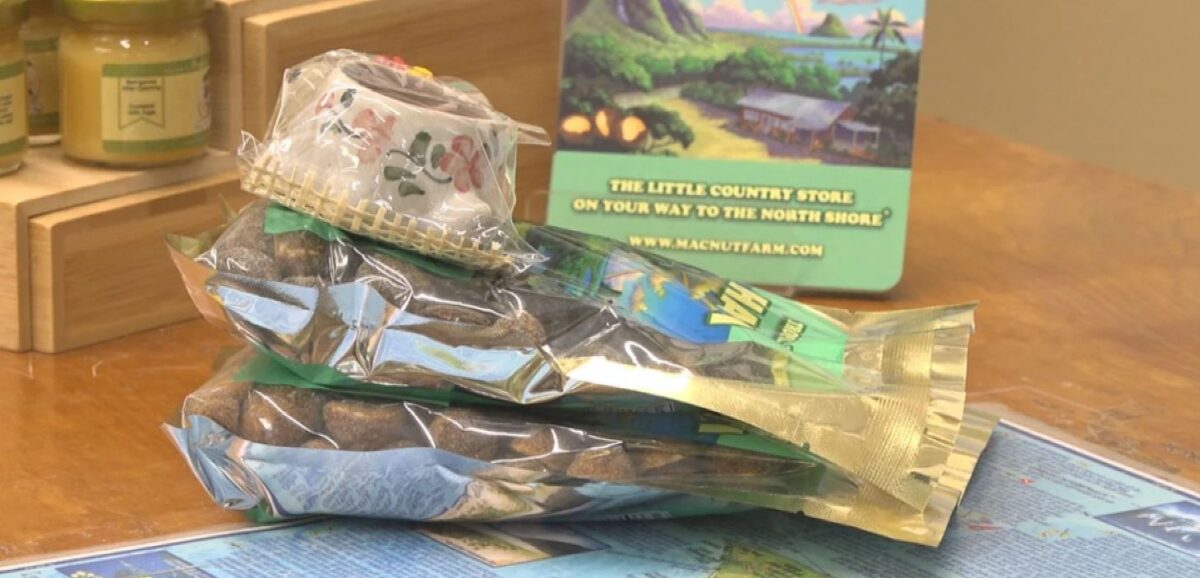
HONOLULU (KITV) — A new Hawaii law that took effect Jan. 1 is changing how macadamia nuts are labeled, and for local growers, it’s about protecting what makes their product different.
Act 199 requires that any macadamia nut package sold in Hawaii include a statement if the product contains nuts grown outside the state. The required wording reads: “This package contains macadamia nuts that were not grown in Hawaii.”
Richard Cohen, Measurement Standards Program Manager for the Department of Agriculture and Biosecurity, said the law is designed to give consumers truth in labeling.
“It requires any supplier or packager of macadamia nuts in the state of Hawaii to add a statement to the package if there are foreign macadamia nuts… and the statement is, ‘This package contains macadamia nuts that were not grown in Hawaii,” Cohen said.
The law is limited in scope. Cohen explained that products where macadamia nuts are not the primary ingredient – such as breads, cookies, energy bars, other baked goods, candies, milk and even ice cream—do not need to carry the label.
For local farms like Tropical Farms near Kaneohe, which grow and process all of their nuts in Hawaii, the law has been a point of reassurance and pride.
“Now we understand that us Tropical Farms as a business, we really don’t have to change anything, because all of our nuts are 100% grown and processed here in Hawaii,” said Stevie-Jean Tufaga, President and General Manager of Tropical Farms.
Tufaga said the law provides an opportunity for farms that are entirely Hawaiian-grown to stand apart in a market that also includes imported nuts.
“We’re definitely going to put that on there because now we understand that perhaps some people are bringing in nuts from elsewhere. So it makes us stand out for sure.” Tufaga said.
Cohen added that the law ensures local farmers are represented accurately in the marketplace.
“The Hawaiian macadamia nut farmer is presented truthfully to the consumer… and they’re not being substituted as if they were Hawaiian macadamia nuts,” Cohen said.
For growers, it’s about more than labeling, it’s about supporting Hawaii agriculture and the local economy.
“It does add value to Hawaii and Hawaiian grown products… supporting the farmers, which then support the businesses and all of the employees that work here with us,” Tufaga said.
With the new law in place, shoppers now have a clearer way to know exactly what they’re buying, while Hawaiian macadamia nut farms can continue to promote the quality and heritage of their 100% locally grown products.
Please note: This story was provided to CNN Wire by an affiliate and does not contain original CNN reporting. This content carries a strict local market embargo. If you share the same market as the contributor of this article, you may not use it on any platform.