Legal experts question ICE agent’s self-defense claim in deadly Minneapolis shooting

Erika McGuire
COLUMBIA, Mo. (KMIZ)
Legal experts are weighing in on the deadly shooting in Minneapolis involving an ICE agent that left one woman dead on Wednesday.
United States Immigration and Customs Enforcement agents were on a residential street as they heighten their immigration crackdown in Minnesota. The Department of Homeland Security claims the ICE agent shot the woman in self-defense, alleging the woman was trying to run them over. Others claim the woman was attempting to drive away from the scene.
The woman was later identified by Minneapolis city officials as Renee Nicole Good. The Honda driven by Good was registered out of Kansas City and the Missouri Department of Revenue told ABC 17 News on Wednesday afternoon that one of the two names the vehicle was registered to was Renee N. Good Macklin.
Video circulating online shows the moments leading up to the shooting, sparking mixed reactions.
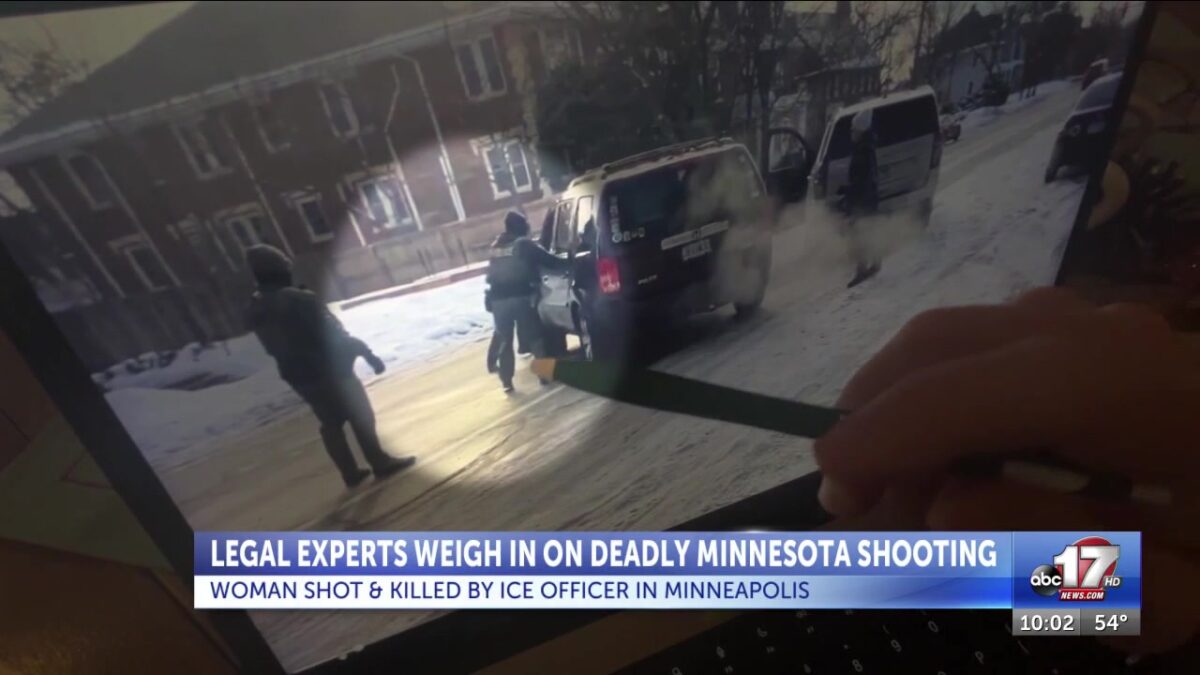
Former Cole County Prosecutor Bill Tackett reviewed the video with ABC 17 News to give his legal perspective on the shooting.
Tackett says in self-defense cases, attorneys examine whether the person who fired the weapon reasonably believed they were in danger of death or serious physical injury.
“This agent right here is off to the side. He started in front of the vehicle, but the first shot has not been fired,” Tackett said. “He’s shooting from the side, not the front. This wheel is turned. The car is pulling away. That’s the first shot, his feet are clear over here, he’s on the side of the vehicle now.”
“If he’s in front of the car, if he’s have been there and she pulled directly at him then he could fire as many times as you want, nobody would say a word here,” Tackett noted.
 Former Cole County Prosecutor Bill Tackett points at a screen showing a video of an ICE agent near a Honda Pilot seconds before the agent opened fire and killed a woman on Wednesday, Jan. 7, 2026, in Minneapolis, Minnesota.
Tackett added that by the second and third shots, the ICE agent was feet away from the vehicle, which Tackett claims did not justify firing the weapon.
“You can’t claim that [self-defense], it seems to me. I would not ,as a prosecutor, you want to have this as a ‘proper use of deadly force’ based on this video, because the position of his feet when he shoots,” Tackett said. “There’s too many avenues to stop the vehicle and make this arrest without putting three bullets in the head of the driver when there just isn’t that threat.”
Defense attorney Dan Viets agreed with Tackett’s perspective on the video.
“He was not in front of the vehicle, she was not coming toward him. She was, if anything, trying to get away,” Viets said. “It’s obvious there is no threat to the shooter or to any other officer. That video makes clear this was an instance of cold-blooded murder.”
With protests happening across the country, questions about people’s rights are taking center stage.
Both Tackett and Viets say everyone has a Constitutional right to express themselves, with political speech protected under the First Amendment. If law enforcement approaches a demonstrator, Tackett says it’s important to cooperate.
“You have to identify yourself to law enforcement, really at any time, if they’re approaching you. So locking the door and not communicating is going to cause a problem and they do have a right at that point because they don’t know whether you have a gun, they don’t know what your motive is, what you’ve done,” Tackett said.
Viets offered a different perspective.
“There’s no obligation to do so. There’s no law that requires us to show our identity, to show our papers to government agentsl unless you’re driving a motor vehicle. In which case, you do, of course. You have to produce a driver’s license,” Viets said.
If law enforcement approaches a person’s home, Viets says a the resident does not have the obligation to open the door unless law enforcement has a search warrant signed by a judge.
Tackett gave another perspective on if a law enforcement officer approaches a vehicle.
“Not when an officer is telling you to stop the car, he’s investigating. At that point you would have to stop the vehicle,” Tackett said. “In a perfect world, she would have stopped and identified herself, she should have done that. But then the officer, from what I’ve seen of this video, was not in imminent danger of death or serious fiscal injury.”