The Krumbah family speaks out after court grants supervised release to son’s killer

By Dan Hanson
Click here for updates on this story
RICHLAND, Wash. (KAPP) — A Benton County judge has granted supervised community release to the man found not guilty by reason of insanity in the killing of a Richland Instacart driver, allowing him outings from a state mental hospital despite strong objections from prosecutors and the victim’s family.
Aaron Kelly, who was diagnosed with schizophrenia, will now be permitted supervised outings with hospital staff and unescorted movement on the grounds of Eastern State Hospital in Centralia, where he has been confined since being found not guilty by reason of insanity in February 2024.
On Dec. 31, Benton County Superior Court Judge Jackie Stam granted Kelly’s request for “limited conditional release,” nearly three years after he shot and killed Justin Krumbah while the victim was working as an Instacart delivery driver at the Richland Fred Meyer on Feb. 7, 2022. Kelly also seriously wounded store employee Mark Hill in the random shooting.
The decision has reopened wounds for Krumbah’s family and reignited community safety concerns about the random nature of the violence that shocked the Tri-Cities area.
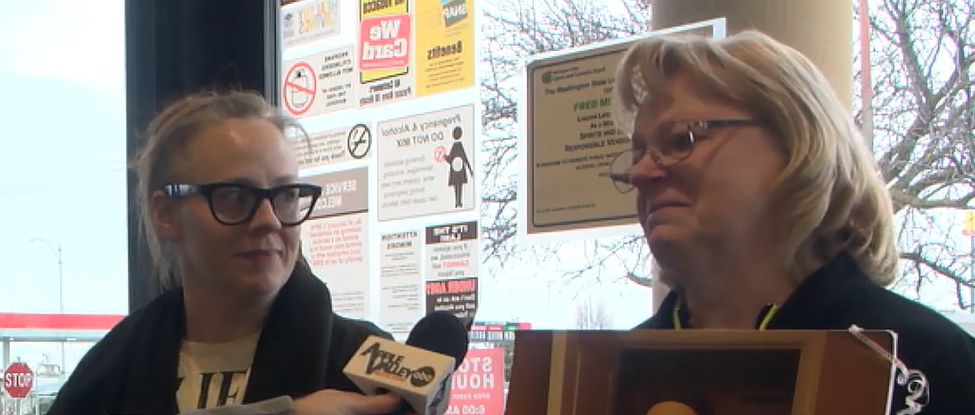
“We’ve always been taught to be responsible for our own actions and to be punished if we do something wrong, and I don’t feel like he’s being punished,” said Karen Mullins, Krumbah’s mother. “We no longer have Justin, and he gets to do basically whatever he wants.”
Krumbah’s sister, Krista Schaaf, remembered her brother as energetic and loving.
“ADHD in a bottle, but fun. He was all over the place. He was the best brother, the best uncle, the best friend. He was amazing, there’s just no other way to put it. You can ask anybody,” Schaaf said. Schaaf also sent Apple Valley News Now a statement she wrote with the support of her family:
“In our opinion, we have felt very unheard and felt we did not get the best representation we could have gotten through this process. The whole prosecution team was slowly phased out with job changes and retirement, as well as never having the same judge two hearings in a row; possibly overlooking crucial information as they “briefed” the case ahead of time. While Kelly was at Eastern State Hospital, he had multiple evaluations done, one in which Dr Yocum made a note that the hospital described Kelly as an “escape risk” due to the “very intricate maps” he previously drew of the hospital’s grounds, including the “surrounding hills, landscape, and where [patients] and staff congregate.” This was noted at a high-level security hospital, where Kelly was transferred to Western State Hospital and then again to Maple Lane. Maple Lane, which, according to their website, “[e]ntrances and exits are controlled by staff. The outdoor spaces for the residents are enclosed by fencing.” Not a highly secure facility, which I feel this individual needs.
Another important fact was another evaluation by Dr Brooke England states, “Mr. Kelly denied substance use, and this was confirmed by his friend, who reported only occasional experimentation with marijuana in college and no evidence of significant use before his arrest.” If this is the extent of his substance abuse, why such a need for treatment, which is off campus, to the hospital where he is placed? This supposedly is one of the needs for off-ground privileges?! In the last evaluation done by Dr. Wendi Wachsmuth before the final competency hearing, she states, “his greatest asset, intelligence, is also a liability for him and his success in treatment. There is a high likelihood that he will convince not only himself, but anyone untrained, of the diagnosis and treatment of mental illness and violent behavior, that he no longer needs treatment. Given the nature of his delusional belief system and his ability to mask his disorder from others, should he discontinue treatment, his likelihood of repeating similar acts is greatly increased from what is already considered high.” I don’t believe either doctor who evaluated him lately has worked with violent offenders, like those in the prison system, which I felt should be an extra priority, given prior information. Given these obvious factors, we believe the current prosecutors have effectively thrown in the towel and have denied the information and pro bono assistance Andy Miller offered to help get the case to trial, rather than agreeing to the insanity plea. It has made it especially difficult to navigate this process, trying to do what’s most important: getting justice for Justin. We believe that, given Eisinger’s lack of experience, he is not fit for the position and should resign to protect the community from individuals like Kelly.” – Krista Shaaf with support of her family.
Kelly applied for the conditional release on Feb. 20, 2024, about a year after his insanity verdict. Under the court’s order, Kelly can now visit restaurants and businesses with a staff escort from Eastern State Hospital and move freely around the hospital grounds without supervision.
The release comes with strict conditions tied to his ongoing mental health treatment and public safety. Kelly must remain in the care of the Department of Social and Health Services, adhere to his treatment plan, and attend therapy. He must remain in sight during supervised outings and requires court and hospital permission to leave Washington state. His release privileges may be revoked for noncompliance with hospital rules or for posing a safety risk.
Benton County Prosecutor Eric Eisinger opposed the release, arguing Kelly had not spent sufficient time in treatment and expressing concerns about public safety.
“With a staff escort from Eastern State Hospital, he can go into restaurants and businesses and engage with the public. I’ve had a lot of concerns about whether that would be safe to do throughout this litigation. As you remember it was only in February of 2024 he was found to be not guilty by reason of insanity,” Eisinger said.
However, multiple state agencies and independent mental health experts supported Kelly’s request, determining his likelihood of reoffending was “relatively low.” After an independent evaluation called a risk review board backed the recommendation, Eisinger said he had limited legal options.
“The law requires me to come forward with an expert that says it’s not appropriate, and here’s why, and after everybody weighed in and we had two separately hired experts that we paid for out of our county budget, we simply weren’t able to put on that kind of testimony,” Eisinger said.
The case has heightened community safety concerns due to the random nature of the violence. Kelly had no prior interaction with Krumbah and no known interaction with Hill. The shooting occurred in an everyday public setting, creating a sense of vulnerability among residents.
Community anxiety was further fueled by Kelly’s history of concerning behavior that had not led to significant legal intervention before the shooting. This included a previous burglary charge that was dismissed and a denied protection order request from a former roommate who accused him of unlawful harassment.
The victim’s family has criticized the prosecutor’s handling of the case. Schaaf questioned why Eisinger, a newly elected prosecutor, didn’t seek additional help with such a significant case.
“Why deny the help you obviously needed and could’ve used to fight your first huge case, especially a murder case like this?” Schaaf asked.
Eisinger defended his office’s efforts, saying they opposed the release as strongly as possible within legal constraints.
“I think the family is grieving. I think they’re upset, and I understand. I understand that they’re upset because this was terrible. At the same time, we developed our case and have opposed this as strongly as we could have,” Eisinger said.
For Krumbah’s family, each court proceeding reopens their trauma.
“It’s a new normal…something we just have to deal with. I mean, there’s no rule book, there’s no…we go…it’s day by day, and just about the time we heal or start to heal, then another court thing comes up and rips off the band-aid, and we start all over again,” Mullins said.
Under Washington state law, individuals found not guilty by reason of insanity are committed to secure mental health facilities rather than prison. The prosecutor’s office must be informed if Kelly requests greater freedom in the future.
Kelly remains in state custody and cannot leave Washington without court approval. The court noted that future reviews could further adjust those privileges, meaning the case could return to court if concerns are raised by hospital staff or prosecutors.
The Feb. 7, 2022, shooting shocked the Tri-Cities community when Kelly walked into the Fred Meyer store and opened fire. Kelly was found not guilty by reason of insanity on Feb. 12, 2024, and was immediately committed to Eastern State Hospital, where he has remained under supervision in a locked facility until this recent court decision.
Please note: This story was provided to CNN Wire by an affiliate and does not contain original CNN reporting. This content carries a strict local market embargo. If you share the same market as the contributor of this article, you may not use it on any platform.