New report paints grim picture of water use problems with Colorado River

By Alan Gionet

Click here for updates on this story

    COLORADO (KCNC) — A new report compiled by the University of Colorado’s Colorado River Research Group warns that threats to the river’s water supply are now so severe that they pose a significant risk to the water supply in seven Western states and tribal areas, potentially impacting the economy and governance.

The report is titled “Colorado River Insights 2025: Dancing with Deadpool.” It is a compilation of reports by a variety of experts looking at different aspects of high demand and supply shortages that have led to low water levels in places like Lake Powell and Lake Mead. These issues threaten both power generation and supply.

“What’s missing is urgency. The window for decisive, collaborative action is closing fast,” said Douglas Kenney, director of the Western Water Policy Program of the Getches-Wilkinson Center at the University of Colorado Law School and chair of the Colorado River Research Group.

This warning comes after more than two years of re-negotiation of a 100-year-old water use pact that sets aside water for use by Western States, native tribes, and even Mexico, missed a November deadline for cutting a deal. That deadline is now pushed back to Feb. 14, 2026.

“The Colorado River Compact of 1922 has some language in it about how much water must move from the upper states to the lower states, and we’re getting very close to dropping below the threshold specified in that compact,” said Kenney.

At a conference in Las Vegas, Kenney said he was reading the room, and there were still vast divides.

The lengthy report has a series of conclusions that paint an ugly picture of the future. Reservoirs that formerly stored four years of river flows are currently more than two-thirds empty. The report indicates that a single dry year or two could jeopardize hydropower, water deliveries, and even physical conveyance downstream as Lake Powell and Lake Mead fall below critical thresholds.

“The problem is that there is more water that’s been promised to people than has ever existed, and that will ever exist. I mean, it’s just a simple case of everyone can’t have what they were promised, and so the solution to that is everyone needs to agree to take less than they were promised,” said Kenney.

But the political will to do so has been hard to generate. The Upper basin states – those that use less water than they add to the river system, Colorado, Utah, Wyoming and New Mexico- are loath to give up rights to claim water for use. Colorado maintains that it has never used all the water it was allowed to under the 1922 pact.

Lower basin states are primarily consumers of Colorado River water. They are Arizona, Nevada and California. California is a major consumer, and much of the water goes to agriculture, over 70%. California uses more than 50% of the power from the Hoover Dam on Lake Mead. There are half a million acres of high water-consuming alfalfa, as well as winter vegetables and other crops, in the state’s Imperial Valley. Farmers are faced with the potential of growing less thirsty crops, but say they should not be alone in cuts.

The original pact was negotiated at a time when the Colorado River had more water, and there was far less population in the Western States. Experts in the report note that climate change has been part of the cause of reductions in available water.

“In the last 25 years, the flows in this basin are down about 20% from what they were the previous century,” said Kenney. “And that correlates quite closely with the fact that this basin got a couple degrees hotter. You know, the whole world got hotter, but parts of this basin got even hotter than that.”

The report indicates that more heat means more rapid evaporation of snowpack, so even if the snowpack is the same, less gets into the basin. Growing seasons are longer, and the vegetation takes more moisture for growth, rather than re-supplying the basin.

Kenney says the Federal Bureau of Reclamation may need to play a bigger role.

“I’ve been writing about this since 1991. I mean, my God, that’s 35 years ago,” said Kenney.

“This is just like driving a car at two miles an hour toward a cliff in the distance, and now we’re right up against that cliff, and we still don’t have the good sense to put our foot on the brake. I mean, it’s just so frustrating, because we’ve had so much warning that this was coming.”

Please note: This story was provided to CNN Wire by an affiliate and does not contain original CNN reporting. This content carries a strict local market embargo. If you share the same market as the contributor of this article, you may not use it on any platform.

Chinook salmon returning to Alameda Creek in Niles Canyon


KPIX

By Ryan Yamamoto

Click here for updates on this story

    SAN FRANCISCO (KPIX) — Almost every day, you will find amateur photographers Dan Sarka and David Young traversing the trails around Alameda Creek, looking to capture and document the return of Chinook salmon in the Niles Canyon area.

“I catch more fish with cameras than I do with a hook,” joked Young. “I used to liken it to a kid in a candy factory, but it’s better, it’s better.”

Sarka would agree, and will patiently spend two to three hours staring at the creek, hoping for any sign of salmon.

“We are looking for ripples in the water,” Sarka said. “And when you see it, it is total excitement to see those fish struggling to make it up into the watershed and beyond. It is a fabulous experience.”

Together, the pair have taken dozens of photos of salmon, including the most recent migration through the creek, which began this fall.

Young even recorded a video of a salmon leaping over a weir.

“I got the final leap,” said Young. “I have several leaps before that that weren’t successful, but the very last one, he leapt all the way across and made it by, you know, a good 2 to 3 feet.”

The return of Chinook salmon has been a historical and pivotal moment for the region after a community of environmentalists, scientists and researchers spent the past several decades trying to restore the area’s natural habitat.

In 2022, the Alameda County Water District completed a massive infrastructure project downstream that included a series of fish ladders to help with the migration of Pacific lamprey, endangered steelhead trout and, of course, salmon.

“They’ve been showing up in big numbers, and the unique thing about them is they are highly visible,” said ACWD water planning manager Thomas Niesar. “They’re just an enigmatic fish, and they are energizing for people.”

No one is more energized than Jeff Miller with the Alameda Creek Alliance, whose group has worked with other environmental organizations to clear dams along the creek, including the final unnatural fish barrier that was removed by CalTrout and PG&E this year, creating nearly 20 miles of potential spawning habitat.

“This is the biggest run of Chinook we’ve seen,” Miller said. “And this is the first time we know since the 1950s that showed Chinook salmon could swim on their own, all the way up as far as they’ve gotten to the Sunol Valley.”

The return of the salmon is already having an impact on the ecological health of the region.

“We have already seen a family of river otters move in, there is a local bald eagle pair that comes in and gets the salmon carcasses,” said Miller. “Turkey vultures, raccoons, and we may have bears here in the next couple decades in the Bay Area.”

It will only mean more natural wildlife for Sarka and Young to document, and whose work capturing the migrating salmon has been more than just a hobby, but also an invaluable piece of research for scientists.

“We actually refer to them as citizen scientists,” said Niesar. “Those early photographs that Dan captured were critical for biologists to determine when we would expect to see the fish. If we didn’t have that data, we would have been shooting in the dark.”

ACWD is encouraging other photographers to upload their photos and videos of wildlife to study and share with researchers.

Please note: This story was provided to CNN Wire by an affiliate and does not contain original CNN reporting. This content carries a strict local market embargo. If you share the same market as the contributor of this article, you may not use it on any platform.

Chinook salmon returning to Alameda Creek in Niles Canyon

By Ryan Yamamoto

Click here for updates on this story

    SAN FRANCISCO (KPIX) — Almost every day, you will find amateur photographers Dan Sarka and David Young traversing the trails around Alameda Creek, looking to capture and document the return of Chinook salmon in the Niles Canyon area.

“I catch more fish with cameras than I do with a hook,” joked Young. “I used to liken it to a kid in a candy factory, but it’s better, it’s better.”

Sarka would agree, and will patiently spend two to three hours staring at the creek, hoping for any sign of salmon.

“We are looking for ripples in the water,” Sarka said. “And when you see it, it is total excitement to see those fish struggling to make it up into the watershed and beyond. It is a fabulous experience.”

Together, the pair have taken dozens of photos of salmon, including the most recent migration through the creek, which began this fall.

Young even recorded a video of a salmon leaping over a weir.

“I got the final leap,” said Young. “I have several leaps before that that weren’t successful, but the very last one, he leapt all the way across and made it by, you know, a good 2 to 3 feet.”

The return of Chinook salmon has been a historical and pivotal moment for the region after a community of environmentalists, scientists and researchers spent the past several decades trying to restore the area’s natural habitat.

In 2022, the Alameda County Water District completed a massive infrastructure project downstream that included a series of fish ladders to help with the migration of Pacific lamprey, endangered steelhead trout and, of course, salmon.

“They’ve been showing up in big numbers, and the unique thing about them is they are highly visible,” said ACWD water planning manager Thomas Niesar. “They’re just an enigmatic fish, and they are energizing for people.”

No one is more energized than Jeff Miller with the Alameda Creek Alliance, whose group has worked with other environmental organizations to clear dams along the creek, including the final unnatural fish barrier that was removed by CalTrout and PG&E this year, creating nearly 20 miles of potential spawning habitat.

“This is the biggest run of Chinook we’ve seen,” Miller said. “And this is the first time we know since the 1950s that showed Chinook salmon could swim on their own, all the way up as far as they’ve gotten to the Sunol Valley.”

The return of the salmon is already having an impact on the ecological health of the region.

“We have already seen a family of river otters move in, there is a local bald eagle pair that comes in and gets the salmon carcasses,” said Miller. “Turkey vultures, raccoons, and we may have bears here in the next couple decades in the Bay Area.”

It will only mean more natural wildlife for Sarka and Young to document, and whose work capturing the migrating salmon has been more than just a hobby, but also an invaluable piece of research for scientists.

“We actually refer to them as citizen scientists,” said Niesar. “Those early photographs that Dan captured were critical for biologists to determine when we would expect to see the fish. If we didn’t have that data, we would have been shooting in the dark.”

ACWD is encouraging other photographers to upload their photos and videos of wildlife to study and share with researchers.

Please note: This story was provided to CNN Wire by an affiliate and does not contain original CNN reporting. This content carries a strict local market embargo. If you share the same market as the contributor of this article, you may not use it on any platform.
Man’s body found inside partially submerged car in Lancaster


KCBS

By Dean Fioresi

Click here for updates on this story

    LOS ANGELES (KCAL, KCBS) — A man’s body was found inside a partially submerged car in Lancaster on Friday morning, hours after the region was battered by rain from a powerful winter storm.

The discovery was made at around 9:45 a.m. near 58th Street East and Avenue H-10, according to a news release from the Los Angeles County Sheriff’s Department.

Deputies said that a department helicopter was flying over the area and spotted a “blue sedan that was partially submerged following yesterday’s flooding.”

They said that due to the terrain and significant flooding that occurred, the car was not visible from the road. Deputies from Lancaster Sheriff’s Station and the Los Angeles County Fire Department were called to the location.

The man, who hasn’t yet been identified, was declared dead at the scene.

“The investigation remains ongoing,” deputies said. “No further information is available at this time.”

Please note: This story was provided to CNN Wire by an affiliate and does not contain original CNN reporting. This content carries a strict local market embargo. If you share the same market as the contributor of this article, you may not use it on any platform.

Man’s body found inside partially submerged car in Lancaster

By Dean Fioresi

Click here for updates on this story

    LOS ANGELES (KCAL, KCBS) — A man’s body was found inside a partially submerged car in Lancaster on Friday morning, hours after the region was battered by rain from a powerful winter storm.

The discovery was made at around 9:45 a.m. near 58th Street East and Avenue H-10, according to a news release from the Los Angeles County Sheriff’s Department.

Deputies said that a department helicopter was flying over the area and spotted a “blue sedan that was partially submerged following yesterday’s flooding.”

They said that due to the terrain and significant flooding that occurred, the car was not visible from the road. Deputies from Lancaster Sheriff’s Station and the Los Angeles County Fire Department were called to the location.

The man, who hasn’t yet been identified, was declared dead at the scene.

“The investigation remains ongoing,” deputies said. “No further information is available at this time.”

Please note: This story was provided to CNN Wire by an affiliate and does not contain original CNN reporting. This content carries a strict local market embargo. If you share the same market as the contributor of this article, you may not use it on any platform.
Video shows off-duty NYPD officer saving choking 1-year-old


WCBS

By Dave Carlin

Click here for updates on this story

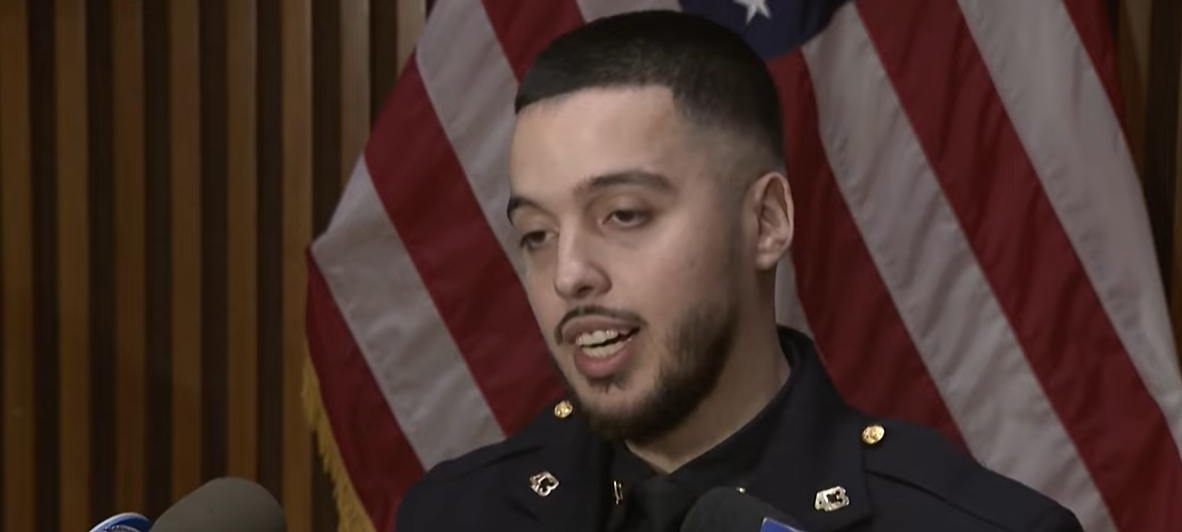
    NEW YORK (WCBS, WLNY) — An off-duty NYPD helped a frantic mother whose infant was choking.

If not for his brave actions, the baby girl might not be alive.

“I went out and saw the mom with the baby lifeless in her arms” Video from a home surveillance camera shows NYPD Officer Freddy Cerpa saving the life of the unresponsive 1-year-old girl. He checked her airway and then patted her on the back until she was breathing again. It happened on Dec. 7 at around 2 p.m.

Friday at NYPD headquarters, he spoke about his heroic actions, which he called just part of his job.

“I was home getting ready to go to work,” Cerpa said. “I hear banging on my door … ‘Please help my baby.’ I went out and saw the mom with the baby lifeless in her arms.”

The taps to the baby’s back he learned during police academy training about a year ago.

“I felt her chest go up and down, meaning that she’s starting to breathe again,” Cerpa said. “It’s an amazing feeling to know I was able to help save a baby’s life before Christmas.”

The parents knew they could get help by running to his front door because they are longtime family friends. The couple asked not to be identified.

“They gave me their gratitude about helping them and just let me know the baby’s fully recovered,” Cerpa said.

That very same week there was a similar save. On Dec. 10, NYPD Det. Michael Greaney saved a choking 8-month-old girl. That impressive rescue witnessed by many driving by along the Bronx River Parkway.

“Our mission is to preserve life, and I feel that’s the most Important part of being a police officer,” Cerpa said.

He said he will remember forever the rush of relief he felt.

Cerpa is assigned to the 43rd Precinct stationhouse in the Bronx. There’s one thing he wants every member of the public to know.

“If you have any precautions you want to take, like taking a CPR class there are resources you can find online,” Cerpa said.

That’s advice from an officer who knows when he’s off duty, he’s always on call.

Please note: This story was provided to CNN Wire by an affiliate and does not contain original CNN reporting. This content carries a strict local market embargo. If you share the same market as the contributor of this article, you may not use it on any platform.

Storm spotter remembers warning of a deadly tornado that hit North Texas towns 10 years ago


KTVT

By Bo Evans

Click here for updates on this story

    TEXAS (KTVT) — 10 years ago today, an EF-4 tornado touched down and ripped through Sunnyvale, Garland, and Rowlett, leaving more than a dozen dead.

But things could have been worse; a storm spotter watched the tornado form and alerted the National Weather Service and emergency responders immediately, no doubt saving countless lives.

“Just hate to think that people lost their lives and there was nothing we could do,” said Laszlo Laky.

10 years later, Laky still lives with the fact that 13 people were killed when an EF-4 tornado touched down in Sunnyvale.

He saw the events of that day from the beginning.

“We were warning them, and they were setting off the sirens based on what we were seeing when it first formed, so we couldn’t have done it any earlier. We saw it before it actually touched the ground,” said Laky.

The trained storm spotter called 911 as the tornado was forming

“It’s fixin’ to cross I-30. It’s fixin’ to cross I-30. We need to shut traffic down on I-30,” Laky can be heard on the 911 calls. “It’s getting bigger. God it’s huge.”

There’s no doubt Laky saved lives that night, but the memories of the ones he couldn’t save stay with him.

“Man, this is 10 years later, and I can still see that lowering and I can still see that closet, I can still see the gas station,” he said. “The closet was exposed, and there was a dress hanging that was undisturbed. How does that happen?”

But he knows that his actions that night mattered.

“That’s why we do it. The idea of spotting is to give early warning to people, give them a chance to seek cover,” said Laky.

Laky did exactly that. He gave people a chance.

Please note: This story was provided to CNN Wire by an affiliate and does not contain original CNN reporting. This content carries a strict local market embargo. If you share the same market as the contributor of this article, you may not use it on any platform.

Storm spotter remembers warning of a deadly tornado that hit North Texas towns 10 years ago

By Bo Evans

Click here for updates on this story

    TEXAS (KTVT) — 10 years ago today, an EF-4 tornado touched down and ripped through Sunnyvale, Garland, and Rowlett, leaving more than a dozen dead.

But things could have been worse; a storm spotter watched the tornado form and alerted the National Weather Service and emergency responders immediately, no doubt saving countless lives.

“Just hate to think that people lost their lives and there was nothing we could do,” said Laszlo Laky.

10 years later, Laky still lives with the fact that 13 people were killed when an EF-4 tornado touched down in Sunnyvale.

He saw the events of that day from the beginning.

“We were warning them, and they were setting off the sirens based on what we were seeing when it first formed, so we couldn’t have done it any earlier. We saw it before it actually touched the ground,” said Laky.

The trained storm spotter called 911 as the tornado was forming

“It’s fixin’ to cross I-30. It’s fixin’ to cross I-30. We need to shut traffic down on I-30,” Laky can be heard on the 911 calls. “It’s getting bigger. God it’s huge.”

There’s no doubt Laky saved lives that night, but the memories of the ones he couldn’t save stay with him.

“Man, this is 10 years later, and I can still see that lowering and I can still see that closet, I can still see the gas station,” he said. “The closet was exposed, and there was a dress hanging that was undisturbed. How does that happen?”

But he knows that his actions that night mattered.

“That’s why we do it. The idea of spotting is to give early warning to people, give them a chance to seek cover,” said Laky.

Laky did exactly that. He gave people a chance.

Please note: This story was provided to CNN Wire by an affiliate and does not contain original CNN reporting. This content carries a strict local market embargo. If you share the same market as the contributor of this article, you may not use it on any platform.

Local, statewide cleanup efforts begin after SoCal battered by Christmas storm

Athena Jreij

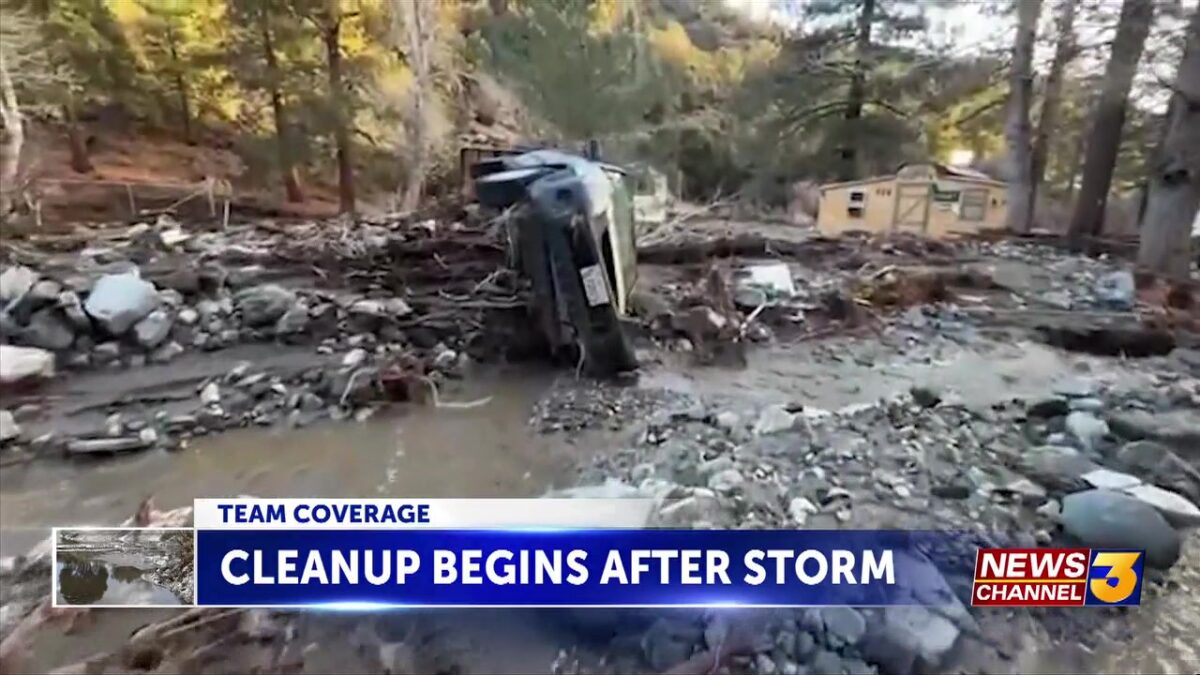
COACHELLA VALLEY, Calif. (KESQ) – This week’s Christmas storm broke records across California, with the National Weather Service (NWS) dubbing it the wettest Christmas on modern record.

Parts of the state, including here in the Valley saw flash floods, muddy roadways and in the San Bernardino mountains, devastating damage.

The NWS reports the mountains saw anywhere from 7 to 14 inches of rain from Wednesday to Friday evening.

The worst was seen in Wrightwood, a small mountain community an hour northwest of Palm Springs, that received over 10.5 inches as of Friday night.

In parts of Los Angeles, cities saw more than 3 inches of rain.

Extreme weather impacts were seen when a man was rescued from the Ventura River below the 101 freeway, and an EF-0 tornado touched down in Boyle Heights Christmas day.

Locally, several roads in Palm Springs remain closed at the wash.

Gene Autry Trail and Indian Canyon Drive both remain closed Friday night, while Vista Chino reopened Friday morning.

Crews on Gene Autry Trail recorded mud piles up to 3 feet high.

Cleanup efforts are expected to continue through the weekend. Stick with News Channel 3 for the latest updates.

Click here to follow the original article.

No snow, no sales: Local ski shops feel the heat in a low snowpack year

Marina Garcia

COLORADO SPRINGS, Colo. (KRDO) – Colorado is experiencing one of the weakest snowpack levels on record for this time of year, and that slow start is being felt here in Colorado Springs. On Friday, December 26, the snowpack statewide was 54% of the median.

USDA

Our meteorologists say you can see in the photo above that we are in the 50% range, which is low. We want to be at least in the 100% to 125% range for a decent amount of water where we won’t flood, and drought is avoidable. 

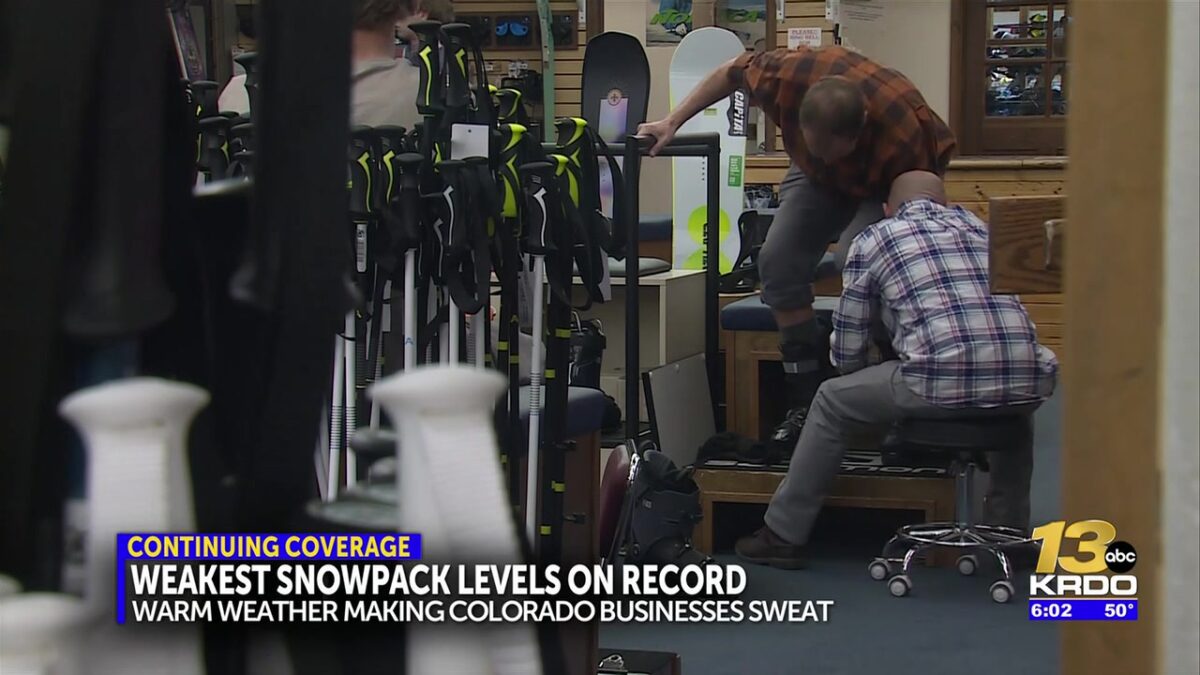
December is usually a busy time of the year for ski shops, but this season, sales are lagging. One local shop tells KRDO13 that Friday was the busiest day they’ve had all year.

At The Ski Shop, the doors are open, but the people just don’t have a need for snow gear, which is usually a hot commodity at this time of the year. Unfortunately, the only thing hot right now is the weather.

This time last year is drastically different, and locals are feeling it. Walking around in t-shirts and shorts, customers tell KRDO13 it’s strange to be getting ski and snowboard rentals in 60-degree weather.

Store owners say some years, snowboards and skis are flying off the shelves, but with some of the warmest temperatures on record this year, they say shops are feeling the brunt of it.

The Ski Shop in Colorado Springs says sales have been noticeably slower, and no snowfall is delaying gear purchases. 

“I am definitely concerned, yeah. I’ve got a lot of inventory. I’ve had a lot of ski season, but the inventory can drag me down if I don’t pay enough attention to that,” explained The Ski Shop owner, Rick Uhl.

Though one skier tells KRDO13 this won’t deter him and his family from their long-awaited trip.

“We planned this trip for a long time, and we expected a little bit more snow, but we think we’ll have fun in the mountains with what we have,” shared a shopper.

Many people tell KRDO13 the fake snow will have to do until we see those colder temperatures, which will hopefully be here this weekend.

Click here to follow the original article.