Man injured after shooting in Santa Maria

Caleb Nguyen

SANTA MARIA, Calif. (KEYT) – A shooting around 8:30 p.m. on Nov. 8 injured a 21-year-old man at the 1900 block of Noroeste Ave., according to the Santa Maria Police Department.

The man’s injuries are considered non-life-threatening and there are no additional known victims, according to the SMPD.

The SMPD also said there is no known threat to the public at this time in this ongoing investigation.

Those with more information should contact the SMPD at the following number.

Click here to follow the original article.

Exceptional Community Hospital celebrates three-year anniversary with reaffirmation event

Paul Vozzella

YUMA, Ariz. (KYMA) – After three years of providing care to the people of Yuma, Exceptional Community Hospital is marking its anniversary by strengthening its bond with the community it serves.

Hospital leaders, staff, local officials, and community members gathered at the Pivot Point Conference Center for a ceremony celebrating the hospital’s third anniversary and its continued dedication to the region.

“We are here for the long-term and here to make a difference in the care that people get,” said Bruce McVeigh, Chief Operating Officer of Exceptional Healthcare.

During the event, the hospital’s leadership team signed a Community Pledge, publicly reaffirming their commitment to quality care and community involvement.

“Everything’s about the patient and family for us,” McVeigh added. “You’ll hear that as we reaffirm our commitment to not only the town but to all the patients we take care of. It’s vitally important to celebrate that and reaffirm our commitments.”

Since opening its doors in 2022, Exceptional Community Hospital has made community outreach a priority, an effort that hasn’t gone unnoticed by local leaders.

“We all carry the weight as a community, and I see Exceptional Health doing that here in Yuma,” said Mayor Doug Nicholls.

The hospital has also earned national recognition from the Center for Improvement in Healthcare Quality for its high standards of care.

Looking ahead, Exceptional Community Hospital is continuing to expand its presence in Yuma.

“We’re soon to be opening up our first acute care surgical center on our property,” McVeigh said. “We’re here for the longterm to keep growing that campus. We have a lot of space…if you look behind the hospital, there’s 10 acres there.”

As it looks toward the future, Exceptional Community Hospital remains focused on its mission of providing compassionate, high-quality healthcare and strengthening its partnership with the Yuma community.

Click here to follow the original article.

Fort Yuma Rotary hosts annual Penitentiary Pint Fest

Dillon Fuhrman

YUMA, Ariz. (KYMA) – Fort Yuma Rotary hosted their annual Penitentiary Pint Fest Saturday evening.

The event, which took place at the Yuma Territorial Prison from 4:00 p.m. to 8:00 p.m., brought several different breweries across Desert Southwest.

There was also live music from bands like Big Boss Band and food provided by Taco El Gando.

Sal Martinez, the Brand Manager for Romer Beverage, shared how Pint Fest benefits Yuma County.

“So we’re not just promoting beers. We’re also raising money for building playgrounds, so…that’s what [Fort Yuma Rotary] put on the show and that’s this is their biggest fundraiser of the year and they build a lot of playgrounds around the county,” Martinez explained.

Attendees must have been 21 and up to attend and IDs were required, and all proceeds from the event went to Fort Yuma Rotary.

Click here to follow the original article.

Senate advances deal to reopen government after centrist Democrats strike major deal to end shutdown

CNN Newsource

By Manu Raju, Ted Barrett, Alison Main, Sarah Ferris, CNN

(CNN) — A critical bloc of eight Senate Democratic centrists on Sunday helped advance a funding deal to reopen the government in exchange for a future vote on extending enhanced Affordable Care Act subsidies, putting Congress on a path to end the longest shutdown in US history within days.

That deal would include a new stopgap measure to extend government funding until January and be tied to a larger package to fully fund several key agencies. It includes no guarantee from Republicans to extend the health care subsidies that have been at the heart of the funding fight.

What Democrats did secure is a future vote on the matter. Senate Majority Leader John Thune said on the chamber floor Sunday that he will hold a vote on a measure to extend the Affordable Care Act tax credits by the middle of next month. Democrats involved in the talks believe that will give enough time for House and Senate GOP leaders to negotiate a true compromise in the coming weeks, though it would be a major lift to get through a Republican-controlled Congress.

Despite the outrage from the rest of the Senate Democratic Caucus, GOP leaders are determined to move the funding measure quickly through Congress and to President Donald Trump’s desk in the coming days. Once Trump has signed it into law, it’s still not clear how quickly agencies can restore services for the tens of millions of Americans facing shutdown pain, from the loss of federal food aid to child care closures to delayed paychecks. Senate GOP leaders have not yet scheduled a final passage vote.

“I am optimistic that after almost six weeks of this shutdown, we’ll finally be able to end it,” Thune declared from the Senate floor on Day 40 of the funding lapse.

An exasperated Sen. John Hickenlooper of Colorado voted no on the deal but argued that his colleagues who supported it did not “cave” and instead were doing “what they feel is helping the most number of people.”

“There’s no good solution,” Hickenlooper said, adding that some of his colleagues believe Trump will “stop at nothing to prevent that subsidy from being restored.” He added: “I voted no just because … piss off, I’m just frustrated. We tried it and now we’re going to use every other tool. We’re not going to quit.”

Once the Senate has given final approval to the funding measure, it heads to the House, where Speaker Mike Johnson must muscle the deal through a fractious GOP conference — likely with help from Trump himself. It’s not yet clear how many House Democrats will help Johnson with that job.

Behind the scenes, Senate Democrats who backed the deal to reopen the government say Trump’s increasing opposition in recent days to extending the Obamacare subsidies forced them to change their position and accept a compromise to end an indefinite government shutdown, according to sources familiar with their thinking.

They believe that Democrats have an upper hand on the issue of health care and that a separate health care vote will spotlight the differences between the two parties, even though it has little chance of becoming law. And they’re not ruling out another shutdown showdown in January, when the next tranche of funding expires (though critical programs such as food aid and WIC will already be funded, to lessen the pain for millions of Americans).

Sen. Jeanne Shaheen, a retiring Democrat from New Hampshire, said Republicans made clear repeatedly over recent months that “this was the only deal on the table.”

“Now I understand that not all of my Democratic colleagues are satisfied with this agreement, but waiting another week or another month wouldn’t deliver a better outcome.”

Asked whether Democrats would willing to vote down the next funding measure on January 30 if Congress fails to deliver a health care fix by then, Shaheen said: “That’s certainly an option that everybody will consider.”

The deal, which has been in the works for the last five weeks, came together between three former governors — Shaheen of New Hampshire, Angus King of Maine and Maggie Hassan of New Hampshire — along with Senate Majority Leader John Thune and the White House. Details of the deal were first reported by CNN.

One of those Democrats involved is Sen. Tim Kaine, who represents thousands of federal workers in Virginia and who said he supports the GOP’s promise for a future vote on the subsidies.

“Lawmakers know their constituents expect them to vote for it, and if they don’t, they could very well be replaced at the ballot box by someone who will,” Kaine said of GOP senators who choose not to support extending the subsidies.

And importantly for Kaine, Democrats also secured an agreement from the White House to reverse its mass firings of federal workers during the shutdown, as well as protections against them happening the rest of this fiscal year. It also guarantees all federal workers will be paid for time during the shutdown.

But inside the Democratic Party, the funding deal has exposed a deep divide. Liberal senators were fuming at their colleagues for backing the deal, with House Democratic leaders vowing to “fight” the deal in the House.

Senate Democratic leadership was split on the vote, with Minority Leader Chuck Schumer opposing the deal while his No. 2, retiring Sen. Dick Durbin, supported it.

But some liberal senators have fiercely opposed the plan, including Sen. Richard Blumenthal of Connecticut.

“For me, it’s no deal without health care,” Blumenthal said, voicing a widespread sentiment in the Democratic caucus. “So far as I’m concerned, health care isn’t included, and so I’ll be a no.”

Even some centrist-leaning Democrats, like Michigan Sen. Elissa Slotkin, voiced concerns with the idea on Sunday night.

“I was involved for many weeks, and then over the last couple of weeks, it changed — last week it changed,” Slotkin said, noting that she was no longer involved in talks in recent days. “But I always said, like, it’s got to do something concrete on health care, and it’s hard to see how that happened.”

Across the Capitol, House Democratic leaders sharply condemned the deal. House Minority Leader Hakeem Jeffries said his caucus “will not support spending legislation advanced by Senate Republicans that fails to extend the Affordable Care Act tax credits,” adding: “We will fight the GOP bill in the House of Representatives.”

One member, Rep. Ro Khanna of California, took to X on Sunday night calling for Schumer to be replaced. “Senator Schumer is no longer effective and should be replaced. If you can’t lead the fight to stop healthcare premiums from skyrocketing for Americans, what will you fight for?” Khanna wrote.

House Democrats plan to have their own caucus huddle on Monday, according to a person familiar with the discussions.

The broader legislative package would include three full-year appropriations bills that deal with military construction and veterans affairs, the legislative branch and the Department of Agriculture. That includes $203.5 million in new funding to enhance security measures and protection for members of Congress in addition to $852 million for US Capitol Police, per a summary of the bill to fund the legislative branch provided by top Democratic appropriator Sen. Patty Murray.

The next step after Sunday night’s vote is a vote on the full measure, which includes the larger funding package negotiated between the two parties and a stopgap through January 30.

The Senate would first vote to take up the House-passed stopgap measure, which means eight Democrats would need to support it for it to advance. Then, the Senate would amend that bill with the larger funding package negotiated between the two parties.

Democratic Sen. John Fetterman, who has voted on the GOP funding plan throughout the shutdown and criticized his own party’s stance, said Sunday that it is time to ”take the win.”

Vote yes, he said, “and then we can find a way to lower our costs about health care.”

This story and headline have been updated with additional developments.

The-CNN-Wire™ & © 2025 Cable News Network, Inc., a Warner Bros. Discovery Company. All rights reserved.

Click here to follow the original article.

New Mosaic women’s clinic aims to address maternity care challenges in Missouri

Patrick Holleron

ST. JOSEPH, Mo. (News-Press NOW) — Women’s health has been and continues to be a priority in Northwest Missouri.

Earlier this week, the Mosaic Medical Center formally announced a groundbreaking ceremony would take place Nov. 18 for a new women’s clinic in Maryville, Missouri.

This new facility will feature expanded services for women, including preventive care, obstetrics, gynecology and general wellness care.

Megan Jennings, development officer at St. Francis Hospital Foundation, said expanding services isn’t just to provide additional aid, it’s to prevent unnecessary health complications for women.

“Women across Missouri are unnecessarily dying during the time of pregnancy or postpartum, due to a number of factors,” Jennings said. “Substance abuse and mental health have played a role. And access to care greatly affects our rural communities. Missouri is referred to as a maternity desert.”

This rendering shows a check-up room for the new Mosaic Medical Center- Maryville Women’s Clinic.

Results from a pregnancy mortality review conducted by the Missouri Department of Health and Senior Services found that from 2018 to 2022, a total of 350 deaths were documented, with an average of 70 women passing away each year while pregnant or within a year after their pregnancy.

The pregnancy-related mortality ratio was 32.3 deaths per 100,000 live births. This is notably higher than the U.S. rate of 22.3.

Additionally, the review panel found that 80% of all pregnancy-related deaths were preventable. 

“It’s caused the state of Missouri to take extreme pause and think about how we begin to address these issues,” Jennings said. “Rural hospitals all across the nation are struggling to maintain maternity services, it’s a challenge to keep open for a variety of reasons.”

The current Maryville clinic is housed within a facility that sees and treats other sick patients. By expanding the space, crowding and overlap will be eliminated.

A rendering of the entrance to the new Mosaic Medical Center- Maryville Women’s Clinic.

“Someone going in for prenatal care may sit in the same waiting room as someone that could have COVID-19, influenza, pneumonia or something else,” Jennings said. “We’re putting our pregnant moms at risk and their child at risk. Our biggest priority was to separate the clinic into its own comprehensive space. That allows us to expand upon the services that we’re providing and creating something that’s comprehensive for all women through all ages.”

After the groundbreaking, the demolition and start of the construction of the facility will take place on Jan. 1, 2026. Completion is expected to be sometime in October of 2026.

Click here to follow the original article.

Indian Canyon to be closed at wash Nov. 17-20 for bridge project

Jesus Reyes

PALM SPRINGS, Calif. (KESQ) – N Indian Canyon Drive will be fully closed between Palm Springs Station Road and Garnet Avenue next week due to work on the widening and bridge project.

The closure is just off Interstate 10, a main artery to get in and out of Palm Springs.

The closure will start at 2 a.m. on Monday, Nov. 17 through Thursday, Nov. 20, the city announced.

City officials noted that access for emergency vehicles will be maintained through the work zone throughout the indicated closure.

Travelers are asked to use alternate routes to avoid traffic congestion. Expect delays around the affected areas.

Click here to follow the original article.

Questions about race and representation persist at the University of Missouri, 10 years after protests

Nia Hinson

EDITOR’S NOTE: The University of Missouri banned people who yelled a racial slur from a vehicle at Cayleigh Moore and Gabbi Gordon from campus. Those people were not students.

The university’s Office of Institutional Equity is investigating another incident that Moore and Gordon recounted to an ABC 17 News reporter. MU says that the incident had not previously been reported to university officials.

COLUMBIA, Mo. (KMIZ)

Cayleigh Moore walked to downtown Columbia one night from the University of Missouri’s campus like many students do. She didn’t think anything of it because it was her usual routine.

Moore passed the student center on her walk. Then a truck window rolled down, and someone inside yelled the N-word out as they drove by.

She says it wasn’t the first incident.

Moore sat alongside her friend, Gabbi Gordon, one Thursday afternoon a year later at the University of Missouri Student Center on Rollins Street. They reflected on their experiences at the university as two Black women attending a predominantly white institution.

Gordon and Moore recalled a separate time when the two were walking with a friend, when a vehicle drove by and, this time, made monkey sounds at the group.

The two said they stopped and stood stunned, trying to figure out what had happened. A few days later, they talked to other students on campus who had experienced a similar situation. Gordon and Moore said they’ve heard stories of several Black students on campus being harassed and called racial slurs.

“We go to a school with so many people. You don’t know these people. You don’t know what their intentions are and what they could do,” Gordon said. “Even if they think it’s funny, which it’s clearly not, you don’t know how far they would go with their actions.”

Ten years ago, frustration with incidents like these led to protests that rocked the MU campus and made national headlines. Student activists in the fall of 2015 said they were protesting for better treatment of minorities and more representation.

Students today say racism hasn’t disappeared from the MU campus, but it’s unlikely to boil over into the kind of demonstrations that filled the Carnahan Quad in 2015.

The protests

Ten years ago, tents filled the lawn near Carnahan Quadrangle on campus, and students were calling on university leaders to implement change. They believed racial inequalities on campus had persisted for years and needed to be addressed.

Students of color said they were called racial slurs, discriminated against, and harassed both physically and verbally.

A group that called itself Concerned Student 1950 led the demands for change.

Maxwell Little was one of the original 11 members of the group, which comprised student activists on campus. He now lives in Chicago, but remembers the turning point that led to the escalation in protests on campus.

Students had already been holding demonstrations for Mike Brown and Eric Garner– two black men who were killed by police in 2014. But what pushed students over the edge was Oct. 10, 2015, the day of MU’s homecoming parade.

A group of students barricaded then-president Tim Wolfe’s vehicle, letting him know the frustrations students of color on campus had. Between the crowd antagonizing the group and claims that Wolfe had hit one of its members — Jonathan Butler — with his vehicle, things reached what Little called a breaking point.

“You have a policy that wasn’t protecting Black American students on campus as far as like free speech,” Little said. “And to be able to actually get something done as far as racial policy when we talk about inclusion and diversity and being able to sit at the table with decision makers and make changes and talking about curriculum, that wasn’t inclusive to Black American students on campus.”

The mood on campus was solemn for student activists. They had to focus not only on completing their schoolwork to receive their degree, but now they were juggling civic engagement on a demanding scale. It was frustrating, but Little said he viewed it as a necessary sacrifice.

Their next step, 10 days after MU’s homecoming, was to release a list of demands.

Concerned Student 1950 list of demandsDownload

The group came together, demanding eight specific changes from university leadership. First, they wanted Wolfe out, along with a handwritten apology. They also demanded diversity, equity and inclusion efforts on campus, for students to be included in the curriculum and for the percentage of Black staff and faculty on campus to increase.

Wolfe didn’t agree.

On Nov. 2, 2015, Butler began a hunger strike that he pledged to continue until Wolfe either resigned or was removed. That ultimately led to tents filling the quad and nightly prayer vigils, as other students showed their support.

“Jonathan is a very calculated, smart dude. He knew in order to move the movement to the next level, he had to take an individual sacrifice, and that’s what he did,” Little said. “All of us supported him, and the student body supported him as well.”

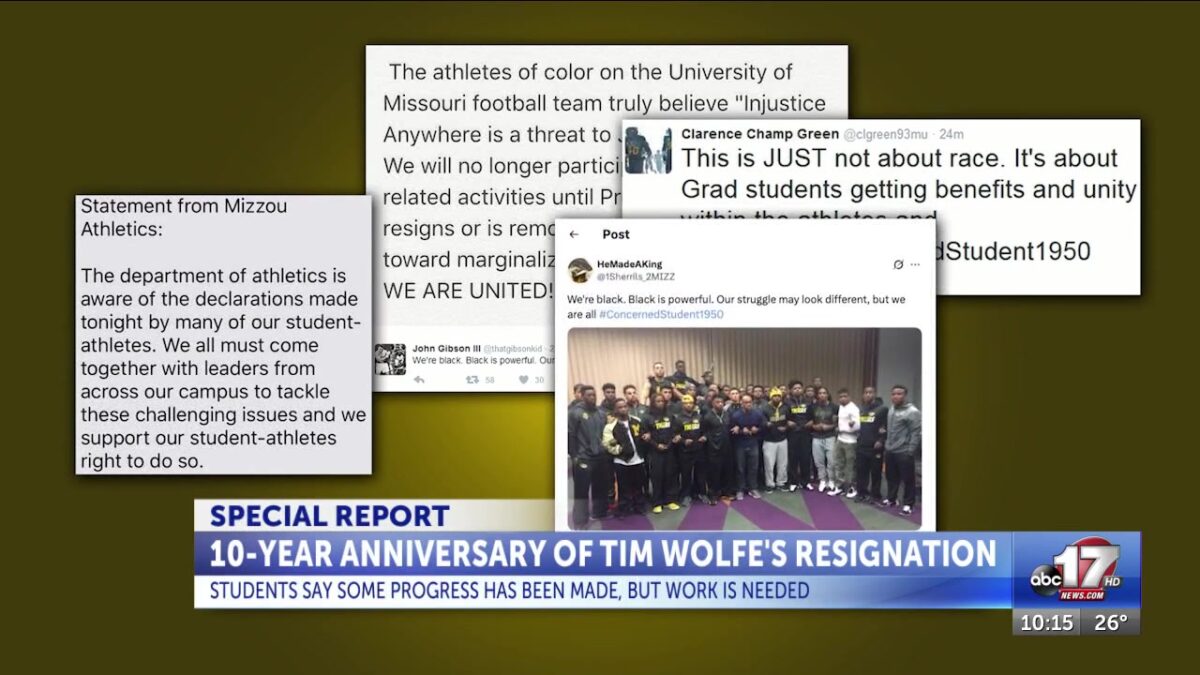
It wasn’t until the Missouri Tigers football team showed its support, vowing not to participate in football-related activities until Wolfe was gone, that action came.

We’re black. Black is powerful. Our struggle may look different, but we are all #ConcernedStudent1950 pic.twitter.com/obCjSWCFVY

— HeMadeAKing (@1Sherrils_2MIZZ) November 8, 2015

Two days later, on Nov. 9, Wolfe, along with MU Chancellor R. Bowen Loftin, stepped away. That brought an end to Butler’s weekslong hunger strike.

“It was something that I couldn’t fathom because Jonathan Butler was deep into his hunger strike, we had camp city going up, we had a lot of momentum because the football team got involved,” Little said. “It was a beautiful day as you saw, and the rejoice on campus, it’s something I’ll always remember, and I’m glad it happened. It’s a shame that it actually took financial ruin for Tim Wolfe, or the board of curators, to actually do something.”

Wolfe later sent an email, listing concerns over public safety on campus as a main contributor to his choice.

Little said all protests at the time were peaceful, despite an incident on the day Wolfe resigned, when former MU professor Melissa Click was seen on video asking for “muscle” to remove a journalist. She was suspended, and later came out stating she regretted her actions.

The University of Missouri Board of Curators announced Mike Middleton as the interim president for the UM System. The board also turned over MU chancellor responsibilities from Loftin to interim Chancellor Hank Foley. 

Has progress been made?

If you ask students Moore and Gordon if progress has been made on campus, they’ll say their answer is yes and no.

The two glanced over Concerned Student 1950’s list of demands, comparing them to some of their own experiences at MU. The demand that the two believe may have been achieved is demand No. 5: “We demand that by the academic year 2017-2018, the University of Missouri increases the black faculty and staff campus-wide to 10%.”

Gordon and Moore said they feel like they’ve seen more diverse professors, and both say they have multiple Black professors. However, data from the university shows that in 2024, about 3.7% of MU’s faculty were Black. That’s a number that appeared to have fluctuated in each category over the years since 2016.

LINK: Faculty demographics at the University of Missouri-Columbia

However, Moore feels progress has been lost in other areas, referencing the university’s decision to dismantle its diversity division in 2024, as well as its cancellation of certain events. The Legion of Black Collegians said that its Black 2 Class Block Party was canceled after administrators took issue with the name in August.

UM President Mun Choi had claimed at the time that the name of the event was not inclusive, but Gordon and Moore said the move appears to single out Black students.

“There’s Asian events and there’s Hispanic events and those are catered more towards their group, but it’s like we can’t have any of that,” Moore said. “It’s like as soon as we try, it was like ‘no, you’re being exclusive,’ but we’re really not because we allow them [people of other races] to come.”

Although in Chicago, Little still keeps up with the news on MU’s campus. He doesn’t think things have changed. He said he believed the university hired a diversity, equity and inclusion vice chancellor just to make it appear as though the school had done something.

Ten years later, Little is outraged by the university’s cancellation of the Black 2 Class Block Party.

ABC 17 News requested interviews with Choi and the members of the Board of Curators, but was told no one was available. UM System spokesman Christopher Ave sent a statement to ABC 17 News instead, writing that the university has made “significant investments in the success of all students.”

According to Ave, during the last 10 years, graduation, retention and successful career outcome rates have risen for all student groups:

Six-year graduation rates of all students have increased by 6 percentage points to 74.9%.

The retention rate for students who completed their first year at the university has risen by 5.5 percentage points to 92.7%.

MU graduates have a 95% success rate within six months of graduation, up 18% from 2017, the first year that such a measure was tracked.

Ave said that since 2015, the university’s provost office has added several faculty cohort programs focused on teaching and research support, training sessions and leadership programs. MU has also added leadership and professional development programs for its staff, Ave wrote.

“The university does not tolerate discrimination or harassment on our campus and works diligently to investigate complaints through various offices and when appropriate, the University of Missouri Police Department,” Ave wrote. “All reported cases are investigated and individuals who violate our policies or the law are held accountable. Potential consequences for those who commit such violations include being trespassed from campus, being expelled from the university and/or being charged with a crime.”

Hope and frustration

In fall 2025, Black students make up about 4.7% of enrollment on MU’s campus, according to data from the university. White students account for more than half of the student enrollment population at about 77%.

More than 11% of Missouri’s population is Black.

Other minorities, such as Hispanics and Latinos, account for about 6% of the student population, while Asians make up 3%.

Eddie Chiu is Taiwanese and is a freshman at the university. He said he sometimes thinks about the lack of the Asian population on campus, but believes the university is inclusive of all races. Chiu, however, said he wouldn’t mind seeing that number grow as he looks ahead to his future as a Tiger.

“It’s just something that I work with. I don’t personally mind it too much, but if there’s more, that’d be a better culture,” Chiu said.

For other students, the push now is to come together and brainstorm ways to hopefully see a change. Moore said she isn’t sure exactly what that might look like just yet.

“We shouldn’t have to try and force ourselves to replicate what they [Concerned Student 1950] did,” Moore said.

Moore said Choi called her personally about the racial slur that was yelled from the truck, offering an apology, letting her know of resources on campus, and reassuring her that the university is looking into increased security.

But a year later, she claims nothing’s changed.

“There’s been no difference. It still has happened this year. It happened the same year when it happened to me, and it’s just like he doesn’t care anymore because he’s like ‘Oh, I did this. What more do you want from me?’ basically,” Moore said.

Click here to follow the original article.

Imperial Irrigation District approves re-powering project budget

Karina Bazarte

IMPERIAL COUNTY, Calif. (KYMA) – The Imperial Irrigation District (IID) Board of Directors approved a budget amendment for their re-powering project.

During the regular meeting, the IID approved more than $2 million to upgrade their re-powering project which will replace the unit four boiler and steam turbine.

IID says the unit four boiler and steam turbine has been operating since 1968 at the El Centro generating station.

“What it helps us do is it adds more energy to our portfolio, so what we see behind us here, in unit four, is a generator that produce a 74 MW. When this project is done will increase it to 113 alone, so that’s a big step…That’s 39 MW and just to put that in perspective 1 MW serves about 1000 customers 1,000 homes,” said Robert Schettler with IID.

IID says although it is a large cost the focus is investing in the valley and not buying power on the market.

The project is expected to be finished in three years.

Click here to follow the original article.

Four injured in crash on W. 20th Street in Yuma

Dillon Fuhrman

YUMA, Ariz. (KYMA) – The Yuma Police Department (YPD) is investigating a crash which left four people injured.

According to a press release, the crash happened Saturday at around 5:45 p.m. in the area of W. 20th Street and S. Avenue C, near Cibola High School.

YPD says a 53-year-old woman was driving a 2011 Scion XD southbound on S. Avenue C, and was “making a left-hand turn onto W. 20th Street” when she crashed into a 2024 Ford F-250 “traveling northbound on Avenue C.”

The driver of the Scion and her passenger, a 14-year-old girl, were taken to Onvida Health for non-life-threatening injuries. However, the girl was later taken to Phoenix Children’s Hospital for her injuries, according to YPD.

Meanwhile, YPD says the driver, a 34-year-old man, and passenger, a 31-year-old woman, of the Ford suffered minor injuries, and “were treated and released” by the Yuma Fire Department while on scene.

While alcohol and speed did not factor in the crash, the investigation is ongoing. If anyone has information regarding the case, call YPD at (928) 783-4421 or 78-CRIME at (928) 782-7463 to remain anonymous.

Injury collision 20th Street and Avenue C 25-70434Download

Click here to follow the original article.

Locals in Yuma attend annual Christmas tree lighting ceremony

Madeline Murray

YUMA, Ariz. (KYMA) – A tree lighting ceremony was held at the Yuma Palms Regional Center early Saturday afternoon.

The event had a trackless train, face painting, local high school band performances, music, and even Santa Claus himself made an appearance.

The tree lighting ceremony is sponsored by Arizona’s Children Association, Toys for Tots and Silver Spur Rodeo Inc. 

Dave Brudy, CEO of DRB Group LLC with the Yuma Palms Regional Center, shared about why this event is important for the community.

“We support the community, and the community is what keeps retail alive and vibrant, so we feel it’s a way to give back and at the same time, the community gets to enjoy something free of charge for everybody,” Brudy explained.

The ceremony lasted until about 6:30 p.m, and organizers say the annual Winter Festival is a great way to give back to the community.

Click here to follow the original article.