Air quality test finds acrylonitrile at higher-than-normal levels in this Arkansas city

By Adam Roberts

Click here for updates on this story

    TONTITOWN, Arkansas (KHBS, KHOG) — The Arkansas Department of Energy and Environment (E&E) has asked the Arkansas Health Department (ADH) to conduct an assessment of Tontitown.

A contractor conducted a study of the city’s air quality in May.

The study found levels of acrylonitrile at levels above the regular background ambient air across the U.S.

The study suggests the acrylonitrile isn’t coming from the landfill, but from another source.

The E&E asked the ADH to study the potential impacts of the compound in Tontitown.

The National Library of Medicine’s entry on acrylonitrile reads:

“Acrylonitrile is a colorless, liquid, man-made chemical with a sharp, onion- or garlic-like odor. It can be dissolved in water and evaporates quickly. Acrylonitrile is used to make other chemicals such as plastics, synthetic rubber, and acrylic fibers. A mixture of acrylonitrile and carbon tetrachloride was used as a pesticide in the past; however, all pesticide uses have stopped.”

It also states that prolonged exposure to the vapors or skin contact is harmful.

It found 35 other compounds in the air. It was determined that none were exclusively from the Eco-Vista landfill, but two likely had contributions from the landfill. Those were benzene and ethylbenzene.

Acrylonitrile was the only one found at elevated levels.

Please note: This content carries a strict local market embargo. If you share the same market as the contributor of this article, you may not use it on any platform.

Updating progress of major drainage project along Siferd Boulevard in Colorado Springs

Scott Harrison

COLORADO SPRINGS, Colo. (KRDO) — In the recent past, a rainy spring and summer like we’ve had this year would have occasionally closed the Siferd Boulevard/Date Street intersection because of flash flooding, and even required the emergency rescues of people trapped in their vehicles.

The problem was that the intersection was in the middle of the Templeton Gap Floodway, a narrow drainage channel that starts east of the Academy Boulevard/Austin Bluffs Parkway intersection and eventually flows under Academy and into the north end of Shooks Run Creek.

Another issue was that the area is located in the Park Vista neighborhood, which fell within an enclave — a small section of El Paso County surrounded by city jurisdiction — making it unclear who was responsible for flood control.

However, the city and county reached an agreement under which they’ll split the $11 million cost, and the city annexed the enclave.

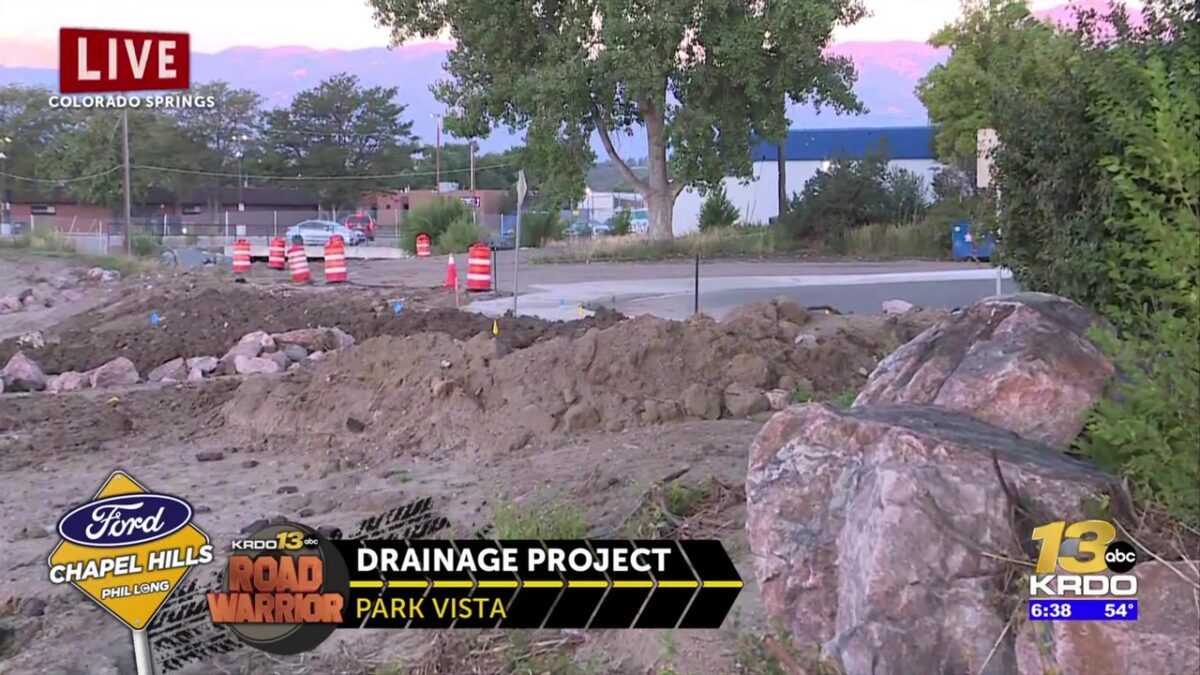
Earlier this year, crews permanently closed the three-way Siferd/Date intersection, and have now built cul-de-sacs at each end.

The Date cul-de-sac connects to an access road leading to several businesses along Austin Bluffs.

Workers are widening the drainage channel to increase capacity and are adding drop structures to slow the velocity of stormwater flow.

Crews will eventually plant vegetation on the banks of the channel to create a park-like atmosphere.

The project’s next major step comes this fall, when a bridge over the north end of the channel on Hopeful Drive will close for nine months as workers replace it with a new structure.

Officials hope to finish the project late next year.

“The previous drainage had capacity for about a 50-year event, which has a 2% chance every year of occurring,” said Erin Powers, the city’s Stormwater Enterprise Manager. “Moving forward, it’s going to be able to convey the full 100-year event, which is our largest flood design event. So, that allows us to take houses out of the floodplain in that neighborhood.”

Todd Frisbie, the city’s traffic engineer, said that traffic safety upgrades have been made on at least one neighborhood street used as a detour around the project.

“On Hopeful Drive, we put in some speed humps, and we’ll be putting in some other traffic control measures — some striping — to address the existing speeding issue on that roadway,” he explained. “That’s a road that potentially could get more traffic with the closure.”

Click here to follow the original article.

‘It’s a game changer’: Farmers, researchers and industry experts weigh in on benefits of AI in Ag

By JuYeon Kim

Click here for updates on this story

    Missouri (KSHB) — The use of artificial intelligence is growing in every sector of daily life, and this includes how food is produced. Industry experts say the use of precision agriculture (PA) has boomed in the last 15 to 20 years.

While the use of PA greatly depends on farm size, geographical location, farm type, technology type and cost, 2024 data by the USDA Economic Research Service shows guidance auto-steering systems on tractors, harvesters, and other equipment were used by 52% of midsize farms and 70% of large-scale crop-producing farms in 2023.

Yield monitors, yield maps, and soil maps were used on 68% of large-scale crop-producing farms.

Storm Dancer Farm Margaret Chamas and her husband Eric started Storm Dancer Farm in 2015.

The couple focuses on dairy goats for production and show, a small flock of layers, several equines, and meat goats and sheep for grazing services.

Chamas started targeted grazing in 2018. She has been using physical fencing, electrical netting and solar chargers to keep her goats contained in a specific area.

But in the winter of 2024, she hopped over to virtual fencing. She now depends on GPS fencing that uses cell signals to communicate with goat collars.

She can monitor and move her goats by adjusting the perimeters with her fingertips on the app. Anytime a goat escapes the perimeters she has set, Chamas will get a notification on her phone showing which goat has escaped and its location.

“The goats will walk towards the barrier, get that ascending tone. At the top of the scale, they’ll get an electric shock,” Margaret Chamas said. “I can get these goats to go anywhere on this property I want them to without having to come out and string up fence, and without having to worry about a lot of other physical obstacles or limitations.”

Chamas says the change in operation has been very effective, and she was pleasantly shocked herself when her grazing goats quickly adapted to the new technology.

To put the benefits into perspective, she finally took a vacation last year.

“It’s a game changer — like the peace of mind of knowing where your animals are is a big one,” she said. “The ability to start to identify one who’s not feeling well because they are always lagging behind. I can do that so much easier when I’m just looking at my phone.”

Chamas uses a Norwegian brand called No Fence. According to the product’s website, each collar costs $255, and the subscription to the app and system is $45 per year for five to 49 collars.

With spare batteries and other upkeep taken into account, Chamas says it is about $75 per goat, per year.

“Yes, it’s costly per animal, but this is fence that you can put anywhere,” she said. “It really is improving animal management as well as the land management.

Precision agriculture research at Kansas State University At Kansas State University, there is a dedicated group of researchers who are experimenting with precision agriculture and helping local farmers.

According to the precision agriculture landing page, the goals of the research include:

Developing more accurate methods to document farming practices to demonstrate compliance with various government programs and regulations. Expanding the capability of researchers to conduct replicated, commercial-scale, on-farm research in precision agriculture. Helping producers implement this technology and successfully apply the results to improve efficiency.

“Main goal of precision Ag is to optimize the yield, crop yield, by minimizing the use of the input, like fertilizer, or irrigation, or herbicides, pesticides,” said Dr. Deepak Joshi, assistant professor of precision agriculture.

Precision agriculture offers a myriad of benefits, including less physical labor, time saving, solutions to the labor shortage, and environmental sustainability by reducing waste and chemical harm.

Farmers and industry experts are using tools like drones, satellite imagery, autonomous tractors, and various digital systems for decision-making.

Depending on the types of sensors, farmers are able to measure soil moisture, identify weeds, diagnose the health of the plant, and take plant body temperature for irrigation planning.

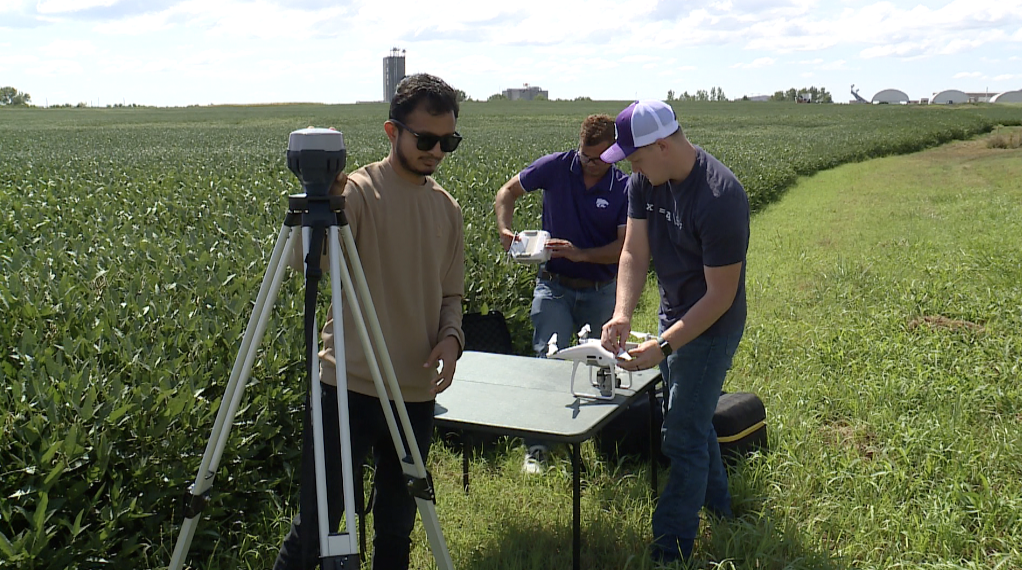
For example, the drone pictured below was made out of Styrofoam and costs about $18,000. It can cover 150 acres in less than 45 minutes. It has a multi-spectral sensor that creates NDVI maps, which helps farmers identify healthy and unhealthy plants.

The helicopter drone below costs about $2,000. It has an RGB sensor that mimics the human eye. It is used for smaller acres to filter out weeds.

There are also drones with thermal sensors, which can cost over $20,000. Those are used to measure plant body temperatures to help make decisions around irrigation and catch plant diseases and insects.

“Once we collect those images, we bring that images to the campus in our lab, in our computer,” Joshi said. “We process them, we analyze them, and we bring that image back to the farmer within couple of days of the flying, and so that they can make the decision at the right time.”

As AI data becomes more available and dependable, Joshi believes farmers will eventually be able to trust the recommendations more and fact-check less.

“We already know a lot, and we are improving a lot,” he said. “So they (AI drones) will fly, and at the same time, they will analyze as well on the sky. And they will give you recommendation right away at the same time.”

Digital farming solutions at Bayer Crop Science Like most up-and-coming ideas, there are still limitations:

Poor internet access in rural areas Initial cost of entry Data security concerns Education gap for farmers on how to use tools

LeAnna Guerin is Bayer Crop Science’s director of data science and data engineering in the digital farming solutions organization. She says another barrier she often sees is the hesitancy and doubt from farmers to give their digital tools a try.

This is why Guerin believes it is important for tech companies to involve farmers in the discussions and develop the technology together. It allows for rapid feedback and true understanding of farmers’ needs.

“They want to be able to trust it, but they need to see it proven on their farm. And that’s where we’re really partnering together, where we conduct experiments with them,” Guerin said. “We may offer them a recommendation based on an AI model or a statistical model, and we offer them a program where they can plant part of the field in the way that they would traditionally plant it, maybe with a hybrid that they are comfortable with. And we would offer them a bag or two of seed to plant our recommendation so they can see the data for themselves.”

Despite existing barriers, Guerin says the use of AI is the future. Choosing to opt out may mean farmers start to lag behind their competitors.

At Bayer Crop Science, she says researchers and product developers are thinking of ways to make this transition as easy and smooth as possible for producers.

“They’re not gonna take time out of their day, usually, to go sit through a training seminar or even an online training course,” Guerin said. “They want an expert who knows the digital tech, who knows the agronomy. They want an expert with them, on the farm, as they are running a system or as they are getting ready to make a decision about planting.”

She understands there are risks when it comes to changing how to operate, but she also wants farmers to know that with it comes potential benefits.

For example, a solution to the ongoing labor shortage.

“I think these tools can definitely help when we have limited labor, limited resources, so that farmers can really utilize the resources that they do have available to them to make the most efficient activities,” Guerin said.

Guerin spoke to the trustworthiness and effectiveness of the tools that currently exist.

“What we might learn one year may not necessarily hold true the next year if the weather drastically changes, if commodity prices change, if there’s a new disease pattern,” she said. “What we’re finding is it’s very important that we continue to have humans and have experts review the output, review the results, and also provide perimeters to the inputs of these AI models.”

Storm Dancer Farm Back on Storm Dancer Farm, Margaret Chamas thinks her virtual fencing will never fully replace the physical fence.

She also worries about things like reliability and data security as society integrates AI into more areas of life.

“I’m not personally super concerned that someone will try and mess with my goats that are on somebody’s private property in the middle of Missouri. But yes, overall, who owns the data? And who’s allowed to use it? And what security measures are being taken?” Chamas said. “It’s a growing concern in my mind, especially for programs where government funding is being used to support grazing. Are they going to say we want your data, or we expect your data? Or we have rights to your data cause it’s on our land?”

But as her business grows, and the accuracy of AI increases, Chamas is excited about the possibilities.

“You know, are we gonna put like a mini GoPro in here so we can take a snapshot? Like where is this goat? You know, see what it’s seeing. Or another one would be any sort of biometrics, like a heart rate or a temperature. Those would be other cool add-ons,” Chamas said.

Please note: This content carries a strict local market embargo. If you share the same market as the contributor of this article, you may not use it on any platform.
Missouri Department of Conservation to remove 40,000 pounds of invasive carp from Platte River

By JuYeon Kim

Click here for updates on this story

    Missouri (KSHB) — The Missouri Department of Conservation is conducting an intensive, short-term removal of invasive carp from the Platte River. The effort is in partnership with the U.S. Fish and Wildlife Service and a commercial fishing operation.

Carp were initially brought over from Asia years ago to help with water quality issues. But through accidental escapements over time, the carp have built up populations across the Midwest. With no natural predators, over population led to consequences.

According to the Missouri Department of Conservation, a female carp may spawn up to 500,000 eggs at a time.

“They are in high enough densities now that they are impacting and showing threats to our populations of native species that they compete directly with for food sources, and also indirectly with by just messing up the food web and the food chain,” said Missouri Department of Conservation’s Missouri River and Biometrics Unit Supervisor, Kasey Whiteman.

Carp swim around with their mouths open and eat large amounts of microscopic organisms like Phytoplankton and Zooplankton. Those organisms are necessary food sources for other filter feeders like paddlefish, gizzard shad, and bigmouth buffalos that coexist.

They also are dangerous to boaters and anglers.

Carp have a strong fight or flight response, which means boaters and anglers may find themselves fighting for their own safety as they dodge airborne fish.

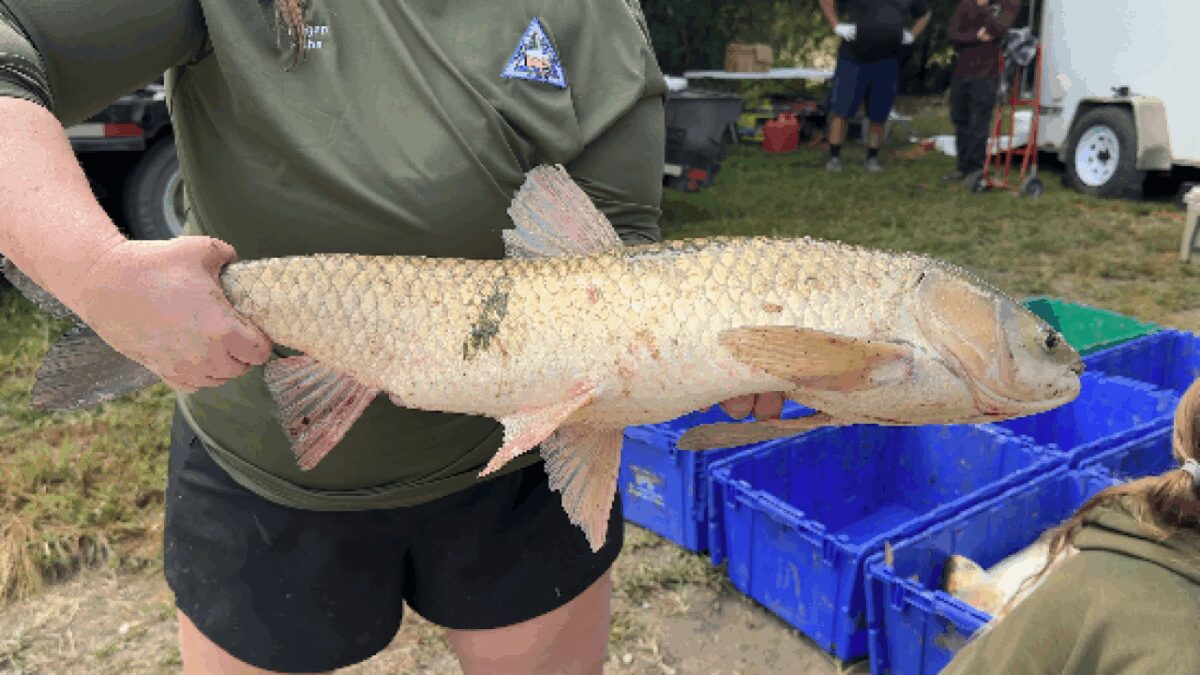
In Missouri, an average carp weighs between five to seven pounds, but can grow up to 30 pounds.

“Ultimately, there’s a possibility you can get hit in the head or something like that, which is not fun,” said Whiteman.

The mission, however, does not stop when the fish are taken out of the water. After measurements and data collection, the fish are handed off to Greg Trial and his team at Missouri Coast Fisheries.

“We’ll take those fish and process them down to usable parts,” Trial said. “Each one of these will go into a product, so it’ll either be fertilizer, or bait product, dog treats. So we’re using something that we wouldn’t want and making it something that we need.”

It is all about sustainability and reducing waste. Ten percent of all proceeds from products made with carp go back to conservation efforts like this one.

“And the greatest hope for the fertilizer is, it’s something that we can not only help give back to the state that they can use to fertilize grassland and some of the woodlands. We can also help some local farmers with fertilizer cost. To help them keep their cost of production down and put a fertilizer that’s not burning to the crops and actually is biodegradable,” said Trial.

Trial and his team use 100% of the meat and said many people are surprised by how delicious it tastes.

“It’s second to none to salmon in Omega-3 fatty acids,” said Trial. “I have friends that try it and they go, ‘Wow, this is the best hickory smoked salmon I’ve ever had.’ And then you go, ’It’s silver carp.’ ‘What?'”

Crews will be removing 20,000 pounds of invasive carp from the Platte River through Thursday, September 11.

After a week off, crews will return for another week to remove an additional 20,000 pounds.

“Benefitting the community, benefit businesses, as well as benefitting the environment, is a win, win, win,” said Whiteman.

Please note: This content carries a strict local market embargo. If you share the same market as the contributor of this article, you may not use it on any platform.

Mesilla Valley residents urged to sign up for emergency alert app

Nicole Ardila

The Mesilla Valley Regional Dispatch Authority and the Doña Ana County Office of Emergency Management are urging all residents to sign up for CodeRED alerts, to keep them informed and prevent tragedies and loss.

Local public safety officials would quickly send time-sensitive alerts directly to residents through phone calls and texts, email, and social media. 

Notifications may include:

Severe weather warnings

Evacuation notices

Hazardous materials incidents

Missing persons

ABC-7 spoke with the MVRDA’s Executive Director Jennifer Gorham, and she says the system has been underutilized.

“There’s an opportunity for some preventative. As for instance, this month being National Preparedness Month, this is a great time for us to kind of reunite this application to our community,” said Gorham. “Because, again, being prepared in many cases can save lives or save property as well.”

You can start on their website, here, or text “Alert me 911” to 99411 — or download the app on your phone’s app store.

You’ll then insert basic contact and location information so you’ll get notifications based on your area.

Then you can select if you want weather notifications, but MVRDA highly suggests you keep them on….

They also send notifications after a major event such as how to receive resources…

Click here to follow the original article.

Woman accused of hitting co-worker in parking lot and leaving scene

By Shay O’Connor, Cohen Breaux

Click here for updates on this story

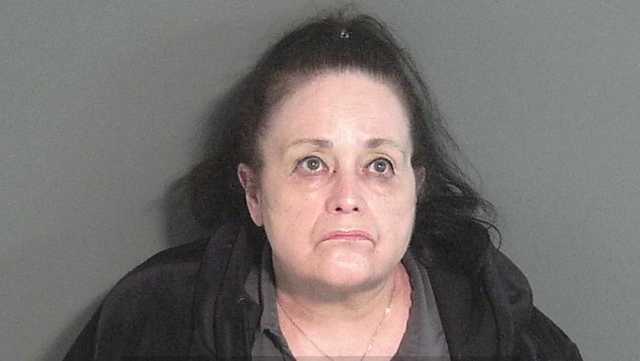
    SLIDELL, Louisiana (WDSU) — The Slidell Police Department arrested 67-year-old Lillian Sellers of Mandeville in connection with a hit-and-run investigation that left one of her co-workers hurt.

Police say Sellers struck a woman with her car late Sunday night at the Greenbriar Community Care center on Robert Boulevard and then drove off. That is where both the suspect and the victim work. Police have released video of the incident. We do want to warn you that some of you may find it disturbing to watch.

Surveillance video of the incident shows Sellers backing up recklessly through the parking lot, striking her co-worker, retrieving a broken piece of her bumper and driving off.

Sellers has been booked into St. Tammany Parish Jail on reckless operation of a motor vehicle, hit-and-run driving causing serious bodily injury, negligent injuring, and obstruction of justice by tampering with evidence.

Bond has not yet been announced, and the victim has been listed in critical condition.

The investigation remains ongoing. Lisa Gardner with Greenbriar Community Care Center released a statement saying in part:

“We are heartbroken about our coworker. It is tragic. We are cooperating with the police and support their investigation in finding justice. Staff and residents are shaken up. Our prayers are with the family.”

This is what Slidell Police is saying about the incident after video was released:

“For those saying it was intentional, the suspect, Lillian Sellers, was clocking into work (presumably running late) and rushing / driving recklessly to get to her assigned location at the facility. The driveway is part of a larger one-way cul-de-sac around the facility, which was why Sellers was driving in reverse…in order to get into a parking spot. The moments before the video that you see here show Sellers going inside to clock in, and immediately coming back out to leave. All indications and evidence indicate that there was no intent; however, the case is still under investigation. We encourage anyone with any additional information to please come speak with an Slidell PD investigator. You can call 985-643-3131 or e-mail PIO@slidellpd.com.”

Please note: This content carries a strict local market embargo. If you share the same market as the contributor of this article, you may not use it on any platform.

Man sentenced to 10 years for crash that left an student hurt

By Jonah Gilmore, Bailey Barnes

Click here for updates on this story

    NEW ORLEANS (WDSU) — Cedrick Marshall has been sentenced to 10 years in prison after pleading guilty to first degree vehicular negligent injury. This was in connection to a 2024 crash that left a 15-year-old Edna Karr student hurt.

Jamal Jackson is still in critical condition after an SUV crashed into his bedroom at his residence on the corner of Cerise Avenue and Chef Menteur.

The judge said if Jackson passes away he could be charged with vehicular homicide could face up to 30 years.

Through many tears in the weeks after the crash, Cierra Patterson, the mother of Jamal Jackson, 15, described the horrific scene that left her son in the Intensive Care Unit.

“All she heard was loud glass noise, and when she called me on the phone because I wasn’t there, she just said that Jamal was under the car,” Patterson said.

“There’s no way in the world my child should be in critical condition at 15 years old by somebody not doing the right thing,” Patterson said.

Patterson said her son recently started school at Edna Karr and was looking forward to the school year, getting involved with football and the drill team.

“He don’t get into no trouble. He don’t hang with people, he stays inside, that’s like his comfort zone,” Patterson said.

Police did not say how fast Marshall was driving when he crashed, but confirmed he stayed at the scene and allegedly failed a sobriety test.

“He should have called an Uber if he knew he was too intoxicated. He should’ve never got behind a wheel,” Patterson said.

Patterson called her son her “strong boy,” saying she’s staying by his side as he continues to fight for his life.

“I’m praying that he gets through this. He going to get through this, I have faith in this. He’s going to walk out this hospital with me. He’s not leaving no other way,” Patterson said.

Please note: This content carries a strict local market embargo. If you share the same market as the contributor of this article, you may not use it on any platform.

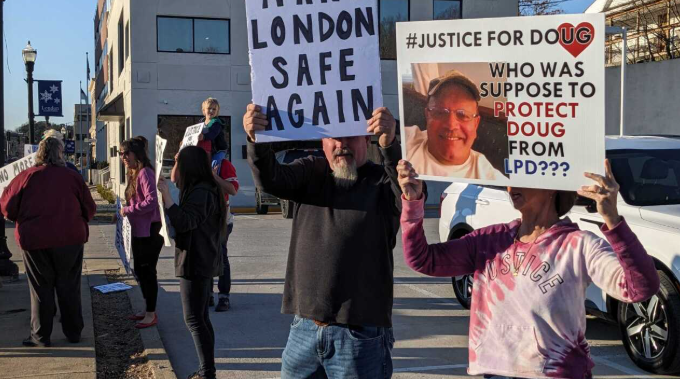
Family of Doug Harless sues London PD, the city after he’s killed during police raid

By WLEX News Staff

Click here for updates on this story

    LONDON, Kentucky (WLEX) — On Wednesday, the family of Douglas Harless filed a lawsuit in Laurel Circuit Court against the London Police Department and numerous officers, along with the City of London, following the fatal police raid that killed Harless in his home, a release read.

The lawsuit seeks compensatory and punitive damages for violations of Harless’ constitutional rights and wrongful death under Kentucky law.

On the night of Dec. 23, 2024, several London police officers, some armed with AR-15 style rifles, arrived at Harless’ home at 511 Vanzant Road in Lily purportedly searching for a stolen weed eater, the release explained. The officers attempted to execute a search warrant reportedly intended for a different residence, 489 Vanzant Road.

Just before midnight, officers made entry into his home and fired their guns, striking Harless multiple times and killing him, according to the release.

Harless, a 63-year-old maintenance worker, father and grandfather, had no criminal record beyond minor traffic infractions and was not a suspect in the underlying investigation, the release reported.

The complaint alleges that officers knowingly or recklessly raided the wrong home, ignored obvious signs that they were at the wrong address and acted outside their jurisdiction.

“Doug Harless should have been safe in his own home. Instead, he was killed when police raided the wrong address, and months later, his family is still being denied answers,” said Tad Thomas of Thomas Law Offices, representing the Harless family.

“While nothing can bring Doug back, his family deserves truth and accountability,” Thomas said.

Further, the release read, “Despite the months that have passed since Harless’ death, the Kentucky State Police continue to withhold critical records, including the original and all known copies of the search warrant and supporting affidavit, citing a still ongoing investigation.”

“This was a completely preventable tragedy and has left my family heartbroken. Our Dad, Doug, was one of the hardest-working people we knew, always putting his family and friends first. He loved watching NASCAR, listening to music, and cracking jokes that made everyone laugh. We miss him every single day,” said Nicki Lawson and Mona Alsip, daughters of Douglas Harless.

“No family should have to endure this kind of loss, and we want to hold the police accountable for their reckless error. As we grieve, we also ask for privacy to mourn and remember Dad,” they said.

The lawsuit alleges violations of the Fourth and 14th Amendments, including unlawful search, excessive force and supervisory liability, as well as state-law claims for gross negligence, assault and battery, trespass, false imprisonment, privacy violations, outrageous conduct and wrongful death.

“Doug Harless was a friend to so many. He should have been safe at midnight in his own home, not killed because police went to the wrong address,” said Howard O. Mann, Amanda Hill and Jeff Hill who also represent the Harless family.

“His death has left a hole in the family and community that cannot be filled, and both the public and his family deserve answers and justice,” Mann said.

On Tuesday the acting London Mayor Tracy Handley requested an update on the investigation into the shooting death of Harless from KSP Commissioner Colonel Phillip Burnett Jr. She specifically requested an investigation timeline, preliminary findings, and documents in the case.

Please note: This content carries a strict local market embargo. If you share the same market as the contributor of this article, you may not use it on any platform.

Crash sends car into apartment building, another split in half

By Fletcher Keel, Nicole Aponte

Click here for updates on this story

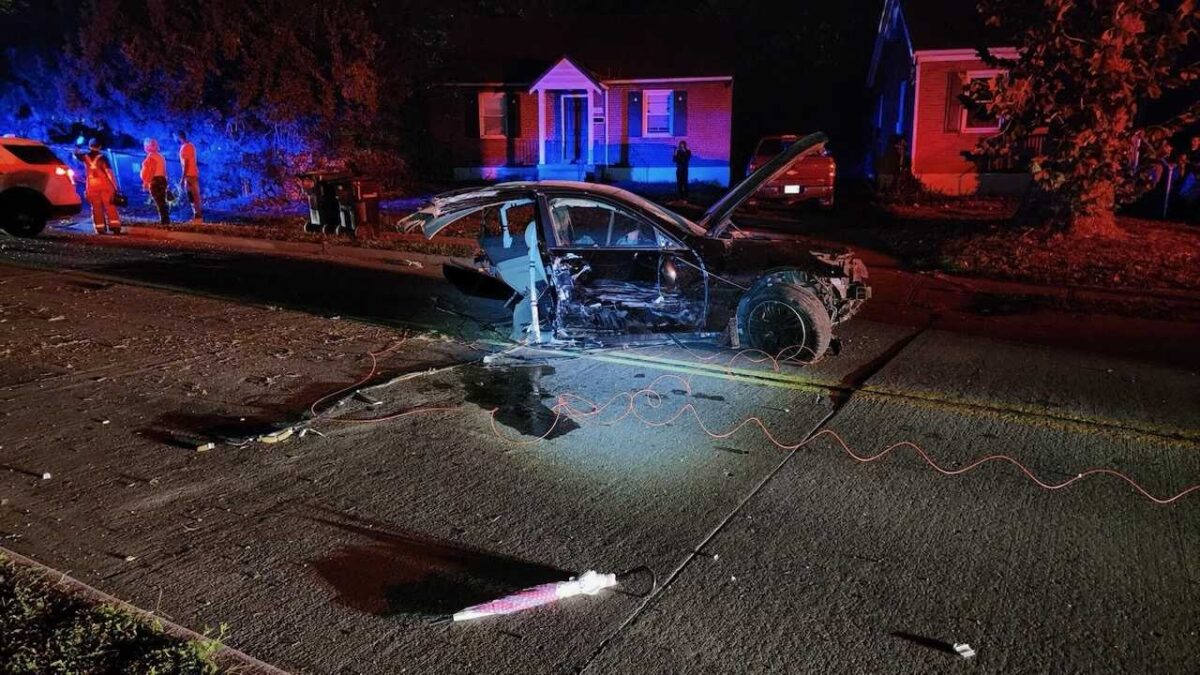
    CINCINNATI (WLWT) — An overnight crash sent one car flying into a College Hill apartment building and another split in half.

It happened just before 1 a.m. Wednesday morning on Grosebeck Road, near Folchi Drive.

The magnitude and intensity of the crash can be seen just by looking at where it ended. A gaping hole, caused by one of the cars in the crash, was left, allowing you to see into the building.

The two parts of the car that was split ended up about 50 feet from one another.

Cincinnati police say one person was taken to UC Medical Center, but their condition was not specified.

Crews are still trying to clean up the mess hours later. The building inspector has been on scene, beginning the process of covering the hole left in the building.

Duke Energy is also on scene, inspecting a power line that was hit.

We’re working to understand what exactly led to the crash.

Please note: This content carries a strict local market embargo. If you share the same market as the contributor of this article, you may not use it on any platform.

Protesters gather at Missouri Capitol to oppose redrawn congressional maps

Erika McGuire

(Editor’s note, 9/10: The story corrects the day of the week that the state senate will begin taking up legislation in the special session.)

JEFFERSON CITY, Mo. (KMIZ)

Hundreds gathered at the Missouri State Capitol Wednesday afternoon to protest state Republicans taking one step closer to officially redrawing Missouri’s congressional maps.

The rally was held by Missouri democrats in response to the “Missouri First Map” that was drawn after President Donald Trump requested Gov. Mike Kehoe to call a special to redraw the maps — a process that typically occurs only after the census.

Republicans are aiming to protect their narrow majority in the U.S. House with mid-term elections coming up next year.

According to a press release from the Missouri Democrats, this decision came despite bipartisan opposition and ignored the testimony of thousands of Missourians who voiced concern over the maps.

On Tuesday, the House of Representatives approved Gov. Mike Kehoe’s “Missouri First” map Tuesday in a 90 to 65 vote. The approved map would change Congressman Emanuel Cleaver’s fifth district in Kansas City by cutting the city into three districts.

Several groups, including Missouri Jobs with Justice, Indivisible, and the United Auto Workers Union attended the rally that began at noon.

Protesters first gathered on the Capitol steps, then moved inside to the rotunda — where crowds filled all three floors, chanting and holding signs.

The rally then moved to the third floor, where protesters marched around the House Chambers at lawmakers were in session debating redistricting and initiative petition reform.

Protesters claim the redrawing of Missouri’s congressional maps is unfair, illegal, and a blatant power grab.

“It’s against the law. It’s against our state constitution. How can they do this?” said protester Stephanie McCorkle.

“Any other way, they’d lose. If they don’t cheat they lose,” added protester Darryl Stines.

“It’s a blatant power grab to overturn the will of the people, it continues to have a through line with President Trump his agenda and Gov. Kehoe’s agenda and the agenda to continually marginalize individuals that need representation within our government,” Robert Fisher with PROMO Missouri said.

Terrence Wise, with with Missouri Workers Center and Stand Up KC said the moves of the republican party not only in Missouri but in the federal government is something he takes personal.

“They are attacking and showing violence to my family and my community and i know us coming together won’t stop them we have to build a movement with everyone who is in here today and not standing with us today,” Wise said.

Congressional candidate for the 5th district in Missouri, Jordan Herrera, says the tactics being used by republicans is telling.

“They are trying to get this done when people are not paying attention tells me everything, they don’t even believe what they are doing hell even Speaker of the House John Patterson said he’s not gunna vote for this thing,” Herrera said. “The last thing I have for Kehoe is this map even though majority of Missourians do not want it I will be suing against this map immediately so I will see you in court.”

State Rep. David Tyson Smith (D-Columbia) said the redraw of the maps is about Trump trying to keep control of the house.

“The way this is happening is insidious that’s what its about so we’ve gotta fight back, Missouri cannot be Donald Trump’s puppet we can’t be a slave to the White House we’ve gotta stand up for Missouri values and the citizens of Missouri,” Smith said.

Democrats, Smith said, will keep fighting back and do whatever they can to take their power back.

The Missouri House of Representatives also voted Tuesday to send initiative petition reform, along with redistricting bills, to the Senate in a 98 to 58 vote. Joint House Resolution three would require all initiative petitions to get approval from a majority of voters across the state and from each district.

Click here to follow the original article.