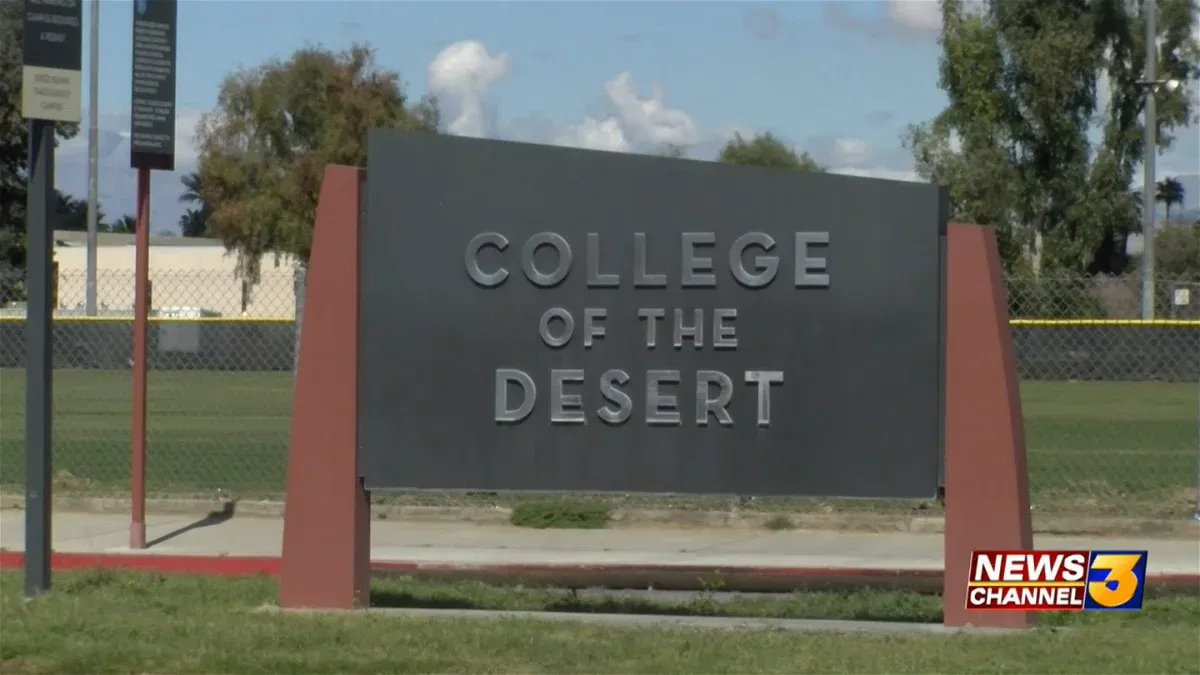
College of the Desert names semi-finalists for Superintendent/President

Jesus Reyes

PALM DESERT, Calif. (KESQ) – College of the Desert is down to four semi-finalists who advanced to the final stage in the search for the school’s next Superintendent/President.

COD officials said they received 73 qualified applications from across the country following an extensive recruitment process conducted by AGB Search, LLC – a national firm specializing in leadership searches for higher education institutions.

The four semi-finalists selected to advance are:

● Dr. Monica Chahal, Interim President, Clovis Community College

● Val Martinez Garcia, Acting Superintendent/President, College of the Desert

● Dr. Kimberlee S. Messina, President, Spokane Falls Community College

● Dr. Don Moya-Miller, Vice President/Assistant Superintendent, Rio Hondo College

“The COD Superintendent/Presidential Search has attracted an exceptional group of candidates, each demonstrating a strong commitment to student success, community engagement, and academic excellence,” said Dr. Joel Kinnamon, Chair of the COD Board of Trustees. “We are proud to introduce the finalists to the College of the Desert community and invite the public to take part in open forums where they can hear directly from each candidate, ask questions, and share in the important conversation about the future of the college.”

A public forum will take place in person on Thursday, May 1, 2025, at the Pollock Theatre on the Palm Desert Campus. The event will also be live-streamed via YouTube to ensure broad access. The time of the public forum will be announced at a later date.

Members of the community interested in submitting questions for the in-person forum can submit their questions at https://forms.office.com/r/iYWTxxdKB3.

The Board of Trustees will conduct final interviews with the candidates in person on Friday, May 2, 2025. These interviews will be closed to the public. The Board is expected to announce the next Superintendent/President during an upcoming meeting.

For more information and updates, please visit www.collegeofthedesert.edu/president.

Modular Sidewalks Get Green Light on State Street

Tracy Lehr

SANTA BARBARA, Calif. – The Santa Barbara City Council gave the green light to modular sidewalks on a portion of State Street.

A Santa Barbara City Council majority approved the $528,000 purchase on Tuesday.

Mayor Randy Rowse was the lone no vote.

The sidewalks will be installed on both sides of the 500 block of State St.

It’s a block where parklets have helped businesses weather COVID financially.

But it has not been easy for pedestrians, e-bikes, bicycles, and emergency vehicles to share the open road.

State Street Master Planner, Tess Harris, calls them “pedlets.”

“So the pedlet would be an 8-foot sidewalk extension,” said Harris. “It will allow businesses to move their outdoor dining furniture up against the building frontage making it easier to businesses to go from inside to outside to serve patrons.”

Sandbar General Manager, Brandon Stilwell, said the popular business loves the outdoor dining space and the restaurant and bar appears ready to roll with sidewalk change.

“We are really excited,” said Stilwell, “hope people feel more safe and don’t have to worry about the bikes or anything.”

Santa Barbara Public Works Manager, Sarah Clark, said they bought enough to be flexible.

“We have also purchased an extra segment they are modular units so they can be moved around and re-positioned so in the future if we want to use them at a different location, we can do that,” said Clark.

The “pedlets” are made by Modstreet out of Colorado.

Carpinteria bought parklets made by the same and leases them to businesses unless they choose to buy them.

Pedlets are the company’s latest offering and Santa Barbara is ready to give them a try.

The extensions should be installed by July.

Police searching for another driver involved in deadly I-25 road rage crash

Michael Logerwell

COLORADO SPRINGS, Colo. (KRDO) – Colorado Springs Police tell KRDO13 Investigates they are still searching for another driver involved in the road rage crash that killed a 21-year-old and shut down the interstate for hours on Friday.

At this point in the investigation, police couldn’t say what charges the driver would face.

KRDO13 Investigates obtained police documents that describe the road rage incident in more detail.

PREVIOUS COVERAGE:

CSPD: Road rage incident leads to fatal crash and hours-long closure on I-25 in Colorado Springs

21-year-old identified as victim in I-25 road rage crash, three passengers still in critical condition

Durriel Humphrey is now facing felony charges of vehicular homicide and vehicular assault, along with misdemeanor charges of reckless and careless driving.

The arrest affidavit details his interview with police after the Friday night crash. Humphrey told authorities a white Dodge Charger was tailgating him, and he did not like to be tailgated. Then Humphrey said the charger changed lanes, sped up, and cut him off.

Humphrey then told police he sped up to 75mph to get ahead of “the joker,” and began waving at the driver of the charger. He said he was hoping it would get the car to leave him alone.

Another driver interviewed by police reported seeing Humphrey giving someone the finger. They added seeing Humphrey and the white car weaving in and out of traffic, causing drivers to suddenly brake.

After speeding up, Humphrey said he hit a grey Toyota, which hit the SUV that 21-year-old Salvador Diaz was driving. 

Humphrey is out on bond, and his first court date is at the end of April.

Colorado Springs Police have not named any other suspects, but told KRDO13 Investigates they have solid leads on who the second driver involved in the road rage incident is.

Board tentatively OKs ordinance restricting where E-Bikes can operate

City News Service

RIVERSIDE, Calif. (KESQ) – The Board of Supervisors today tentatively approved an ordinance restricting where electric bicycles can be operated, generally prohibiting them from being driven on pedestrian walkways, along sidewalks or on nature and equestrian trails in unincorporated communities throughout Riverside County.  

The E-Bike Safety Ordinance was drafted at the request of Supervisor Chuck Washington, who first raised the issue of potential conflicts with e-bikes back in September.

“I’ve personally witnessed instances of unsafe behavior by riders and those around them,” Washington said ahead of the 5-0 vote Tuesday. “While they offer many benefits, riders have a responsibility to ensure the bikes are used safely and responsibly.”

The new measure, which is slated to be formally approved after a second reading on May 6, replicates similar ordinances passed in municipalities and other counties statewide.

It classifies e-bikes as pedal-driven motorized two-wheelers that generally rely on rechargeable lithium-ion batteries for power, which kicks in when riders have reached speeds of at least 20 mph, aiding the bicyclists in gaining and maintaining momentum.

Washington, along with Supervisors Manuel Perez and Karen Spiegel, all observed that the bikes are becoming more and more popular.   

“I see them coming up and down Highway 74,” Perez said.  

Washington’s initial concern was over the bikes’ growing presence on Temecula Valley Wine Country trails, as well as outdoor recreational sites favored by horse enthusiasts. However, the ordinance would apply to unincorporated areas countywide.

With few exceptions, e-bikes would be prohibited on sidewalks and trails, on pedestrian overpasses and underpasses. However, signage must be posted on sidewalks and trails notifying entrants of the county prohibition, or the ordinance would not be enforceable.

Some usage would be allowed on sidewalks where there are no designated bicycle paths along roadways. The only requirement would be that e-bikers obey all traffic laws and ensure safe passage to avoid conflicts with pedestrians.

Similar restrictions already apply to mopeds and other motor-driven cycles.   

Violators could be issued citations carrying fines of $100 to $500, depending on the number of infractions that occur in a year’s time.

Egg-cellent Duck Dive in Palm Springs on Saturday

Cynthia White

PALM SPRINGS, Calif. (KESQ) – The Palm Springs Parks and Recreation Department is inviting the community to dive into the exciting spring celebration of the Egg-cellent Duck Dive this coming Saturday.

This is a free family-friendly event, which features a pool rubber ducky hunt, arts and crafts, and prizes.

The event is this Saturday, April 19, from 11:00 a.m. until 2:00 p.m. at the Palm Springs Swim Center, 405 South Pavilion Way in Palm Springs.

For more information, call 760-323-8272 or go to palmspringsca.gov.

MSHP one of two Missouri law enforcement agencies in ICE program

Mitchell Kaminski

COLUMBIA, Mo. (KMIZ)

The Missouri State Highway Patrol has joined a growing number of law enforcement agencies authorized to carry out limited immigration enforcement under federal supervision.

Records obtained by ABC 17 News give further details into what the agreement with U.S. Immigration and Customs Enforcement — which was signed by MSHP in March — entails. 

A 1996 federal law allows U.S. Immigration and Customs Enforcement to give state and local law enforcement limited authority to carry out immigration enforcement under ICE supervision, under an additional provision known as Section 287(g).  

On Jan. 20, 2025, President Donald Trump signed an executive order directing ICE to expand the 287(g) program to the fullest extent allowed by law. The order encourages ICE to partner with qualified state and local law enforcement agencies to enforce immigration laws.

In response, Missouri Gov. Mike Kehoe signed executive orders on his first day in office aimed at positioning Missouri to support federal immigration enforcement efforts

ICE operates three models that law enforcement agencies can sign up to take part in: the Jail Enforcement Model, Task Force Model and Warrant Service Officer Program, according to information from its website. 

The Jail Enforcement Model is designed to identify and process removable aliens, with criminal or pending criminal charges, who are arrested by state or local law enforcement agencies.

The Task Force Model serves as a force multiplier for law enforcement agencies to enforce limited immigration authority with ICE oversight during their routine police duties.

The Warrant Service Officer program allows ICE to train, certify and authorize state and local law enforcement officers to serve and execute administrative warrants on aliens in their agency’s jail.

A spokesman for the Missouri Sheriffs’ Association told ABC 17 News in an email that it has made all information about these programs available to all sheriff’s offices, and it is up to each of them whether they participate.

Missouri is one of 38 states that have a law enforcement agency signed up for the program. However, of the 456 agreements signed across the country, the Show Me State accounts for just three of them. 

The Boone County Sheriff’s Office has not signed any agreements with ICE, and a spokesman told ABC 17 News that there are no discussions about changing that status. 

Currently, Missouri only has two agencies that have signed agreements with ICE, the MSHP and the Christian County Sheriff’s Office. The Christian County Sheriff’s Office has signed two agreements with ICE, one for a Jail Enforcement Model and another for a Warrant Service Officer. The MSHP signed a Task Force Model agreement. 

Missouri_State_Highway_Patrol_TFM_MOA_LEA_signed_3.18.25_-_ICE_Signed 1 (1)Download

Under the MSHP’s agreement, the chief officer of the MSHP is responsible for nominating candidates for a mandatory training program provided by ICE. Only trained personnel who are nominated and certified have authority pursuant to the agreement to conduct immigration officer functions

According to Capt. Scott White, of the Missouri State Highway Patrol, 45 people will participate in the training program, with troopers from each of the state’s nine troops already nominated.

Five troopers from each of the nine troops will receive training along with five people from the Division of Drug and Crime Control, two from the Gaming Division and one from General Headquarters. 

MSHP will cover personnel expenses, while ICE will handle the installation and maintenance costs of the IT infrastructure. According to the agreement, eligible MSHP officers will be assigned to various units, teams or task forces designated by ICE. 

MSHP officers are not authorized to perform immigration officer duties unless they are under the direct supervision or direction of ICE. 

Once certified MSHP officers are — according to the agreement — authorized to perform the following: 

Can question anyone they believe is not a U.S. citizen.

Can arrest someone without a warrant if they’re trying to enter the U.S. illegally.

If there’s reason to believe someone should be arrested, a warrant can be requested — but that person must first be brought to an immigration officer to review their legal status.

Can arrest without a warrant if someone has committed an immigration-related crime and may flee before a warrant can be issued.

Can deliver and carry out arrest warrants for immigration-related offenses.

Can collect fingerprints, take photos, interview people, and gather evidence needed for immigration cases.

Can prepare official immigration charges.

Can issue immigration detainers (requests to hold someone for ICE).

Can take custody of people arrested for immigration violations, even if another agency made the arrest.

Can hold and transport people arrested for immigration reasons to ICE-approved detention centers.

Under the agreement, participating law enforcement agencies are exempt from Sunshine Request, which Dave Roland, Director of Litigation, Freedom Center of Missouri, believes is a problem for accountability. 

“ It is true that federal entities are not subject to Missouri’s Sunshine Laws… but state or local entities should not be able to deny citizens access to public records held by the state and local agencies simply because a federal agency says they shouldn’t be shared,” Roland wrote ABC 17 News in an email. 

As of April 14, there are 86 Jail Enforcement Model agreements in 25 states, 180 Warrant Service Officer agreements in 27 states and 190 Task Force Model agreements in 23 states.

participatingAgencies04142025amDownload

participatingAgencies04142025amDownload

Oregon House approves bill to limit smartphone use in schools

Barney Lerten

SALEM, Ore. (KTVZ)– With bipartisan support, the Oregon House of Representatives on Tuesday passed House Bill 2251, which would prohibit Oregon students from using their smartphones during the school day.

“With this legislation, Oregon will join the growing number of states taking action to support students’ mental health and academic outcomes by reducing digital distractions,” lawmakers who supported the bill that passed 36-21 said in a news release that continues below:  

The bill requires each school district to adopt a policy prohibiting student use of personal electronic devices, with limited exceptions, from bell-to-bell but allows local districts to choose how to implement the policy – such as using magnetized pouches or requiring cell phones to be “off and away” in students’ backpacks. 

“I’m proud to be joining 17 other states reducing student access to smartphones during the school day,” said Rep. Kim Wallan (R- Medford), who introduced HB 2251. “I find it notable that no state that has curbed phone use in schools has reversed course. I’m confident that this legislation will improve outcomes for Oregon’s students and teachers.” 

The bill provides exemptions for the use of personal laptops for schoolwork and devices that are medically necessary or part of a student’s IEP or Section 504 plan. School districts that have already implemented bell-to-bell restrictions on student cell phone use have seen improvements in behavior, attendance, and academic performance.  

“We have to improve outcomes for Oregon students,” said Rep. April Dobson (D- Happy Valley & N Clackamas County), a chief sponsor of the bill. “Our teachers shouldn’t have to compete with trillion-dollar tech companies and the most advanced social media algorithms for students’ attention in the classroom.” 

Developed over the course of the session by a bipartisan coalition of lawmakers, HB 2251 provides needed relief for educators who are increasingly finding themselves policing cell phone usage, rather than focusing on teaching. 

“In Bend-La Pine, I’ve heard directly from parents and educators about what a positive impact getting phones out of the classroom has had. But these can be tough conversations, and this bill gives our school districts a push to do what’s best for our kids,” said Rep. Emerson Levy (D- Central Oregon). 

This bill now heads to the Senate, where it is championed by pediatrician Sen. Lisa Reynolds, MD (D- Portland), who said, “I see first-hand the clear and compelling evidence that constant smartphone use harms our kids’ emotional health and is detrimental to their learning.

“As we discuss our largest-ever school budget, I fear we keep one hand tied behind our students’ and teachers’ backs with the distraction of cellphones and their mental health impacts. This is a chance to create a culture shift in our schools, make a positive impact on students’ learning and brain development, and make our lunchrooms loud again with community and conversation.” 

Sixth “Murder Squad” member pleads guilty in 2017 killing spree; U.S. Attorney’s Office

Jeanette Bent

SAN JOSE, Calif. (KION-TV) — The United States Attorney’s Office announced Tuesday that the sixth member in Salinas-based “Murder Squad” criminal street gang pled guilty in federal court to one count of racketeering conspiracy and one count of conspiracy to commit murder in aid of racketeering.

By pleading guilty, 34-year-old Andrew Alvarado of Salinas admitted that he personally participated in six of these hunts between January 2017 and May 2017, according to the attorney’s office.

They say that Alvarado was the the shooter in three of those hunts, “resulting in the deaths of three victims and the wounding of a fourth. In one instance, the hunt began at a gathering to remember a co-conspirator’s family members who had been killed in a car accident, during which the gang members agreed to go hunting for rival gang members to kill.”

The attorney’s office says that Alvarado also admitted that he was in the security/spotter vehicle in three other hunts, resulting in the deaths of three victims, the wounding of four victims, and the near-miss of one victim.  

They said that he admitted that each additional “body” increased Alvarado’s status and prestige within the gang.

Alvarado is in custody and is scheduled to be sentenced on July 15, 2025, according to the attorney’s office.  

They say that he faces a maximum sentence of life in prison and a $250,000 fine for racketeering conspiracy with another 10 years in prison and a $250,000 fine for conspiracy to commit murder in aid of racketeering.

According to the U.S. Attorney’s Office, Alvarado was indicted along with multiple co-defendants by a federal grand jury on Oct. 15, 2020.

They say that court documents outlined Alvarado and his fellow “Murder Squad” peers as going on “hunts” to shoot and kill rival gang members, or even those to be perceived rivals.

“The squad would often use military-style tactics, traveling in a convoy of vehicles with a designated shooter vehicle and a designated security/spotter vehicle, all of which were in constant communication via conference call,” wrote the attorney’s office on their website. “The security/spotter vehicles would patrol the streets, find a target, and transmit their location to the shooter vehicle [while] the shooters in the shooter vehicle would drive up, exit, fire at the victims until their magazines were empty, and speed away. The security/spotter vehicles would follow behind, ready to distract or intercept law enforcement and allow the shooter vehicle to escape.”

In May 2024, the attorney’s office says that five of Alvarado’s co-defendants pleaded guilty to racketeering conspiracy and conspiracy to commit murder in aid of racketeering. The five co-defendants were sentenced in September 2024 to between 25 and 41 years in prison, according to the attorney’s office.

Five of the Salinas gang “Murder Squad” members sentenced; U.S. Attorney’s Office

SALINAS, Calif. (KION-TV) — The United States Attorney’s Office announced Wednesday that five members from the Salinas-based “Murder Squad” were sentenced to a combined 161 years in prison for racketeering conspiracy and conspiracy to commit murder in aid of racketeering.

According to the U.S. Attorney’s Office, the “Murder Squad” was responsible for 11 murders with another 17 survivors who were shot at between 2015 and 2018.

The U.S. Attorney’s Office said that several “Murder Squad” murders began when the gang members gathered at a house to remember a recently deceased friend or loved one, then decided to go “hunting” as a way to commemorate the decedent’s memory or lift their spirits. According to the U.S. Attorney, each additional body count increased a defendant’s status and prestige within the “Murder Squad.”

“The ‘Murder Squad’ killed for sport, terrorizing the city of Salinas and forever altering the lives of so many innocent members of our community,” said U.S. Attorney Ramsey. “As described in the court filings, their conduct is reprehensible.”

According to the U.S. Attorney’s Office, the “Murder Squad” conducted more than a dozen hunts, targeting people who were Hispanic, bald or wore blue. Then, a designated shooter would accompany a designated security/spotter vehicle to seek out victims, said the U.S. Attorney’s Office. Using “military-style tactics,” the security/spotter vehicle would patrol the streets searching for potential targets, transmit the information and location to the shooter, then follow behind the shooter after their magazine guns were emptied on the victim, according to the U.S. Attorney’s Office.

“This was an amazing investigation that made a tremendous impact on violence in Salinas. These guys were serial killers,” Acting Police Chief John Murray told KION. “It began when our detectives recognized some similarities and connections between murders back around 2017. It branched out and grew into a federal investigation titled Operation Red Rum.”

All five defendants pleaded guilty on May 7, 2024, to one count of racketeering conspiracy and one count of conspiracy to murder in aid of racketeering, according to the U.S. Attorney’s Office. The Attorney’s Office also said that the members were identified as Siaki Tavale (“Shocky” or “Gunner”), 27, and sentenced to 41 years in prison; John Magat (“Romeo”), 37, and sentenced to 37 years in prison; Anthony Valdez (“Hitter” or “Tony Boronda”), 27, and sentenced to 31 years in prison; Anelu Tavale (“Angel”), 28, and sentenced to 27 years in prison; and Mark Anthony Garcia (“Tony from Santa Rita”), 33, and sentenced to 25 years in prison. All of the defendants were ordered to serve a five-year terms of supervised release after completion of each defendant’s prison term, according to the Attorney’s Office.

“The public has no idea how extensive [the search] was and how much impact it had,” said Murray. “This is another one of these great stories begging to be told. The number of murders has since grown.”

Click here to follow the original article.

Prosecution states man accused of killing 93-year-old woman tried to hide his identity

City News Service

UPDATE 4/16/2025:

INDIO (CNS) – A pool serviceman accused of fatally beating a 93-year-old Palm Desert woman during a robbery took steps to prevent forensic evidence from surfacing that might link him to the crime, a prosecutor said Wednesday.

Benjamin Cabrera Briones, 62, of Thousand Palms is charged with first-degree murder, burglary, forgery and special circumstance allegations of killing in the course of a robbery and murder for financial gain in the 2021 death of Jean Grace Willrich.

In her opening statement at the Larson Justice Center in Indio, Riverside County Deputy District Attorney Hawlee Valente told jurors that Briones attempted to keep from getting caught after Willrich’s death.

Valente said Briones wore latex gloves in the hours following the murder, including when he deposited the victim’s check at an ATM outside an Albertson’s supermarket in Palm Desert. The gloves were “found in his work truck, marked with his company logo, Briones’ Pools,” the prosecutor said.

She said that after a search warrant was executed at the defendant’s residence, shoes, pants and other items of evidentiary value were seized. A notepad bearing names and addresses was also located, and “Willrich’s name and address were the only ones crossed out,” the deputy district attorney said.

Briones’ deputy public defender elected not to make an opening statement.

ORIGINAL REPORT 4/15/2025:

INDIO (CNS) – Opening statements are slated tomorrow in the trial of a pool serviceman accused of fatally beating a 93-year-old Palm Desert woman during a robbery.

Benjamin Cabrera Briones, 62, of Thousand Palms is charged with first-degree murder, burglary, forgery and special circumstance allegations of killing in the course of a robbery and murder for financial gain in the 2021 death of Jean Grace Willrich.

A jury was seated for the trial at the end of last week, and Riverside County Superior Court Judge Anthony Villalobos directed jurors to return to the Larson Justice Center in Indio on Wednesday for opening arguments by the prosecution and defense.

Briones is being held without bail at the Benoit Detention Center. If he’s convicted, the defendant faces life in prison without the possibility of parole.

During a 2023 preliminary hearing, sheriff’s investigators established that Briones, an independent pool cleaner and handyman, had worked for Willrich, but she terminated his contract several years earlier over a disagreement about his compensation.

On the afternoon of Nov. 29, 2021, the defendant went to Willrich’s property in the 77000 block of Michigan Drive, ostensibly to see if he could repair one of her toilets.

Sheriff’s Investigator Gustavo Castaneda alleged that detectives later learned from interviews with Briones that he never intended to provide a service, but rather wanted to commit theft.

“Mr. Briones stated Ms. Willrich let him in and eventually, when he started looking around, a confrontation started, and that’s when he proceeded to assault Ms. Willrich,” Castaneda testified during the preliminary hearing. “Mr. Briones explained to us how he punched her, choked her and eventually got on top of her. He continued to punch her, hit her with both open and closed fists because she wouldn’t stop screaming. When she stopped moving, he got up, grabbed (her) checks and left.”

When the victim’s regular pool man showed up the following day, he noticed things askew, including windows with blinds wide open and a hose running, causing an overflow on the east side of the house. He became concerned and attempted to make contact with Willrich, and when he couldn’t, he notified authorities.   

Deputies conducted a welfare check at the home, locating the victim dead inside, exhibiting obvious signs of trauma.   

Detectives soon confirmed that property had been taken, and that one of Willrich’s checks had been deposited at an ATM outside an Albertson’s grocery in Palm Desert, according to sheriff’s officials.

Security surveillance video images were examined, and authorities identified Briones as the person who cashed the check, Castaneda alleged. He said that security videotape from homes around the victim’s property showed that the defendant had parked there, gone inside and returned to his pickup a short time later on Nov. 29.   

Briones was arrested without incident on Dec. 3, 2021, during a traffic stop near Bob Hope and Frank Sinatra drives in Rancho Mirage.   

He has no documented prior felony convictions recorded in Riverside County.

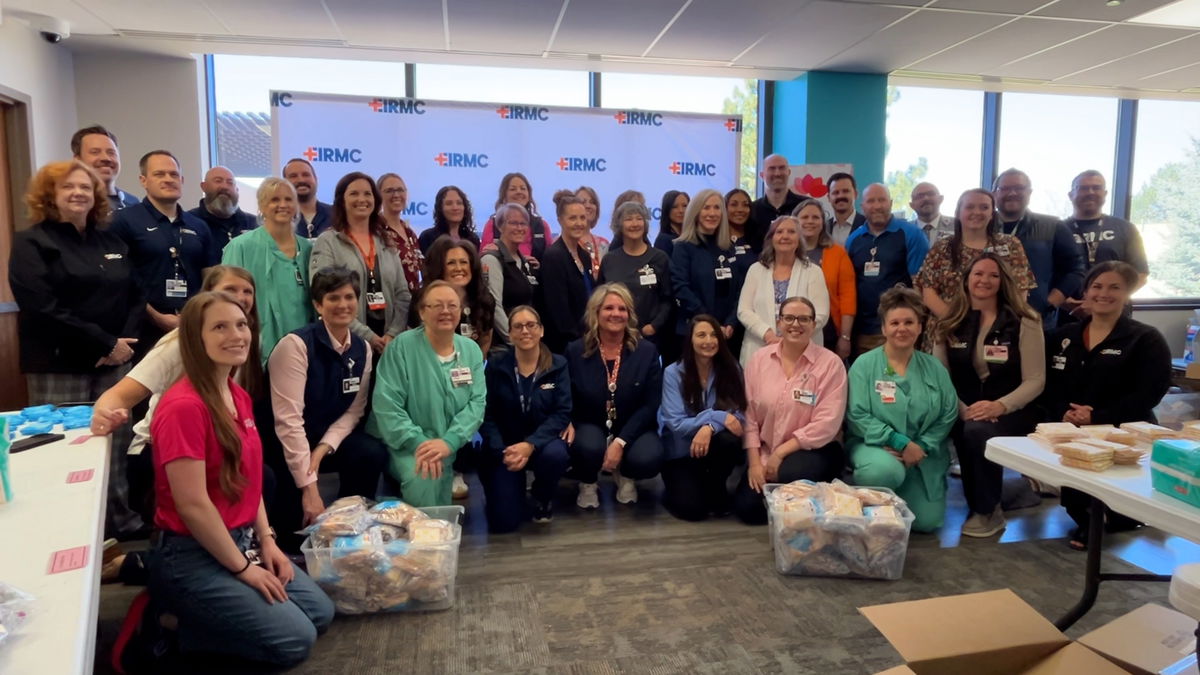
EIRMC and volunteers assemble kits for Idaho Period Project

Ariel Jensen

IDAHO FALLS, Idaho (KIFI) –  Eastern Idaho Regional Medical Center is celebrating a week of service in honor of April National Volunteer Month.

Early Tuesday, April 15, dozens of staff members and community volunteers gathered at the hospital cafeteria to prepare period product kits for local girls.

Over 40,000 period products were packed and bagged into thousands of kits that will be distributed to girls across Southeast Idaho. 

“Through the Idaho Period Project, they’ll be given to school administrators and counselors who then identify the girls who are in need of these,” said Brooke Nelson, Vice President of the Idaho Period Project. “So a girl can simply come to the office or to that faculty or staff member and say, ‘Hey, I might not have what I need for this summer,’ and then they can take them home.” 

Nelson tells us they surveyed schools in Idaho and found that one in four girls are experiencing period poverty.

“Period poverty is simply the lack of access to period products,” said Nelson.” And that leads them to miss out on full class periods, full days of school, and a lot of important activities that they want to participate in.” 

Dozens of ERIMC staff and volunteers sorted through hundreds of boxes of feminine products as part of the organization’s ‘We Show Up For Our Communities’ days of service.

Coleen Niemann, Director of Communication for EIRMC said, “This is an opportunity to show up outside of our building for residents and our neighbors. We are proud to be helping out girls who are in need and schools in our area.”

The goal is to provide girls in the community a chance to fully participate in all their school activities and have a worry-free summer.

Devyn Hinson, Licensed master social worker and Counselor at Bonneville High School, tells Local News 8 this project is greatly needed in our community.

“I often have several female students that come to my office several times a day asking for period products. And it’s so wonderful to be able to have these products available in the office that they can just come and grab when they need,” said Hinson.

The supplies will be going out next month, in the middle of May.

EIRMC is serving the community all month long in a variety of ways.

Other projects they have going on this month include:

Building period product kits for local girls and women in need.  Partnership with Idaho Period Project.

Collecting school supplies for students.  Partnership with F.I.S.H. (Friends in Service Here).

Preparing weekend food kits for children in need. Partnership with United Way of Bonneville County.

Hosting a non-profit agency fair with fifteen local organizations to educate staff about the vital role these organizations play in our community.

Promoting donations to the HCA Healthcare Hope Fund, which supports EIRMC colleagues experiencing unforeseen financial crises.